Beta
Swipe to show menu
The Sharpe ratio tells you how much return you earn per unit of total volatility. Beta asks a different question: how does this asset move relative to the market?
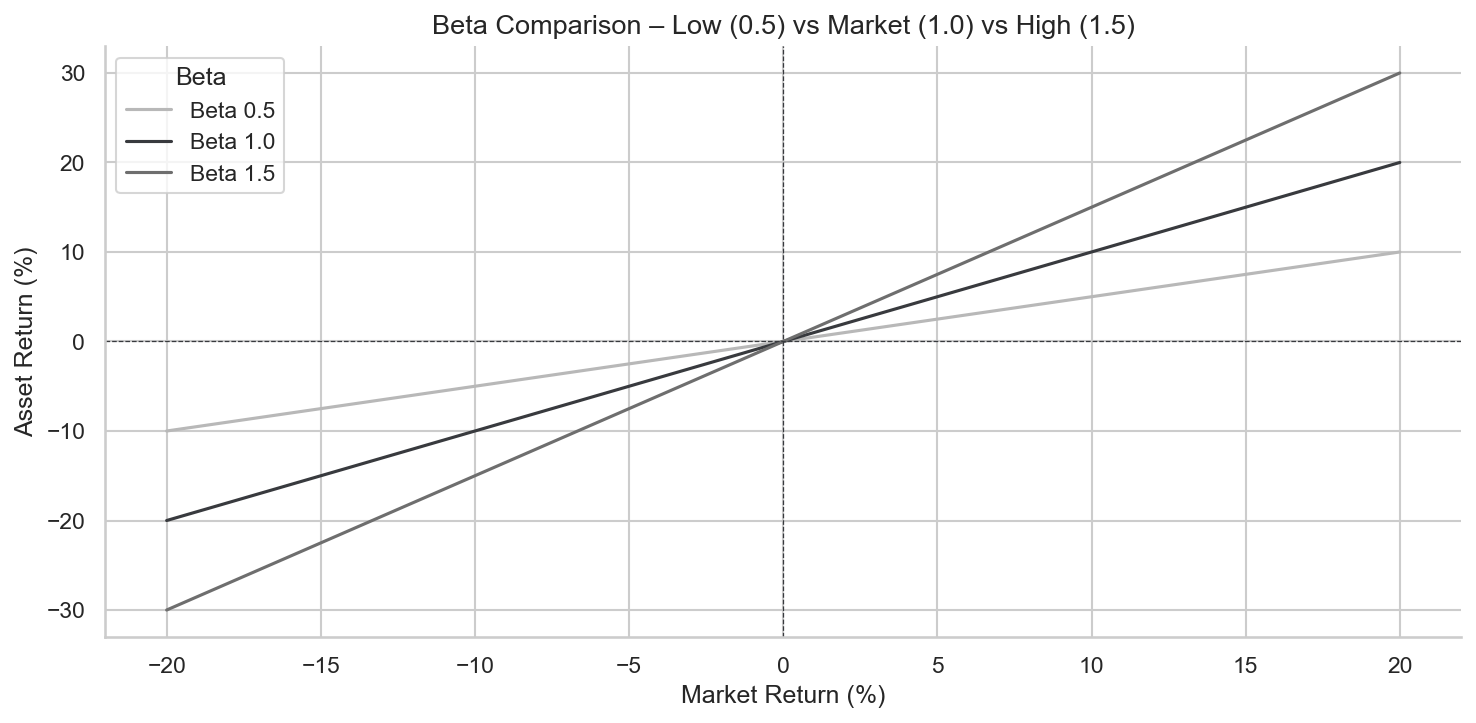
Beta measures an asset's sensitivity to market movements. The market itself – typically the S&P 500 – has a beta of exactly 1.0. Everything else is measured against it.
If the market drops 10% and your stock has a beta of 1.5, you'd expect it to drop approximately 15%. If it has a beta of 0.5, you'd expect a drop of roughly 5%.
What Beta Does and Doesn't Tell You
Beta is a measure of systematic risk – the risk that comes from being exposed to the market as a whole. It does not measure the risk specific to a single company.
A pharmaceutical company awaiting FDA approval has enormous company-specific risk – but its beta might be perfectly average. Beta would tell you nothing about that risk.
- High beta: amplifies both market gains and market losses;
- Low beta: dampens market swings – useful in volatile periods;
- Negative beta: moves against the market – rare, valuable for hedging;
- Beta ≠ volatility: a stock can be wildly volatile on its own but still have a low beta if its swings don't correlate with the market.

A measure of how much an asset's price moves relative to the overall market. A beta of 1.0 means the asset moves in line with the market. Above 1.0 means it amplifies market moves; below 1.0 means it dampens them.

Beta is calculated from historical price data – it tells you how an asset has moved relative to the market in the past. During market crises, correlations between assets tend to spike, meaning low-beta assets can behave more like high-beta ones precisely when you need the protection most.
1. A stock has a beta of 1.8. The market rises 15%. What return would you expect from this stock based on beta alone?
2. An investor wants to reduce their portfolio's sensitivity to market downturns without moving entirely to cash. Which approach is most consistent with using beta as a tool?
Thanks for your feedback!
Ask AI

Ask AI

Ask anything or try one of the suggested questions to begin our chat
