Sharpe Ratio
Swipe to show menu
Two funds both return 10% per year. One swings between -20% and +40%. The other stays between +2% and +18%. Which is the better investment?
The raw return number can't answer that. The Sharpe ratio can.
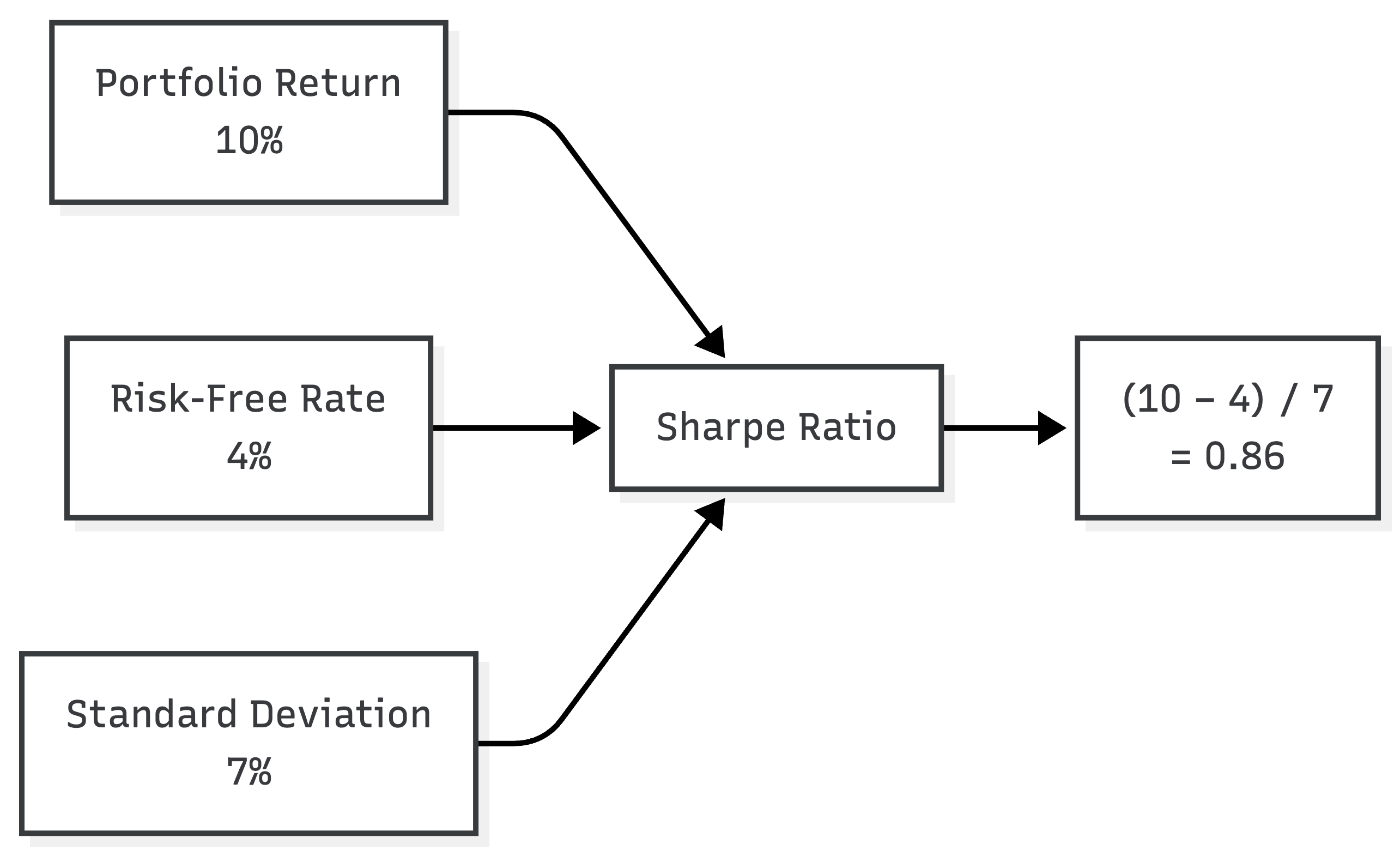
The Sharpe ratio measures how much return you earn for every unit of risk you take. It normalizes return against volatility – so you can compare investments that look identical on the surface but are fundamentally different underneath.
Sharpe Ratio=Standard DeviationPortfolio Return−Risk-Free RateUsing the two funds above (risk-free rate = 4%):
How to Interpret the Number
The Sharpe ratio is a relative metric – it's most useful when comparing two or more options, not in isolation.
The S&P 500 has historically produced a Sharpe ratio of around 0.4–0.6 over long periods. A consistently high Sharpe ratio is harder to achieve than a high raw return.

A measure of risk-adjusted return. It calculates how much excess return (above the risk-free rate) an investment produces per unit of volatility. A higher Sharpe ratio means better return per unit of risk taken.

The Sharpe ratio uses standard deviation as its measure of risk – which means it treats upside and downside volatility equally. A fund that occasionally delivers very high positive returns will look "riskier" than it actually is to a long-term investor. The Sortino ratio addresses this by penalizing only downside volatility, but the Sharpe ratio remains the industry standard.

The Sharpe ratio was developed by Nobel laureate William F. Sharpe in 1966 as part of his work on the Capital Asset Pricing Model (CAPM). His original paper "Mutual Fund Performance" introduced the concept of reward-to-variability as a standard for comparing funds.
1. Fund X returns 12% with a standard deviation of 20%. Fund Y returns 9% with a standard deviation of 6%. The risk-free rate is 4%. Which fund has the higher Sharpe ratio?
2. A hedge fund advertises a Sharpe ratio of 3.2 over the past two years. What is the most cautious interpretation of this number?
Thanks for your feedback!
Ask AI

Ask AI

Ask anything or try one of the suggested questions to begin our chat
