Correlation
Swipe to show menu
You own two stocks. When one falls, the other falls too. You thought you were diversified – but you weren't. That's a correlation problem.
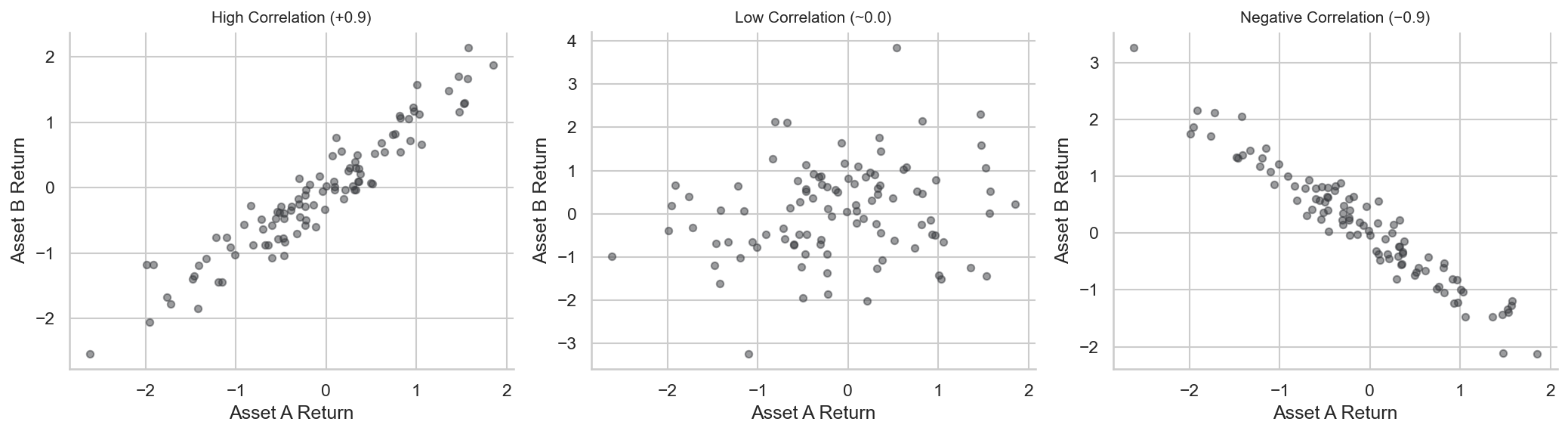
Correlation measures how two assets move in relation to each other. It's expressed as a number between -1 and +1:
Two assets with a +0.9 correlation offer almost no diversification benefit – they behave like one asset. Two assets with a −0.5 correlation genuinely offset each other's swings.
Correlation Is the Engine of Diversification
Adding more assets to a portfolio only reduces risk if those assets aren't perfectly correlated. This is the core mathematical insight behind diversification – and it's why simply owning more stocks doesn't automatically mean less risk.
During normal markets, correlations between asset classes tend to behave as expected. During crises, they tend to spike toward +1.0 – assets that normally move independently start falling together. This is called correlation breakdown and it's one of the most dangerous phenomena in portfolio construction.
- Low or negative correlation between assets is what actually reduces portfolio volatility;
- Adding a correlated asset increases position size without adding diversification;
- Crisis periods often destroy the correlation assumptions built during calm markets.

A statistical measure of how two assets move in relation to each other, expressed on a scale from −1.0 (perfectly opposite) to +1.0 (perfectly together). A correlation near 0 means the assets move independently.

Correlation is not causation – two assets can be highly correlated without any direct relationship. More importantly, correlation is not stable. Historical correlation between stocks and bonds was reliably negative for two decades, then turned positive in 2022 when both fell simultaneously. Always treat historical correlation as an estimate, not a guarantee.

The mathematical foundation for using correlation in portfolio construction comes from Harry Markowitz's 1952 paper "Portfolio Selection," which introduced Modern Portfolio Theory. Markowitz showed that combining assets with low correlation reduces portfolio variance without sacrificing expected return – work that earned him the Nobel Prize in Economics in 1990.
1. An investor holds two ETFs with a correlation of +0.95. They believe this gives them strong diversification. What is the most accurate assessment?
2. During the 2022 market downturn, both stocks and bonds fell simultaneously – an unusual event. What concept does this best illustrate?
Thanks for your feedback!
Ask AI

Ask AI

Ask anything or try one of the suggested questions to begin our chat
