Portfolio Variance
Swipe to show menu
You know the risk of each individual asset. But what is the risk of the whole portfolio? The answer isn't simply an average of each asset's variance – it depends critically on how those assets move together.
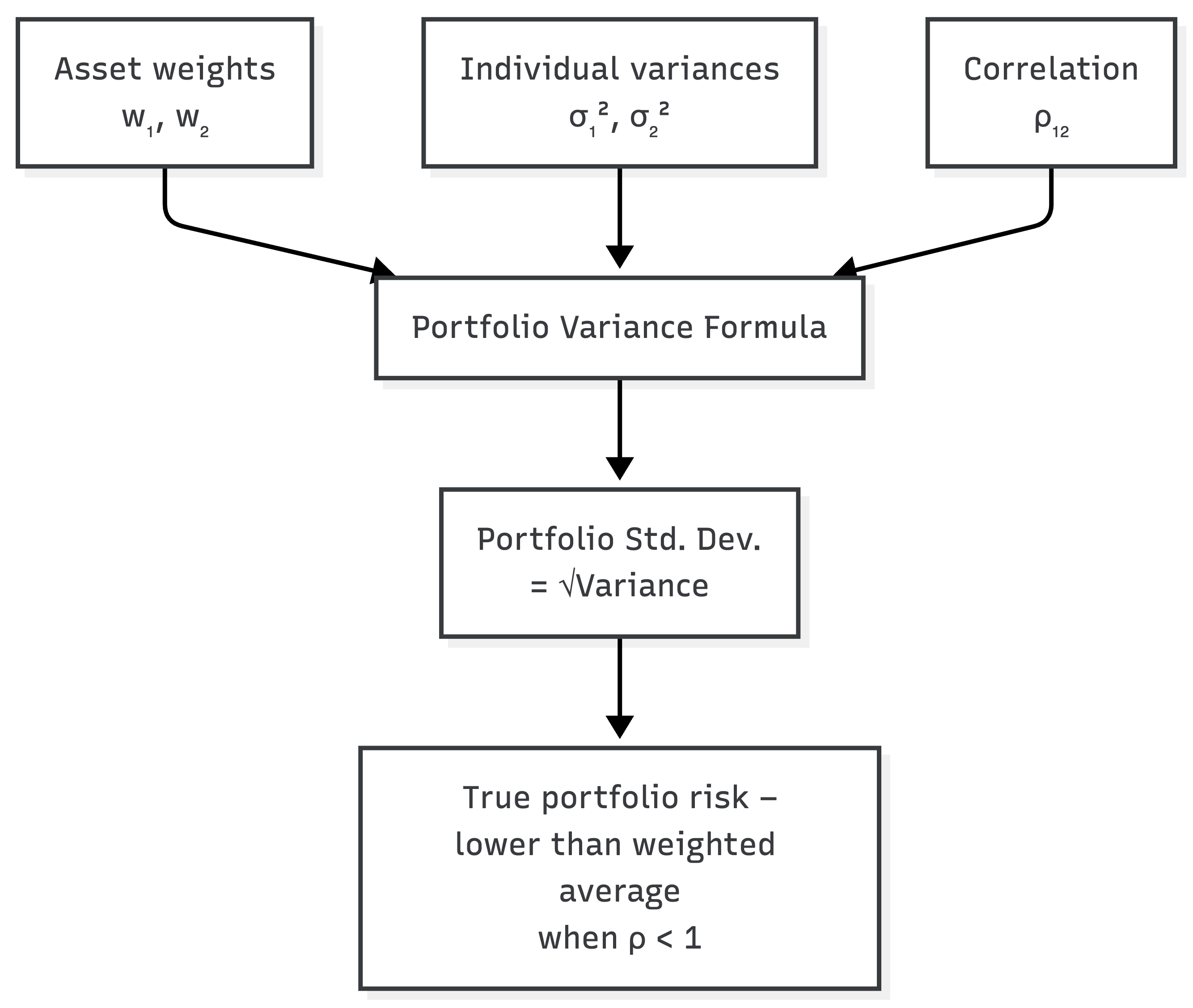
Portfolio variance is the formula that combines individual asset variances with the correlations between them. For a two-asset portfolio:
Portfolio Variance=w12σ12+w22σ22+2⋅w1⋅w2⋅σ1⋅σ2⋅ρ12Where:
- w1, w2 – weights of each asset in the portfolio;
- σ1, σ2 – standard deviations of each asset;
- ρ12 – correlation between the two assets.
A concrete example – 60% stocks, 40% bonds:
If you had simply averaged the standard deviations (0.60×15 + 0.40×6 = 11.4%), you'd have overestimated the portfolio's risk by more than 3 percentage points. The negative correlation did the work.
The Diversification Effect in Numbers
The last term in the formula – 2⋅w1⋅w2⋅σ1⋅σ2⋅ρ12 – is where diversification lives. When correlation is negative, this term subtracts from total variance. When correlation is +1.0, it adds nothing and the portfolio variance becomes a simple weighted average of individual variances.
This is why correlation is the lever that matters most:
- ρ = +1.0: no variance reduction – full weighted average risk;
- ρ = 0.0: partial reduction – assets don't amplify each other;
- ρ = −1.0: maximum reduction – in theory, risk can be eliminated entirely.

A measure of the total risk of a portfolio that accounts for the individual variances of each asset and the correlations between them. Portfolio variance is always lower than the weighted average of individual variances when assets are not perfectly correlated.

Portfolio variance grows more complex with each additional asset – a 10-asset portfolio requires calculating 45 unique pairwise correlations. In practice, portfolio managers use matrix algebra and software to handle this. The two-asset formula is the foundation; the principle scales directly.
1. A two-asset portfolio has a stock weight of 70%, bond weight of 30%, stock std. dev. of 18%, bond std. dev. of 5%, and a correlation of 0.0. Compared to a portfolio with the same weights and std. devs. but a correlation of +1.0, what is true?
2. An investor adds a third asset to a two-asset portfolio. The new asset has a low but positive correlation with both existing assets. What happens to portfolio variance?
Thanks for your feedback!
Ask AI

Ask AI

Ask anything or try one of the suggested questions to begin our chat
Portfolio Variance
You know the risk of each individual asset. But what is the risk of the whole portfolio? The answer isn't simply an average of each asset's variance – it depends critically on how those assets move together.
Portfolio variance is the formula that combines individual asset variances with the correlations between them. For a two-asset portfolio:
Portfolio Variance=w12σ12+w22σ22+2⋅w1⋅w2⋅σ1⋅σ2⋅ρ12Where:
- w1, w2 – weights of each asset in the portfolio;
- σ1, σ2 – standard deviations of each asset;
- ρ12 – correlation between the two assets.
A concrete example – 60% stocks, 40% bonds:
If you had simply averaged the standard deviations (0.60×15 + 0.40×6 = 11.4%), you'd have overestimated the portfolio's risk by more than 3 percentage points. The negative correlation did the work.
The Diversification Effect in Numbers
The last term in the formula – 2⋅w1⋅w2⋅σ1⋅σ2⋅ρ12 – is where diversification lives. When correlation is negative, this term subtracts from total variance. When correlation is +1.0, it adds nothing and the portfolio variance becomes a simple weighted average of individual variances.
This is why correlation is the lever that matters most:
- ρ = +1.0: no variance reduction – full weighted average risk;
- ρ = 0.0: partial reduction – assets don't amplify each other;
- ρ = −1.0: maximum reduction – in theory, risk can be eliminated entirely.
A measure of the total risk of a portfolio that accounts for the individual variances of each asset and the correlations between them. Portfolio variance is always lower than the weighted average of individual variances when assets are not perfectly correlated.
Portfolio variance grows more complex with each additional asset – a 10-asset portfolio requires calculating 45 unique pairwise correlations. In practice, portfolio managers use matrix algebra and software to handle this. The two-asset formula is the foundation; the principle scales directly.
Thanks for your feedback!
