Concentration Risk
Swipe to show menu
Concentration risk is the risk that too much of a portfolio is exposed to a single asset, sector, company, or geographic region. It's the oldest warning in investing – and the most consistently ignored.
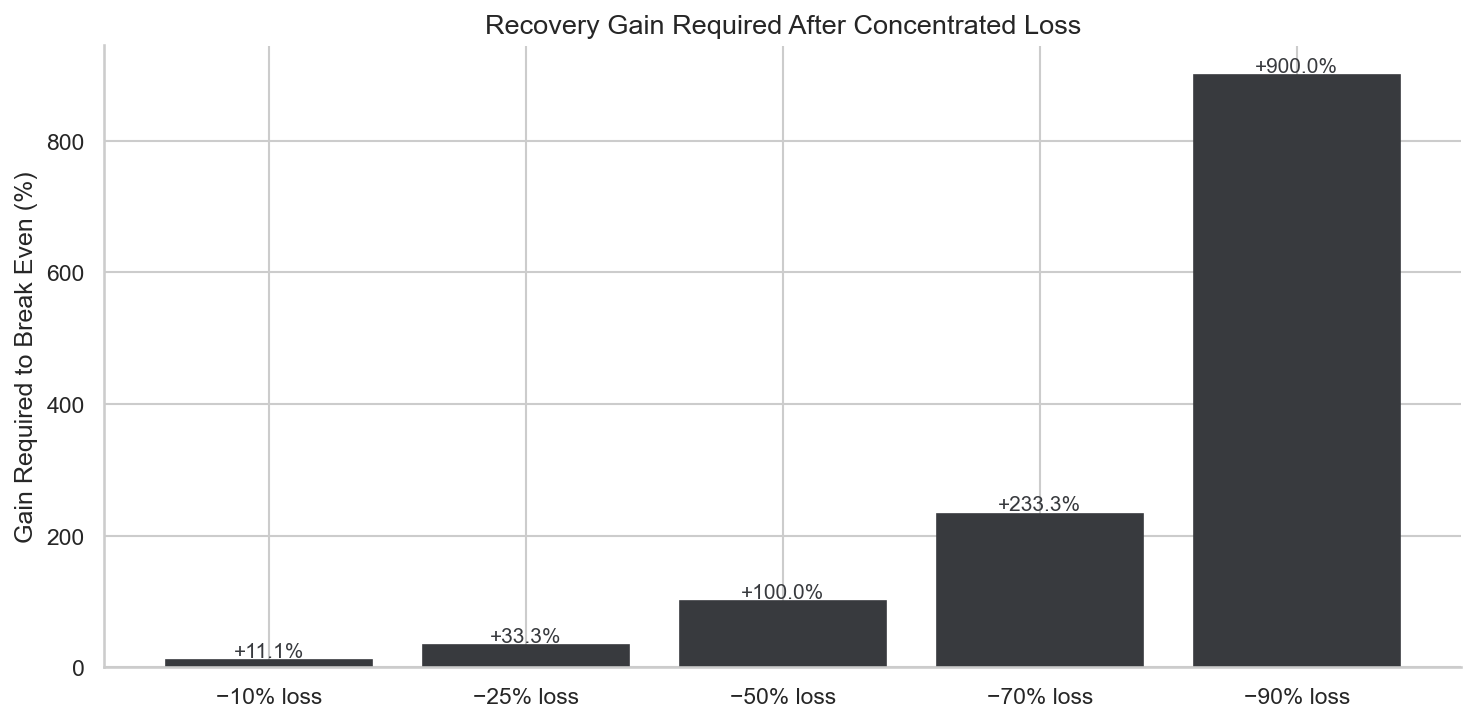
The math is asymmetric. A 50% loss requires a 100% gain to recover. A 70% loss requires a 233% gain. When concentration leads to a large loss, the recovery math becomes brutal:
A concentrated position doesn't just expose you to bigger swings – it exposes you to the possibility of a loss so large that full recovery becomes statistically unlikely within a reasonable time horizon.
Where Concentration Hides
Concentration risk isn't always obvious. An investor can own 30 different stocks and still be highly concentrated if those stocks all belong to the same sector, respond to the same economic conditions, or are all U.S.-based.
Common concentration traps:
- Single stock: holding a large position in an employer's stock combines income risk and investment risk in the same source;
- Sector concentration: owning 10 tech stocks looks diversified – until the tech sector drops 40%;
- Geographic concentration: a portfolio of only U.S. assets is concentrated in one country's economic and political cycle;
- Factor concentration: all holdings share the same characteristic – all growth, all small-cap, all high-yield – creating correlated exposure to a single risk factor.

The risk that arises from having too large a proportion of a portfolio in a single asset, company, sector, or geographic region. Concentration amplifies both gains and losses – and the asymmetry of loss recovery makes large concentrated losses especially damaging.

Employer stock concentration is one of the most common and most dangerous forms of concentration risk. Employees often hold significant company stock through equity compensation, 401(k) options, or habit. When a company struggles, employees face simultaneous job risk and investment loss from the same source – exactly the scenario diversification is designed to prevent.

Enron's collapse in 2001 is the canonical case study in concentration risk. Thousands of employees had the majority of their 401(k) balances in Enron stock. When the company failed, they lost their jobs and their retirement savings simultaneously. The event directly influenced legislation requiring 401(k) plans to allow diversification away from employer stock.
1. An investor holds 40% of their portfolio in their employer's stock. The company reports a major accounting scandal, the stock drops 75%, and the investor is laid off. What makes this situation worse than a typical investment loss?
2. An investor owns 15 different stocks across five different ETF providers. All 15 stocks are U.S. large-cap technology companies. Is this portfolio well diversified?
Thanks for your feedback!
Ask AI

Ask AI

Ask anything or try one of the suggested questions to begin our chat
Concentration Risk
Concentration risk is the risk that too much of a portfolio is exposed to a single asset, sector, company, or geographic region. It's the oldest warning in investing – and the most consistently ignored.
The math is asymmetric. A 50% loss requires a 100% gain to recover. A 70% loss requires a 233% gain. When concentration leads to a large loss, the recovery math becomes brutal:
A concentrated position doesn't just expose you to bigger swings – it exposes you to the possibility of a loss so large that full recovery becomes statistically unlikely within a reasonable time horizon.
Where Concentration Hides
Concentration risk isn't always obvious. An investor can own 30 different stocks and still be highly concentrated if those stocks all belong to the same sector, respond to the same economic conditions, or are all U.S.-based.
Common concentration traps:
- Single stock: holding a large position in an employer's stock combines income risk and investment risk in the same source;
- Sector concentration: owning 10 tech stocks looks diversified – until the tech sector drops 40%;
- Geographic concentration: a portfolio of only U.S. assets is concentrated in one country's economic and political cycle;
- Factor concentration: all holdings share the same characteristic – all growth, all small-cap, all high-yield – creating correlated exposure to a single risk factor.
The risk that arises from having too large a proportion of a portfolio in a single asset, company, sector, or geographic region. Concentration amplifies both gains and losses – and the asymmetry of loss recovery makes large concentrated losses especially damaging.
Employer stock concentration is one of the most common and most dangerous forms of concentration risk. Employees often hold significant company stock through equity compensation, 401(k) options, or habit. When a company struggles, employees face simultaneous job risk and investment loss from the same source – exactly the scenario diversification is designed to prevent.
Enron's collapse in 2001 is the canonical case study in concentration risk. Thousands of employees had the majority of their 401(k) balances in Enron stock. When the company failed, they lost their jobs and their retirement savings simultaneously. The event directly influenced legislation requiring 401(k) plans to allow diversification away from employer stock.
Thanks for your feedback!
