Liquidity Risk
Swipe to show menu
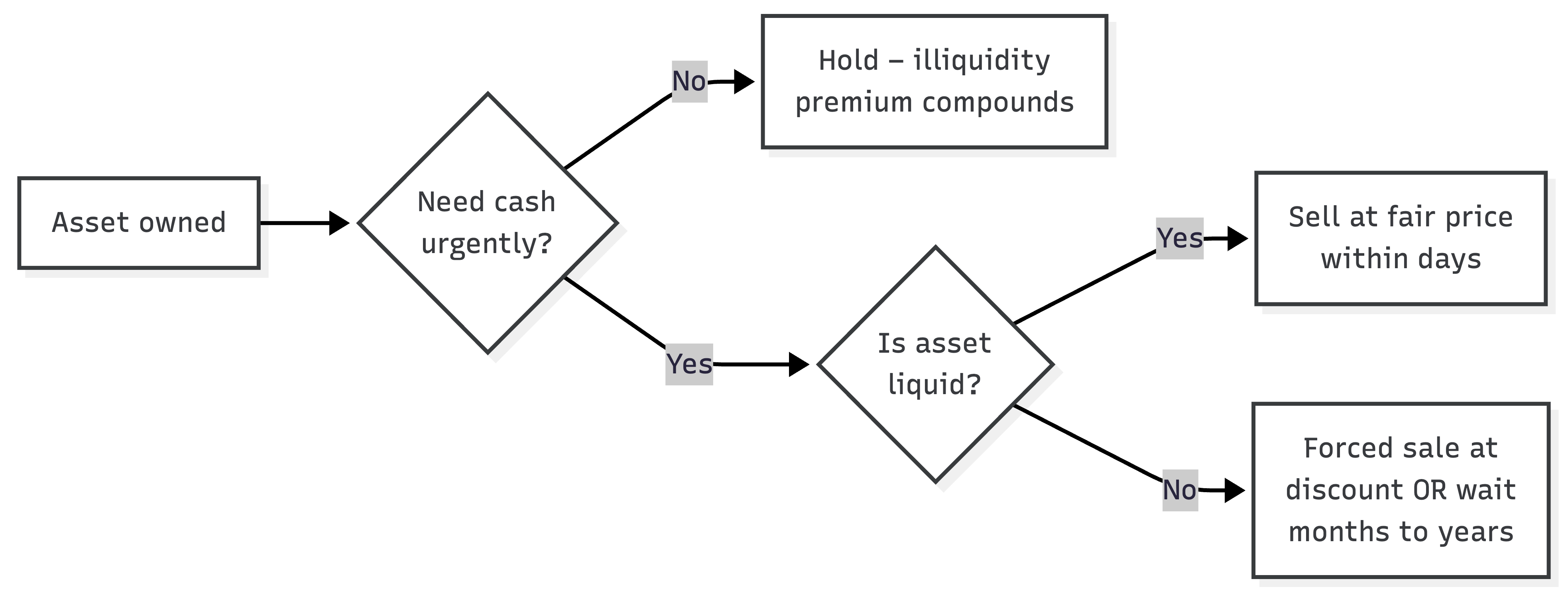
Your net worth looks fine on paper. But when you need cash – for an emergency, an opportunity, or a forced expense – you can't access it without taking a significant loss or waiting months. That's liquidity risk.
Liquidity risk is the risk that you cannot convert an asset into cash quickly enough, or without a meaningful price penalty. It's not about losing money in the traditional sense – it's about not being able to use your money when you need it.
Every asset sits somewhere on the liquidity spectrum:
The Hidden Cost of Illiquidity
Illiquid assets aren't necessarily bad investments – they often compensate for their illiquidity with higher expected returns. This compensation is called the liquidity premium. Private equity, real estate, and venture capital all offer higher long-run return expectations partly because investors accept being locked in.
The danger is not illiquidity itself – it's unplanned illiquidity. An investor who allocates too much to illiquid assets without maintaining sufficient liquid reserves faces three specific problems:
- Forced selling: needing cash during a downturn and having to sell liquid assets at depressed prices while illiquid ones remain locked;
- Missed opportunities: unable to rebalance or take advantage of dislocations because capital is tied up;
- Margin calls and leverage: if borrowed money is involved, illiquidity can trigger forced liquidation at the worst possible moment.

The risk that an asset cannot be sold quickly enough or at a fair price when cash is needed. Liquidity risk increases when markets are stressed, when assets are thinly traded, or when an investor's time horizon is shorter than the asset's natural holding period.

Liquidity risk and market risk interact dangerously during crises. When markets fall sharply, liquidity typically dries up simultaneously – the assets you most need to sell become the hardest to sell. Bid-ask spreads widen, buyers disappear, and the price penalty for forced selling increases exactly when the pressure to sell is highest.

The 2008 financial crisis produced some of the most studied cases of liquidity risk in modern history. Money market funds, mortgage-backed securities, and commercial paper markets all experienced sudden liquidity freezes. Ben Bernanke's book "The Courage to Act" (2015) documents how the Federal Reserve responded to a systemic liquidity crisis across multiple asset classes simultaneously.
1. An investor has 70% of their net worth in a rental property and 30% in a checking account. They face an unexpected $80,000 expense. What liquidity risk does this situation illustrate?
2. A private equity fund offers an expected annual return of 14% but locks up investor capital for 7 years. A public equity index fund offers an expected annual return of 10% with daily liquidity. What concept explains why the private equity fund can offer higher returns?
Thanks for your feedback!
Ask AI

Ask AI

Ask anything or try one of the suggested questions to begin our chat
