Inflation Risk
Swipe to show menu
Inflation risk is unique among investment risks. It doesn't show up as a red number in your portfolio. Your account balance stays the same – or even grows – while the actual purchasing power of your money quietly erodes.
Inflation risk is the risk that your returns don't keep pace with rising prices. A 4% return in a 6% inflation environment is a −2% real return. You made money on paper and lost ground in reality.
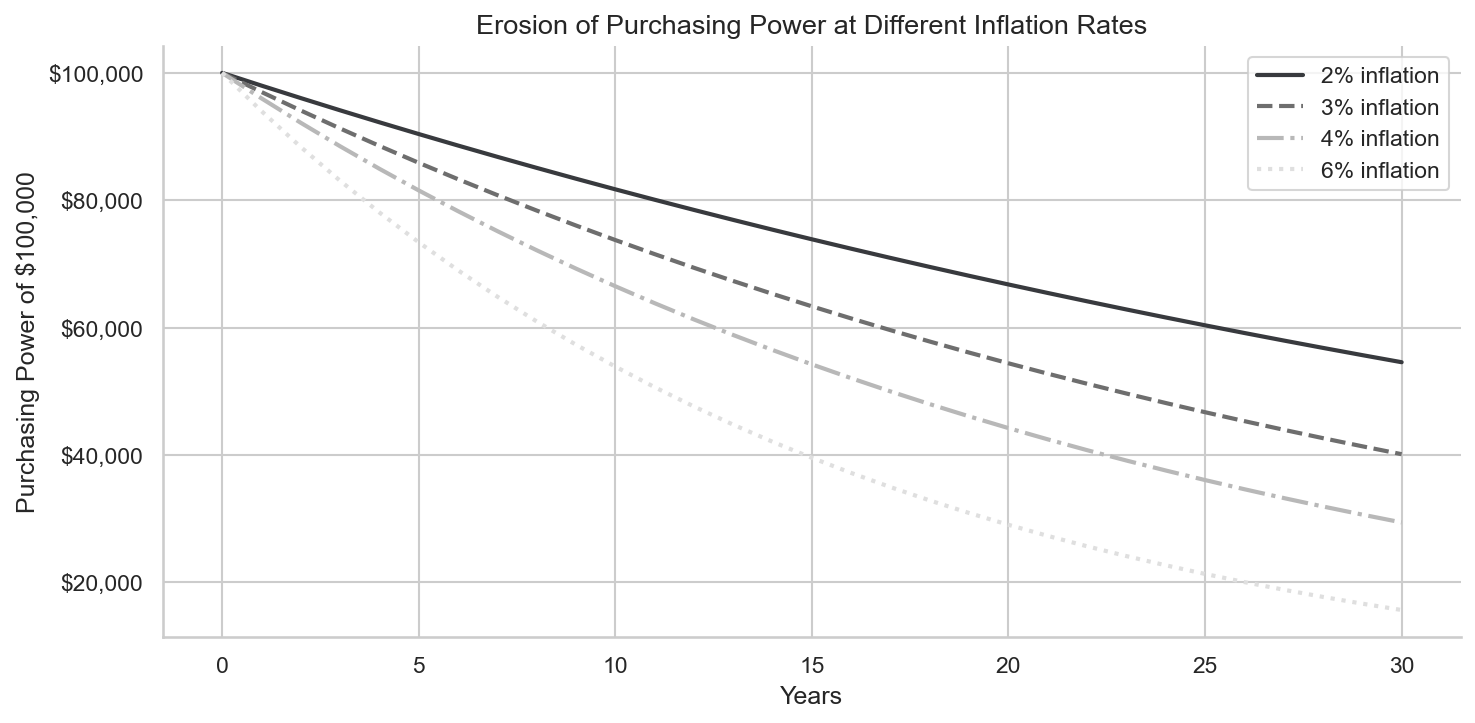
The math compounds quickly:
At 3% inflation – close to the U.S. long-run average – a dollar loses more than half its purchasing power over 30 years. A retirement account that "looks fine" in nominal terms can represent a serious shortfall in real terms.
How Different Assets Handle Inflation
Not all assets respond to inflation the same way. Some erode under it, some keep pace, and some historically outperform during inflationary periods.
The most dangerous place to hide from market volatility – cash – is also the most exposed to inflation risk. A portfolio that feels "safe" because it avoids stock market swings may be silently losing real value every year.

The risk that the purchasing power of investment returns is eroded by rising prices. Inflation risk affects all assets but hits fixed-income and cash holdings hardest, since their nominal returns don't adjust as prices rise.

The distinction between nominal return and real return is critical. Nominal return is what your account shows. Real return is nominal return minus inflation. A savings account paying 4% during 5% inflation has a real return of −1% – you are getting poorer despite earning interest.

The U.S. Bureau of Labor Statistics publishes the Consumer Price Index (CPI) monthly – the primary measure of inflation used in financial planning. The Federal Reserve targets 2% annual inflation as its long-run goal, though actual inflation has deviated significantly from that target in both directions over the past two decades.
1. An investor holds $200,000 in a savings account earning 3.5% annually. Inflation runs at 4.2% for the year. What is the investor's real return?
2. A retiree keeps the majority of their savings in cash and short-term CDs to avoid stock market volatility. What risk does this strategy most directly expose them to over a 20-year retirement?
Thanks for your feedback!
Ask AI

Ask AI

Ask anything or try one of the suggested questions to begin our chat
Inflation Risk
Inflation risk is unique among investment risks. It doesn't show up as a red number in your portfolio. Your account balance stays the same – or even grows – while the actual purchasing power of your money quietly erodes.
Inflation risk is the risk that your returns don't keep pace with rising prices. A 4% return in a 6% inflation environment is a −2% real return. You made money on paper and lost ground in reality.
The math compounds quickly:
At 3% inflation – close to the U.S. long-run average – a dollar loses more than half its purchasing power over 30 years. A retirement account that "looks fine" in nominal terms can represent a serious shortfall in real terms.
How Different Assets Handle Inflation
Not all assets respond to inflation the same way. Some erode under it, some keep pace, and some historically outperform during inflationary periods.
The most dangerous place to hide from market volatility – cash – is also the most exposed to inflation risk. A portfolio that feels "safe" because it avoids stock market swings may be silently losing real value every year.
The risk that the purchasing power of investment returns is eroded by rising prices. Inflation risk affects all assets but hits fixed-income and cash holdings hardest, since their nominal returns don't adjust as prices rise.
The distinction between nominal return and real return is critical. Nominal return is what your account shows. Real return is nominal return minus inflation. A savings account paying 4% during 5% inflation has a real return of −1% – you are getting poorer despite earning interest.
The U.S. Bureau of Labor Statistics publishes the Consumer Price Index (CPI) monthly – the primary measure of inflation used in financial planning. The Federal Reserve targets 2% annual inflation as its long-run goal, though actual inflation has deviated significantly from that target in both directions over the past two decades.
Thanks for your feedback!
