Glide Path
Swipe to show menu
A 25-year-old and a 60-year-old should not hold the same portfolio. Not because one is smarter than the other – but because time changes everything about what risk means.
At 25, a 40% market drawdown is uncomfortable but recoverable. You have 35+ years of contributions and compounding ahead of you. At 60, the same 40% drawdown three years before retirement is potentially catastrophic – there is no time for full recovery before withdrawals begin.
A glide path is the planned, systematic reduction of portfolio risk as an investor approaches and enters retirement. It's not a reaction to market conditions – it's a predetermined schedule that shifts allocation from growth assets toward capital preservation as the time horizon shortens.
These are guidelines, not rules – the right glide path depends on risk capacity, income sources, and spending needs.
Two Types of Glide Path
Not all glide paths work the same way. The key distinction is what happens at and after retirement:
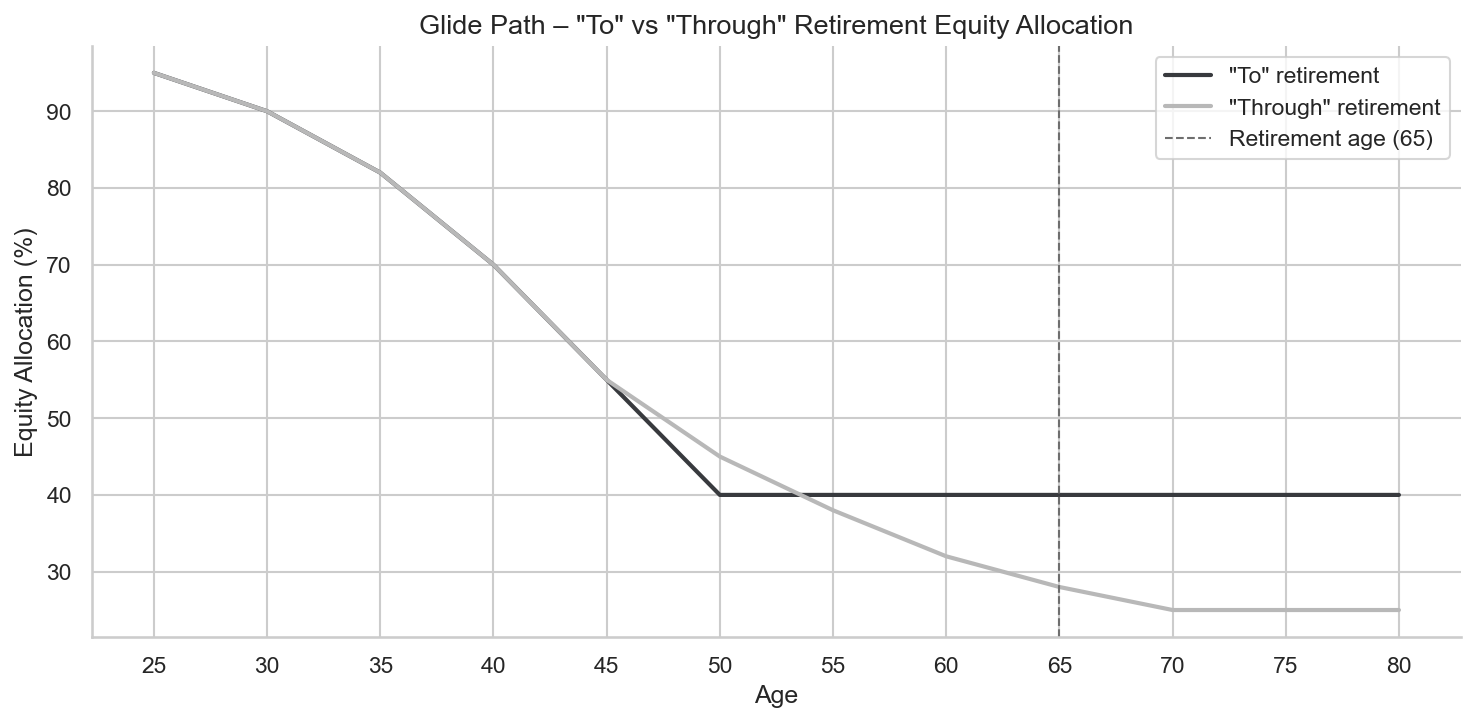
"To" retirement glide path – allocation reaches its most conservative point at the retirement date and stays there. Used by investors who plan to shift to very conservative holdings once they stop working.
"Through" retirement glide path – allocation continues shifting more conservative for 10–20 years after retirement. Based on the insight that a 65-year-old may have a 25-year retirement ahead – still a long enough horizon to justify meaningful equity exposure early in retirement.
Most target-date funds use a "through" approach – continuing to reduce equity exposure until the investor is in their mid-to-late 70s. Research generally supports "through" glide paths for investors without large guaranteed income sources like pensions.
- "To" glide path: maximally conservative at retirement date – prioritizes capital preservation;
- "Through" glide path: continues reducing equity past retirement – balances longevity risk with inflation protection;
- The right choice: depends on income sources, spending flexibility, and how long retirement is expected to last.

A predetermined schedule for reducing portfolio risk over time as an investor approaches and moves through retirement. A glide path systematically shifts allocation from growth assets toward capital preservation assets, reducing sequence-of-returns risk during the most financially vulnerable period.

The "100 minus your age" rule – put that percentage in stocks – is the oldest glide path heuristic and is now widely considered too conservative for modern investors. With longer life expectancies and low bond yields in recent decades, many financial planners use "110 minus age" or "120 minus age" as a starting point, then adjust based on individual risk capacity and income sources.

Target-date funds are the most widely used implementation of glide path investing. Vanguard, Fidelity, and Schwab each publish their glide path methodology, showing exactly how their target-date funds shift allocation over time. Comparing the glide paths of major providers reveals meaningful differences in how aggressively they maintain equity exposure into and through retirement.
1. A 70-year-old retiree uses a "through" retirement glide path and still holds 38% in equities. A friend tells them this is too aggressive for their age. What is the strongest argument in favor of the retiree's allocation?
2. An investor uses the "100 minus age" rule and is currently 55 years old. What equity allocation does this suggest, and what is the primary criticism of applying this rule today?
Thanks for your feedback!
Ask AI

Ask AI

Ask anything or try one of the suggested questions to begin our chat
Glide Path
A 25-year-old and a 60-year-old should not hold the same portfolio. Not because one is smarter than the other – but because time changes everything about what risk means.
At 25, a 40% market drawdown is uncomfortable but recoverable. You have 35+ years of contributions and compounding ahead of you. At 60, the same 40% drawdown three years before retirement is potentially catastrophic – there is no time for full recovery before withdrawals begin.
A glide path is the planned, systematic reduction of portfolio risk as an investor approaches and enters retirement. It's not a reaction to market conditions – it's a predetermined schedule that shifts allocation from growth assets toward capital preservation as the time horizon shortens.
These are guidelines, not rules – the right glide path depends on risk capacity, income sources, and spending needs.
Two Types of Glide Path
Not all glide paths work the same way. The key distinction is what happens at and after retirement:
"To" retirement glide path – allocation reaches its most conservative point at the retirement date and stays there. Used by investors who plan to shift to very conservative holdings once they stop working.
"Through" retirement glide path – allocation continues shifting more conservative for 10–20 years after retirement. Based on the insight that a 65-year-old may have a 25-year retirement ahead – still a long enough horizon to justify meaningful equity exposure early in retirement.
Most target-date funds use a "through" approach – continuing to reduce equity exposure until the investor is in their mid-to-late 70s. Research generally supports "through" glide paths for investors without large guaranteed income sources like pensions.
- "To" glide path: maximally conservative at retirement date – prioritizes capital preservation;
- "Through" glide path: continues reducing equity past retirement – balances longevity risk with inflation protection;
- The right choice: depends on income sources, spending flexibility, and how long retirement is expected to last.
A predetermined schedule for reducing portfolio risk over time as an investor approaches and moves through retirement. A glide path systematically shifts allocation from growth assets toward capital preservation assets, reducing sequence-of-returns risk during the most financially vulnerable period.
The "100 minus your age" rule – put that percentage in stocks – is the oldest glide path heuristic and is now widely considered too conservative for modern investors. With longer life expectancies and low bond yields in recent decades, many financial planners use "110 minus age" or "120 minus age" as a starting point, then adjust based on individual risk capacity and income sources.
Target-date funds are the most widely used implementation of glide path investing. Vanguard, Fidelity, and Schwab each publish their glide path methodology, showing exactly how their target-date funds shift allocation over time. Comparing the glide paths of major providers reveals meaningful differences in how aggressively they maintain equity exposure into and through retirement.
Thanks for your feedback!
