Risk Tolerance vs Risk Capacity
Swipe to show menu
Before building a portfolio, every investor needs to answer two questions that sound similar but are fundamentally different:
How much risk are you willing to take? That's risk tolerance – a psychological measurement of how much volatility you can endure without making emotional decisions.
How much risk can you actually afford to take? That's risk capacity – a financial measurement of how much loss your situation can absorb without derailing your goals.
Most investors confuse the two. A 28-year-old with a stable income and no dependents may have high risk capacity but low risk tolerance – they hate watching their balance drop even though they could financially afford to. A 62-year-old with significant savings but three years from retirement may have high risk tolerance but low risk capacity – they can psychologically handle volatility, but a 40% drawdown three years before retirement would be financially devastating.
How to Use Both Numbers
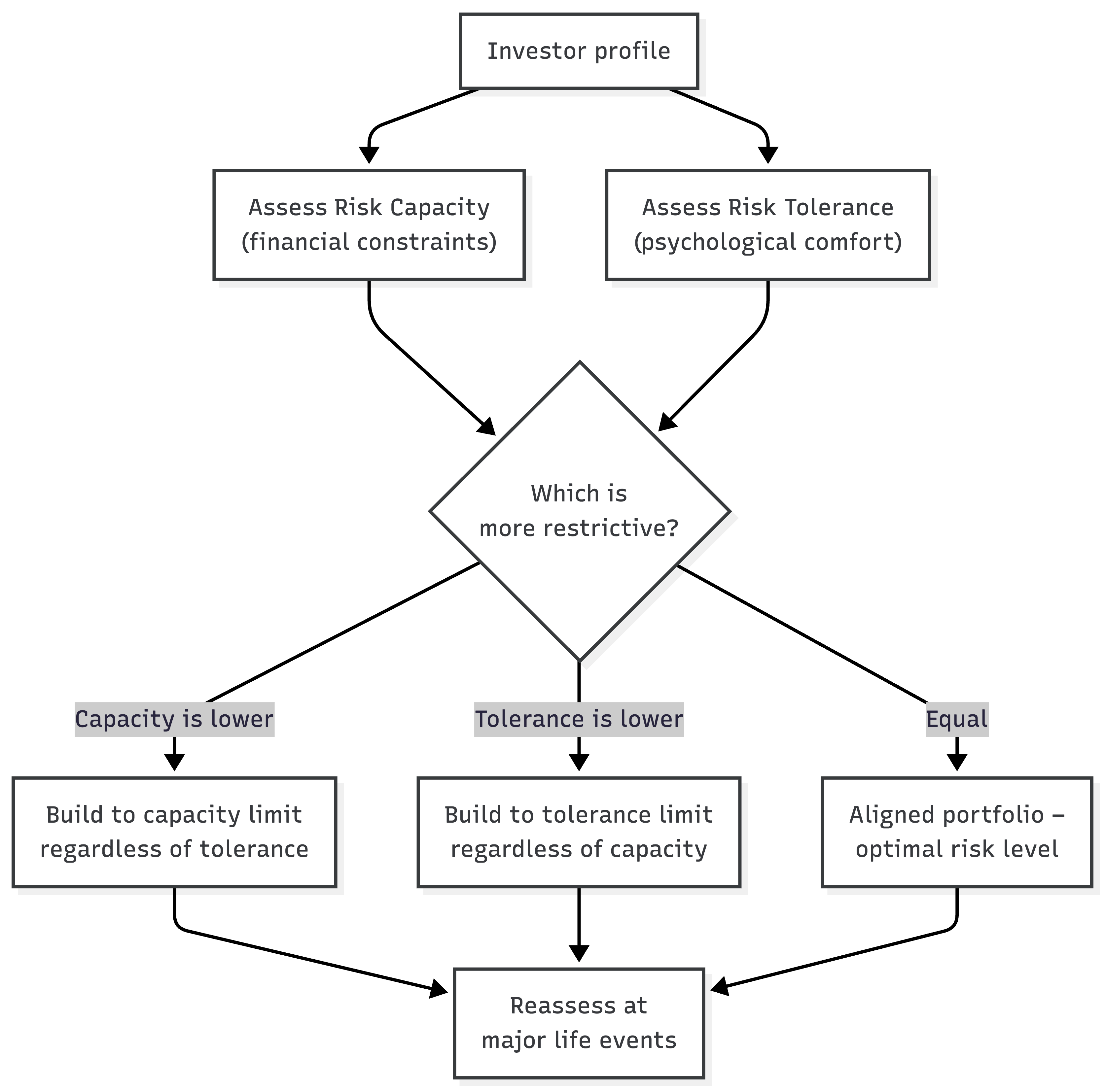
The correct portfolio risk level is determined by whichever constraint is more binding – tolerance or capacity – not by the average of the two.
If your risk capacity is low, it overrides high tolerance. You cannot afford a large loss regardless of how comfortable you feel with volatility. If your risk tolerance is low, it overrides high capacity. A portfolio you will panic-sell during a downturn is worse than a more conservative one you will hold.
The practical framework:
- Assess capacity first – timeline, income stability, upcoming expenses, debt obligations;
- Assess tolerance second – how did you actually behave during the last major downturn?;
- Build to the lower constraint – the binding limit determines the maximum risk level;
- Reassess at major life events – marriage, children, job change, inheritance, approaching retirement.

Risk tolerance is the degree of investment volatility an investor is psychologically willing to accept. Risk capacity is the degree of financial loss an investor can absorb without compromising their goals. Together they define the appropriate risk level for a portfolio – the binding constraint is whichever is lower.

Risk tolerance questionnaires – the kind most brokerages use during account setup – measure stated preferences under hypothetical conditions. Research consistently shows that stated risk tolerance in bull markets significantly overstates actual behavior during real downturns. True risk tolerance is only revealed when money is actually on the line and losses are real.
1. A 58-year-old investor plans to retire in four years. They feel completely comfortable watching their portfolio drop 30% and have never sold during downturns. Their entire retirement depends on this portfolio with no pension or other income source. Which constraint should drive their asset allocation?
2. During a bull market, an investor completes a risk tolerance questionnaire and selects "aggressive" – comfortable with potential 40% portfolio drops. The same investor sold everything during the 2020 COVID crash when their portfolio dropped 25%. What does this reveal?
Thanks for your feedback!
Ask AI

Ask AI

Ask anything or try one of the suggested questions to begin our chat
Risk Tolerance vs Risk Capacity
Before building a portfolio, every investor needs to answer two questions that sound similar but are fundamentally different:
How much risk are you willing to take? That's risk tolerance – a psychological measurement of how much volatility you can endure without making emotional decisions.
How much risk can you actually afford to take? That's risk capacity – a financial measurement of how much loss your situation can absorb without derailing your goals.
Most investors confuse the two. A 28-year-old with a stable income and no dependents may have high risk capacity but low risk tolerance – they hate watching their balance drop even though they could financially afford to. A 62-year-old with significant savings but three years from retirement may have high risk tolerance but low risk capacity – they can psychologically handle volatility, but a 40% drawdown three years before retirement would be financially devastating.
How to Use Both Numbers
The correct portfolio risk level is determined by whichever constraint is more binding – tolerance or capacity – not by the average of the two.
If your risk capacity is low, it overrides high tolerance. You cannot afford a large loss regardless of how comfortable you feel with volatility. If your risk tolerance is low, it overrides high capacity. A portfolio you will panic-sell during a downturn is worse than a more conservative one you will hold.
The practical framework:
- Assess capacity first – timeline, income stability, upcoming expenses, debt obligations;
- Assess tolerance second – how did you actually behave during the last major downturn?;
- Build to the lower constraint – the binding limit determines the maximum risk level;
- Reassess at major life events – marriage, children, job change, inheritance, approaching retirement.
Risk tolerance is the degree of investment volatility an investor is psychologically willing to accept. Risk capacity is the degree of financial loss an investor can absorb without compromising their goals. Together they define the appropriate risk level for a portfolio – the binding constraint is whichever is lower.
Risk tolerance questionnaires – the kind most brokerages use during account setup – measure stated preferences under hypothetical conditions. Research consistently shows that stated risk tolerance in bull markets significantly overstates actual behavior during real downturns. True risk tolerance is only revealed when money is actually on the line and losses are real.
Thanks for your feedback!
