The 4% Rule
Swipe to show menu
The 4% rule is one of the most cited – and most misunderstood – concepts in retirement planning. It didn't come from a financial product or a marketing campaign. It came from a 1994 research paper by financial advisor William Bengen, who asked a simple question: what is the maximum withdrawal rate that has never depleted a portfolio over any 30-year period in U.S. history?
His answer, based on historical S&P 500 and bond return data going back to 1926: 4% per year, adjusted annually for inflation.
The math is straightforward:
The rule also works in reverse – divide your target annual spending by 0.04 to find the portfolio size you need. Spending $60,000 per year requires a $1,500,000 portfolio.
What the Rule Assumes and Where It Breaks
The 4% rule survived every historical 30-year window Bengen tested – including periods starting in 1929 and 2000. But it carries assumptions that don't apply to every retiree:
- 30-year horizon: a 40-year retirement, increasingly common, has not been tested as thoroughly – early research suggests 3.3–3.5% may be safer for longer horizons;
- 60/40 portfolio: Bengen's original work assumed a roughly equal mix of stocks and bonds – a conservative-to-moderate allocation;
- U.S. historical data: the rule is based on American market returns, which have been among the strongest in the world – applying it globally requires caution;
- Inflation adjustments: withdrawals increase with inflation each year – a bad inflation decade early in retirement stresses the rule significantly;
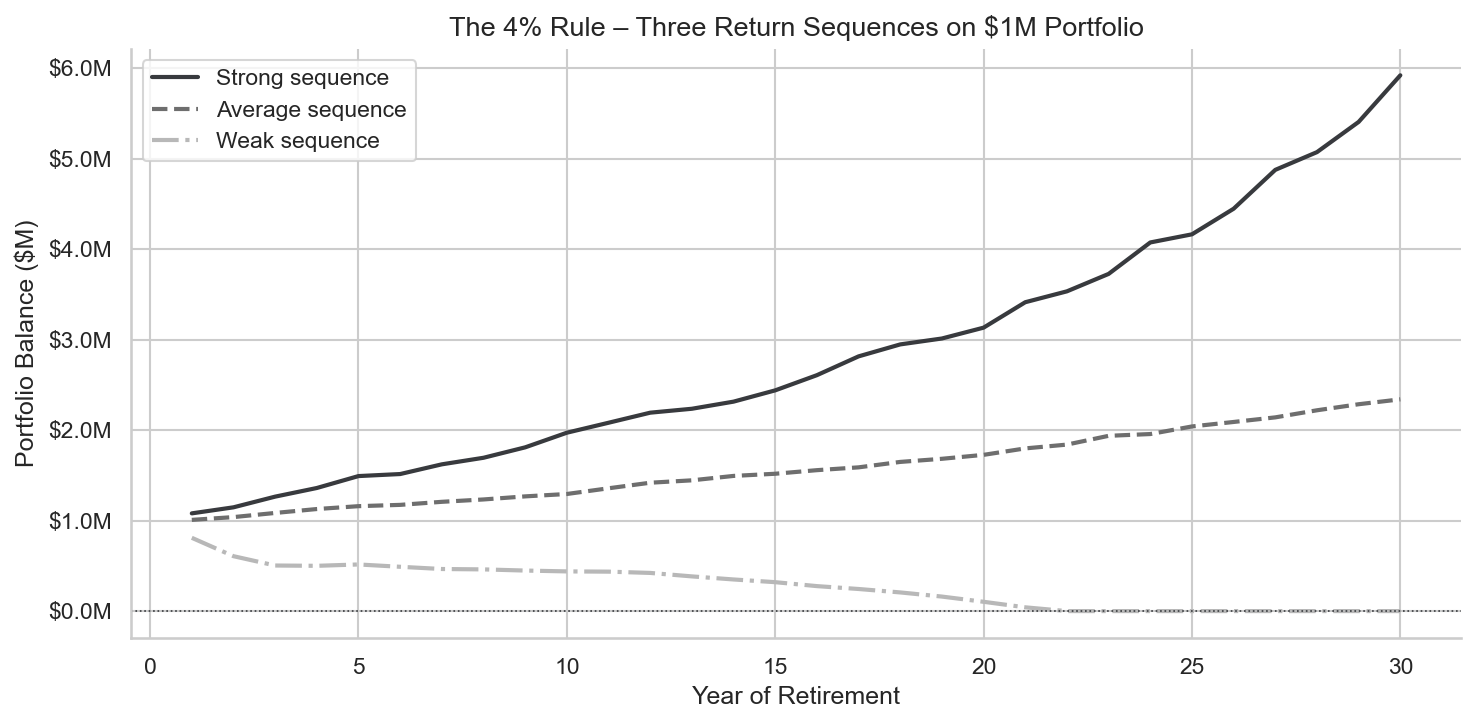
- Sequence of returns: retiring into a bear market tests the 4% rule harder than any average return calculation suggests.

A retirement withdrawal guideline stating that a retiree can withdraw 4% of their portfolio in the first year of retirement, then adjust that amount annually for inflation, with a high historical probability of the portfolio lasting 30 years. It is a starting point for planning, not a guarantee.

The 4% rule has faced increasing scrutiny as interest rates, valuations, and life expectancies have shifted since 1994. Some researchers now suggest 3.3% as a more conservative baseline for modern retirees, particularly those retiring early or into high-valuation markets. The rule is best used as a planning anchor – not as a precise spending authorization.

William Bengen's original paper "Determining Withdrawal Rates Using Historical Data" was published in the Journal of Financial Planning in October 1994. The Trinity Study (1998) by Cooley, Hubbard, and Walz extended Bengen's work across different asset allocations and time horizons and introduced the term "safe withdrawal rate" that is now widely used in retirement planning.
1. A retiree has a $1,200,000 portfolio and plans to follow the 4% rule. What is their first-year withdrawal, and approximately what portfolio size would they need to support $70,000 in annual spending?
2. A 45-year-old plans to retire early and expects a 45-year retirement. They apply the 4% rule as their withdrawal rate. What is the most significant limitation of this approach?
Thanks for your feedback!
Ask AI

Ask AI

Ask anything or try one of the suggested questions to begin our chat
