Expected Return
Swipe to show menu
A stock's past return tells you what happened. Expected return tells you what a rational investor would anticipate going forward – based on probabilities, not hopes.
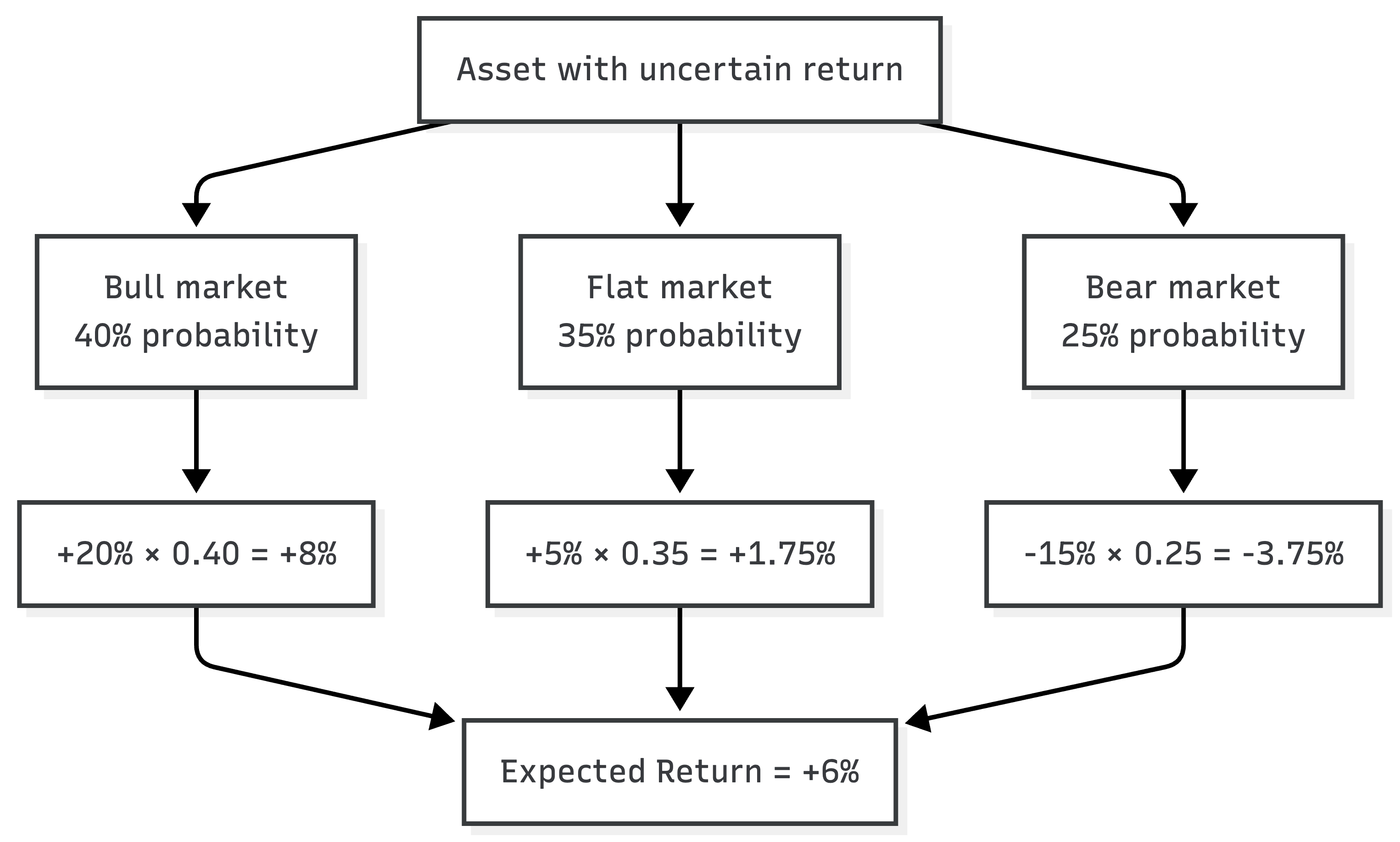
The formula is straightforward. You take each possible outcome, multiply it by its probability, and sum the results:
Expected Return = Σ (Probability × Return)
A stock with three scenarios:
That 6% isn't a guarantee. It's the probability-weighted average of outcomes – the number a rational investor uses to compare this asset against alternatives.
Expected Return vs Realized Return
The expected return is calculated before the fact. The realized return is what actually happened. They are almost never the same number – and that gap is normal.
Over a single year, realized returns can swing wildly from expected. Over 20+ years, they tend to converge. This is why expected return is a long-game tool – it loses most of its meaning if you're investing for 18 months.
- Expected return: a forward-looking estimate based on probabilities;
- Realized return: the actual return over a specific period;
- The gap between them: normal in the short run, meaningful in the long run.

Expected Return is the probability-weighted average of all possible returns for an asset. It represents what a rational investor anticipates earning on average over many periods – not what they will earn in any single period.

Expected return is only as good as the probabilities you assign. If your scenario probabilities are wrong – or if you're missing a scenario entirely – your expected return is misleading. The math is clean; the inputs rarely are.
1. An investor assigns the following probabilities to a stock: 50% chance of +18%, 30% chance of +4%, 20% chance of -12%. What is the expected return?
2. An investor calculates an expected return of +9% for a stock. After one year, the stock returns +22%. Which statement best describes this outcome?
Thanks for your feedback!
Ask AI

Ask AI

Ask anything or try one of the suggested questions to begin our chat
