The Risk-Return Tradeoff
Swipe to show menu
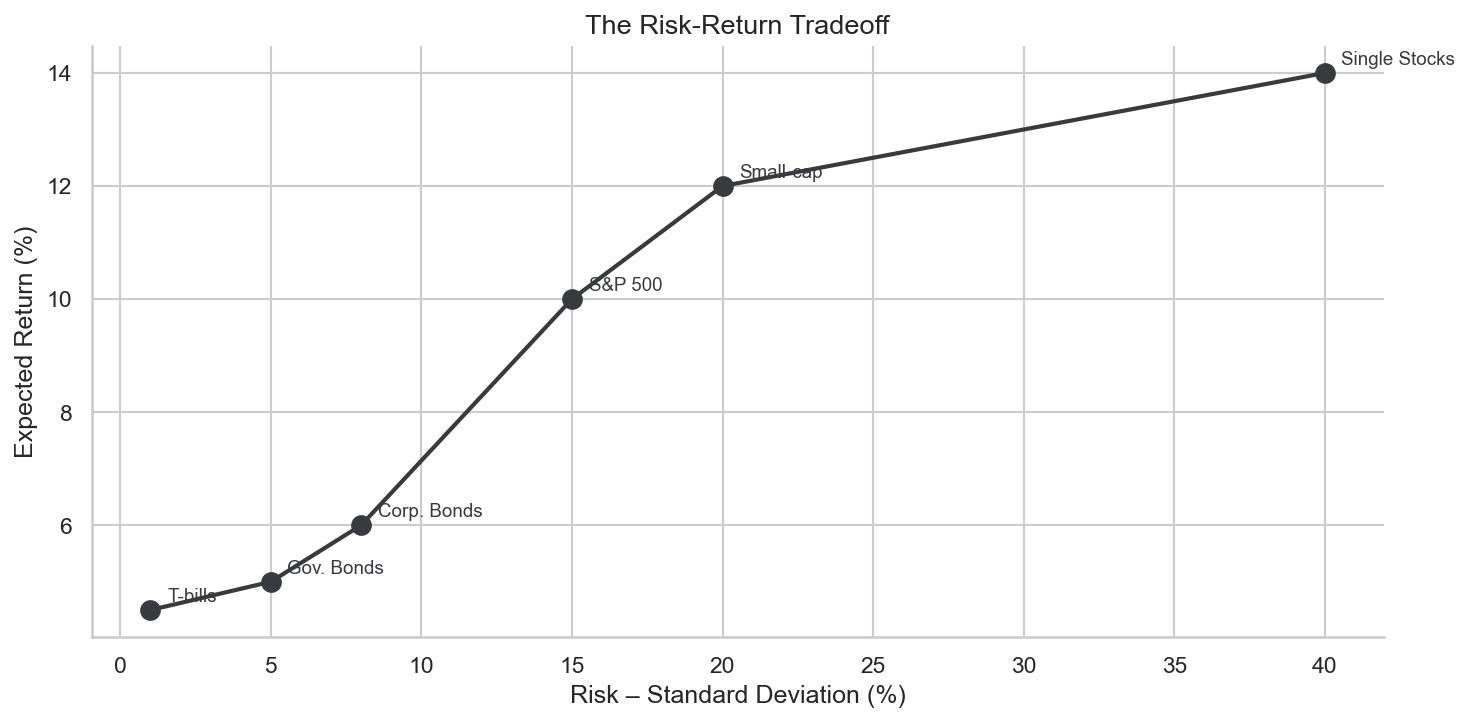
There is no free lunch in investing. Every extra unit of return you want requires accepting an extra unit of risk. This relationship is called the risk-return tradeoff – and it is one of the most fundamental principles in finance.
The logic is simple: if a high-return asset carried no additional risk, every rational investor would pile into it. That demand would drive its price up until the excess return disappeared. Markets are competitive – free returns get arbitraged away quickly.
Moving down this table means accepting more volatility in exchange for higher expected returns.
Where You Sit on the Curve
The risk-return tradeoff isn't a single point – it's a curve. Every investor chooses a position on it based on their goals, time horizon, and capacity to absorb losses.
Choosing too little risk means your returns may not outpace inflation. Choosing too much means you may panic-sell during a downturn and lock in losses. The right position isn't the highest return available – it's the highest return you can hold through a bad year without abandoning your strategy.
- Too conservative: real returns erode over time due to inflation;
- Too aggressive: behavioral risk kicks in during downturns – you sell at the worst moment;
- The goal: find the point where expected return justifies the volatility you can genuinely tolerate.

The principle that higher potential returns require accepting higher risk. In efficient markets, excess returns above the risk-free rate exist only as compensation for taking on measurable risk.
The risk-return tradeoff describes expected outcomes over the long run – not guarantees. A high-risk asset can underperform a low-risk one for years. The tradeoff holds statistically across many periods, not in any single year.
1. An investor finds an asset that offers a 15% expected return with the same risk as a government bond. What should a rational investor conclude?
2. An investor shifts their portfolio from 80% stocks / 20% bonds to 30% stocks / 70% bonds. What is the most likely outcome of this change?
Thanks for your feedback!
Ask AI

Ask AI

Ask anything or try one of the suggested questions to begin our chat
The Risk-Return Tradeoff
There is no free lunch in investing. Every extra unit of return you want requires accepting an extra unit of risk. This relationship is called the risk-return tradeoff – and it is one of the most fundamental principles in finance.
The logic is simple: if a high-return asset carried no additional risk, every rational investor would pile into it. That demand would drive its price up until the excess return disappeared. Markets are competitive – free returns get arbitraged away quickly.
Moving down this table means accepting more volatility in exchange for higher expected returns.
Where You Sit on the Curve
The risk-return tradeoff isn't a single point – it's a curve. Every investor chooses a position on it based on their goals, time horizon, and capacity to absorb losses.
Choosing too little risk means your returns may not outpace inflation. Choosing too much means you may panic-sell during a downturn and lock in losses. The right position isn't the highest return available – it's the highest return you can hold through a bad year without abandoning your strategy.
- Too conservative: real returns erode over time due to inflation;
- Too aggressive: behavioral risk kicks in during downturns – you sell at the worst moment;
- The goal: find the point where expected return justifies the volatility you can genuinely tolerate.
The principle that higher potential returns require accepting higher risk. In efficient markets, excess returns above the risk-free rate exist only as compensation for taking on measurable risk.
The risk-return tradeoff describes expected outcomes over the long run – not guarantees. A high-risk asset can underperform a low-risk one for years. The tradeoff holds statistically across many periods, not in any single year.
Thanks for your feedback!
