Long-Term Care Insurance
Swipe to show menu

Long-term care is the financial risk most people never plan for — and one of the most expensive events that can happen in the second half of life. It is not covered by health insurance. It is not covered by Medicare in any meaningful way. It is not covered by disability insurance. It sits in a gap between all the other protections most people have, waiting for a moment that statistics say is more likely than not.
Roughly 70% of people turning 65 today will need some form of long-term care during their lifetime. The average duration of care is 2–3 years. For a significant minority, care extends 5 years or more. The costs are substantial enough to deplete even well-funded retirement portfolios — and the decision of whether to insure against this risk is one of the more genuinely difficult financial planning questions adults face in their 50s.
What Long-Term Care Actually Means
Long-term care is not medical treatment. It is assistance with the activities of daily living — bathing, dressing, eating, toileting, transferring, and continence — due to physical decline, cognitive impairment, or both.
It is provided in several settings:
- In-home care: a professional caregiver comes to the home to assist with daily activities. Ranges from a few hours a day to around-the-clock care. Cost: $25–$35/hour nationally, or $50,000–$100,000/year for full-time in-home care;
- Assisted living facility: a residential community providing personal care, meals, and supervision without the level of medical care of a nursing home. Cost: $4,000–$6,000/month nationally, or $48,000–$72,000/year;
- Memory care facility: specialized assisted living for people with Alzheimer's or other forms of dementia. Typically 20–30% more expensive than standard assisted living;
- Nursing home — shared room: the highest level of residential care, with 24-hour medical supervision. Cost: $7,500–$9,500/month nationally, or $90,000–$114,000/year.
These are national averages. Costs in high cost-of-living areas — New York, California, the Northeast generally — run 50–100% above these figures.
What Medicare Does and Does Not Cover
A widespread misconception: Medicare covers long-term care. It does not — at least not in any meaningful way for planning purposes.
Medicare covers skilled nursing facility care only following a qualifying hospital stay of at least three days, and only for a limited period:
- Days 1–20: fully covered;
- Days 21–100: covered minus a daily copay of approximately $200;
- Day 101 onward: no Medicare coverage.
After 100 days, costs fall entirely to the individual. For the vast majority of long-term care situations — which involve custodial care rather than skilled nursing, and which last far longer than 100 days — Medicare provides no coverage at all.
Medicaid does cover long-term care — but only after assets are substantially depleted. Medicaid is the safety net of last resort, not a planning tool for people who have spent decades building financial independence.
The Core Planning Question
The fundamental question long-term care planning forces is simple: if you or your spouse needed several years of professional care, where would the money come from?
There are four possible answers:
Self-insurance. Pay out of pocket from accumulated assets. Viable for people with large portfolios — roughly $2,000,000 or more per person — where even a $300,000–$500,000 care event does not threaten overall financial security.
Family care. Rely on family members to provide care. This is how most long-term care is actually delivered in the US — and it comes with significant hidden costs in lost income, career disruption, and physical and emotional toll on caregivers, most of whom are women.
Long-term care insurance. Transfer the risk to an insurer in exchange for premiums. Provides a defined benefit that pays for professional care without depleting the portfolio or burdening family members.
Hybrid products. Life insurance or annuity products with long-term care riders. Pay out either as a death benefit or as long-term care benefits, depending on what is needed. More expensive than pure LTC insurance but eliminate the "use it or lose it" problem of traditional policies.
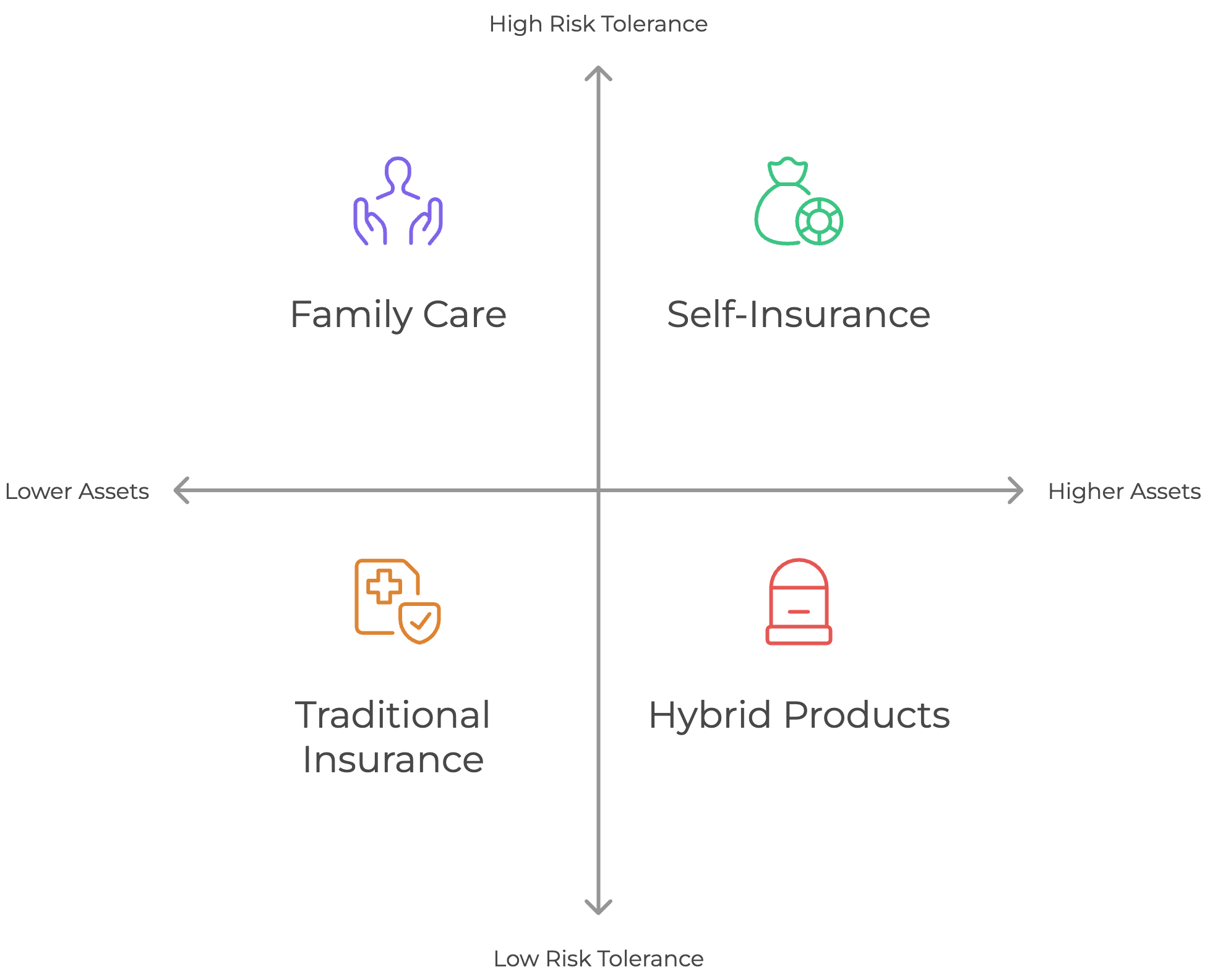
Most people will use some combination of these — and the right balance depends heavily on asset levels, family situation, health history, and personal values.
Traditional Long-Term Care Insurance
Traditional LTC insurance works similarly to other insurance products: you pay premiums, and if you need qualifying care, the policy pays a daily or monthly benefit up to a defined maximum.
Key features to understand:
Benefit amount. The daily or monthly maximum the policy pays. Should be set to cover the cost of care in your geographic area — not national averages. A $150/day benefit may be adequate in rural Mississippi and wholly insufficient in San Francisco.
Benefit period. How long the policy pays benefits — typically 2, 3, 5 years, or unlimited. Given that average care duration is 2–3 years and most catastrophic cases last 5+ years, a 3–5 year benefit period covers the majority of scenarios without the premium cost of unlimited coverage.
Elimination period. The waiting period before benefits begin — typically 30, 60, or 90 days. The policyholder pays out of pocket during this window. A 90-day elimination period significantly reduces premiums and is manageable for people with adequate liquid assets.
Inflation protection. Care costs have historically risen faster than general inflation. Without an inflation rider, a policy purchased at 55 may be significantly underpowered by the time care is needed at 80. A 3% compound inflation rider is the standard recommendation.
The premium instability problem. Traditional LTC insurance has a significant and well-documented flaw: premiums are not guaranteed. Insurers have consistently underestimated claims and have received regulatory approval to raise premiums substantially — in some cases 50–100% or more over the life of a policy. Policyholders face a difficult choice: pay the higher premium, reduce benefits, or lapse the policy and lose all premiums paid.
This instability is one of the primary reasons many financial planners now favor hybrid products over traditional LTC insurance.
Hybrid Long-Term Care Products
Hybrid products — most commonly life insurance with an LTC rider — address the "use it or lose it" objection to traditional LTC insurance and eliminate premium instability risk.
How they work: You fund the policy with a lump sum or a series of fixed premiums. The policy provides a death benefit. If you need long-term care, you draw down the death benefit to pay for care — typically at an accelerated rate, accessing 2–3× the face value for care costs. If you never need care, the death benefit passes to heirs.
The advantages:
- Premiums are typically guaranteed — no surprise increases;
- No "use it or lose it" — if care is never needed, the policy has residual value as a death benefit;
- Simpler underwriting than traditional LTC in some cases.
The disadvantages:
- Requires a significant upfront lump sum — often $50,000–$150,000 — that is tied up in the policy;
- The long-term care benefit may be less generous than a comparable traditional LTC policy;
- Returns on the tied-up capital are modest.
Hybrid products suit people who are uncomfortable with the premium instability of traditional LTC insurance and who have a lump sum available that would otherwise sit in low-yield fixed income.
When to Buy and What It Costs
The optimal window for purchasing traditional LTC insurance is roughly ages 55–65. Earlier than 55, premiums are lower but you pay for more years before likely needing care — and health changes between 55 and 65 may affect eligibility anyway. After 65, premiums rise sharply and health conditions may make coverage unavailable or prohibitively expensive.
Approximate annual premiums for a 55-year-old couple purchasing a joint policy:
These are approximations — actual premiums depend heavily on health status, insurer, and state of residence.
Self-Insurance
For people with large portfolios, self-insurance is a coherent strategy rather than a plan failure.
The logic: a couple with $3,000,000 invested can absorb even a catastrophic $500,000 care event without threatening their financial security. The premiums saved over 20–30 years of coverage, invested instead, add meaningfully to the portfolio available to fund care if needed.
Self-insurance works best when:
- The portfolio is large enough that a 5-year care event for both partners simultaneously would not threaten the surviving partner's security;
- The individual is comfortable accepting the risk of tail scenarios — very long or very expensive care situations;
- There are no strong bequest motives that make asset preservation particularly important.
For most people with portfolios under $1,500,000, self-insurance is not a coherent strategy — it is simply an unplanned exposure to a risk that could permanently alter their retirement.
The Conversation Most People Avoid
Long-term care planning intersects directly with family dynamics in ways that make it emotionally difficult to address. Many people avoid the conversation entirely — with their partners, with their adult children, and with themselves.
The avoidance is understandable. Nobody wants to contemplate cognitive decline, loss of independence, or becoming a burden to their family. But the financial and emotional costs of not planning are borne by exactly the people the avoidance was meant to protect.
The most useful reframe: long-term care insurance is not about preparing for your own decline. It is about protecting your partner's financial security, preserving your children's careers and wellbeing, and ensuring that professional care — rather than family obligation — handles what professional care handles best.
Key Takeaways
- Roughly 70% of people turning 65 will need some form of long-term care — the average duration is 2–3 years, costs run $50,000–$114,000/year depending on care type, and neither Medicare nor standard health insurance covers it;
- Medicare covers at most 100 days of skilled nursing care following a hospital stay — custodial care, which is the vast majority of long-term care, receives no Medicare coverage;
- The four planning options are self-insurance, family care, traditional LTC insurance, and hybrid products — most people use some combination, and the right balance depends on asset levels, family situation, and personal values;
- Traditional LTC insurance has a premium instability problem — insurers have repeatedly raised premiums substantially after purchase; hybrid life/LTC products eliminate this risk at the cost of a larger upfront commitment;
- The optimal purchasing window is ages 55–65 — earlier purchases pay premiums for longer than necessary; later purchases face sharply higher premiums and potential health-related exclusions.
1. Which statements accurately describe Medicare's limitations regarding long-term care coverage?
2. Which statements best describe key trade-offs between traditional long-term care insurance and hybrid LTC products?
Thanks for your feedback!
Ask AI

Ask AI

Ask anything or try one of the suggested questions to begin our chat
