Few-Shot Prompting — Teaching By Example
Swipe to show menu
There are tasks where telling the AI what you want isn't enough — you need to show it. This is the core principle behind few-shot prompting: instead of (or in addition to) writing instructions, you include one or more examples of the kind of output you're looking for, and let the model use those as a template.
Few-shot prompting is one of the highest-leverage techniques available to you, especially for tasks that need to match a specific voice, format, or style that's difficult to describe in words.
How Few-Shot Prompting Works
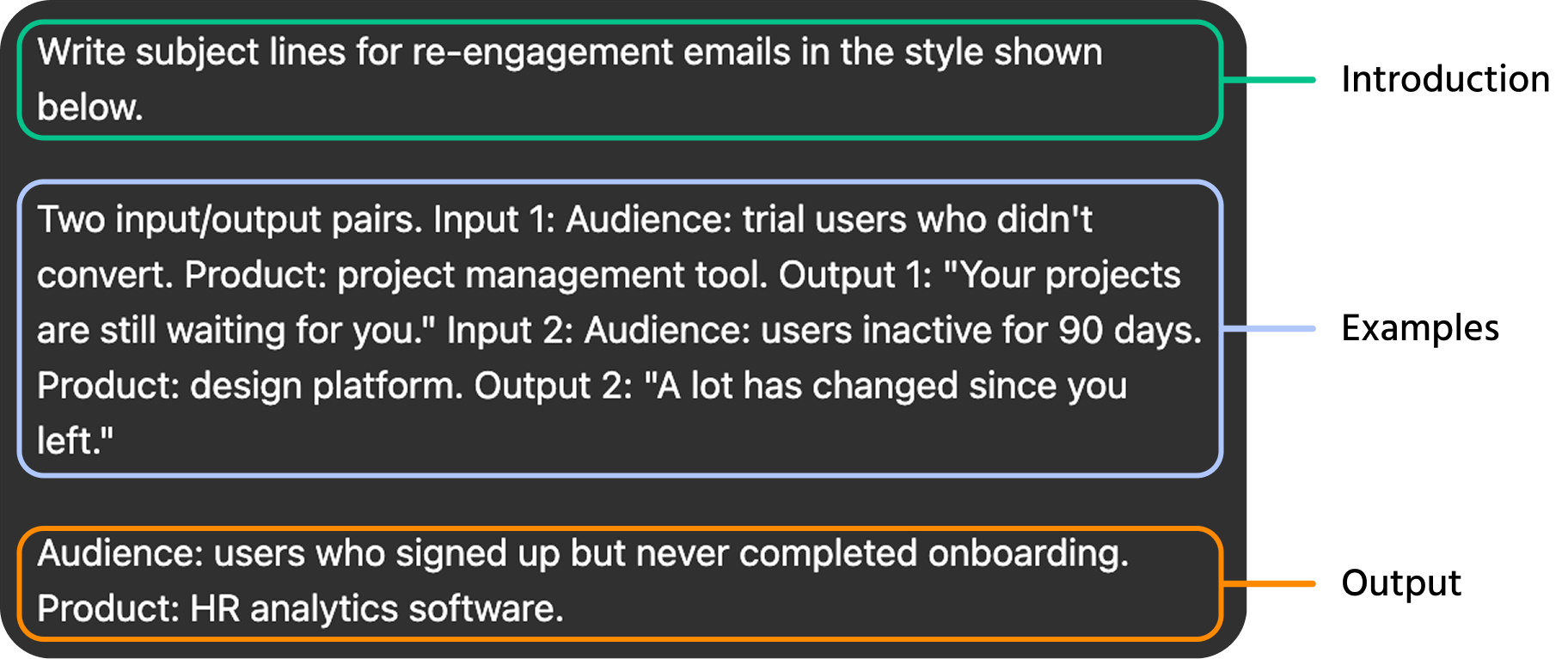
The structure is straightforward. You provide:
- A brief instruction (the task);
- One or more examples showing input → output pairs;
- The actual input you want the model to process.
The model reads the examples, identifies the pattern, and applies it to the new input.
Example structure:

Here is how our team writes internal status updates:
Input: The API integration is delayed due to a dependency issue on the vendor side. ETA unclear. Output: API integration delayed — vendor dependency unresolved. No ETA yet. Flagged to [Owner]. Next update: Friday.
Input: Design review completed. Three minor revisions requested by stakeholders. Changes expected by end of week. Output: Design review done — 3 revisions requested. Changes due EOW. Owner: Design team.
Now apply the same format to this update: Input: The onboarding flow testing is 80% complete. Two edge cases still being resolved by the dev team. Expected completion by Thursday.
How Many Examples Do You Need?
The name "few-shot" reflects the fact that you typically don't need many examples to anchor the pattern:
- One example (one-shot) is often sufficient for simple formatting or style matching;
- Two to three examples cover most professional use cases and give the model enough variation to generalize correctly;
- More than five is rarely necessary and can make the prompt unwieldy.
The quality of your examples matters more than the quantity. One well-chosen example that clearly demonstrates the pattern is more effective than three inconsistent ones.
Choosing The Right Examples
Your examples should be:
- Representative — they should reflect the full range of what you're asking for, not just the easiest cases;
- Consistent — the style, format, and level of detail should be uniform across all examples;
- Real where possible — using examples from your actual work produces more accurate style matching than invented ones;
- Correctly formatted — the model will replicate formatting choices, including mistakes. If your example has a structural error, expect the output to as well.
When Few-Shot Prompting Is Worth The Extra Effort
Few-shot is more work to set up than zero-shot. It pays off when:
- You need output to match a specific existing voice or format (your company's writing style, a report template, a tone guide);
- Zero-shot attempts have produced outputs that are consistently close but not quite right;
- You're building a reusable prompt template that will be used repeatedly — the setup cost is a one-time investment;
- The task involves subjective quality judgments (what makes a subject line good, what makes a summary concise) that are easier to demonstrate than explain.
Thanks for your feedback!
Ask AI

Ask AI

Ask anything or try one of the suggested questions to begin our chat
