How Tax Brackets Actually Work
Swipe to show menu
If you've ever opened a tax form and felt your soul leave your body — you're in the right place.
This course is built for people who hate taxes. Not for accountants. Not for finance bros. For you — the human who just wants to stop overpaying, stop panicking in April, and stop nodding along when someone says "marginal rate" like it means something.
We're going to skip the jargon, kill the myths, and show you exactly how the system works — and where the legal moves are hiding in plain sight.
By the end, you'll know more about taxes than 90% of the people you work with. Probably more than the person doing your taxes.
What This Section Covers
Section 1 is the foundation: how brackets really work, the difference between deductions and credits, and the moves that legitimately lower your tax bill.
Let's start with the most expensive myth in personal finance.
The $5,000 Raise that "Wasn't Worth It"
Maria got a $5,000 raise. She was excited for about three hours.
Then her uncle said at dinner: "Be careful — you just jumped a tax bracket. You'll actually take home less than before."
Maria spent the weekend googling. She almost called HR to refuse the raise.
Her uncle was wrong. And so was every coworker who's ever told you the same thing.
How Brackets Actually Work
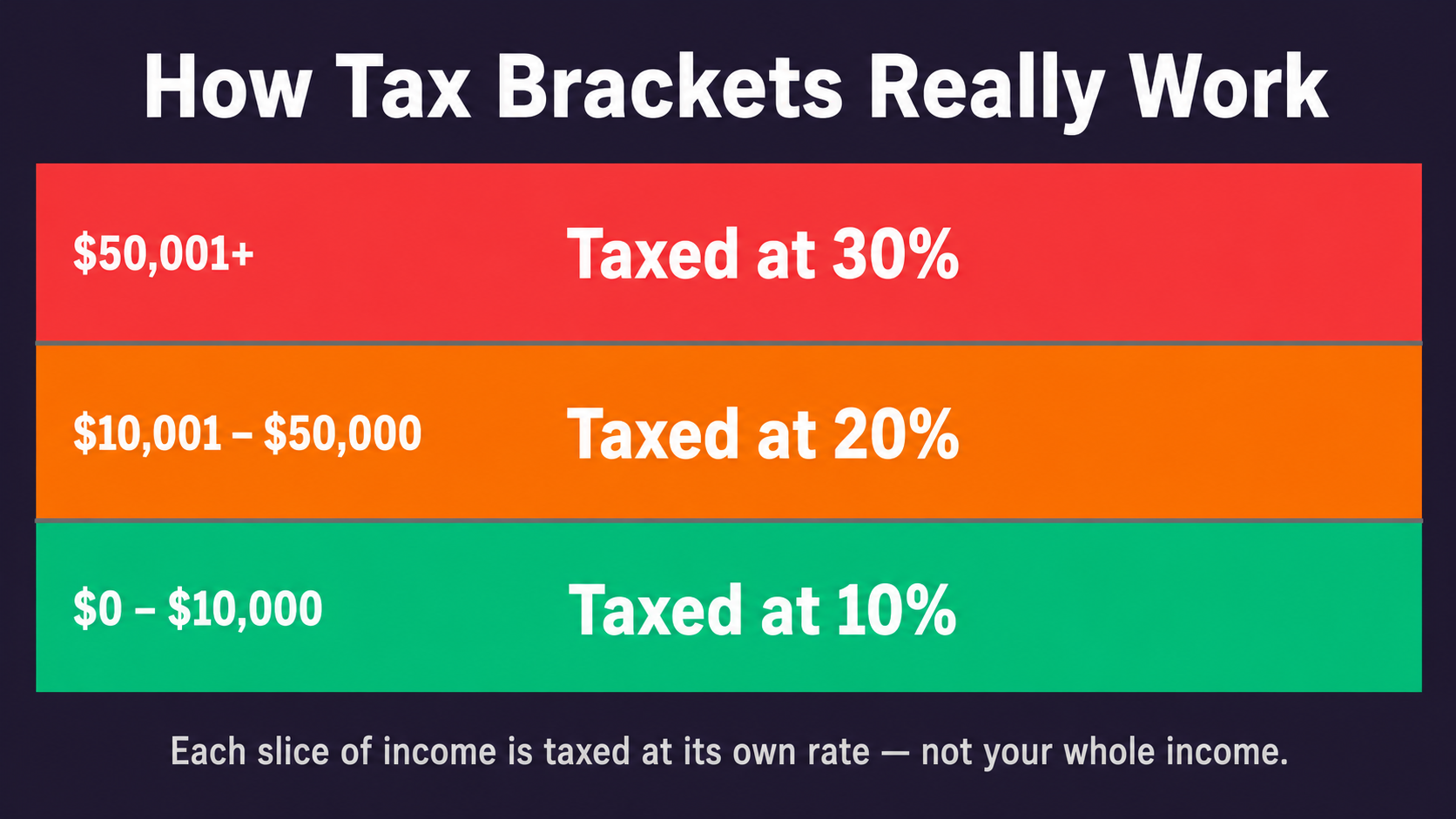
A tax bracket is not a switch that flips your whole income to a new rate. It's more like a layered cake — each slice of your income is taxed at its own rate.
Let's use a simplified two-bracket example:
- Income from $0 to $10,000 → taxed at 10%;
- Income from $10,001 to $50,000 → taxed at 20%.
If you earn $15,000, here's what actually happens:
- First $10,000 → taxed at 10% = $1,000;
- Next $5,000 → taxed at 20% = $1,000;
- Total tax = $2,000.
The 20% rate only applies to the $5,000 above the bracket line. Not to your whole income.
Why This Myth Costs People Real Money
If you turn down raises, side income, or overtime because you're scared of "jumping a bracket" — you're leaving real money on the table.
A higher bracket never means you take home less than before. Worst case: a slightly smaller percentage of the new money goes to you. You always come out ahead.
Maria took the raise. Her tax bill went up by about $1,100. She kept the other $3,900.
1. Maria gets a $5,000 raise that pushes part of her income into a higher tax bracket. Her tax bill goes up — but how much of her new $5,000 raise does she actually keep?
2. Using a simplified system — 10% on income from $0 to $10,000, and 20% on income from $10,001 to $30,000 — how much total tax does someone earning $20,000 owe? Enter the dollar amount with no symbols.
Thanks for your feedback!
Ask AI

Ask AI

Ask anything or try one of the suggested questions to begin our chat
How Tax Brackets Actually Work
If you've ever opened a tax form and felt your soul leave your body — you're in the right place.
This course is built for people who hate taxes. Not for accountants. Not for finance bros. For you — the human who just wants to stop overpaying, stop panicking in April, and stop nodding along when someone says "marginal rate" like it means something.
We're going to skip the jargon, kill the myths, and show you exactly how the system works — and where the legal moves are hiding in plain sight.
By the end, you'll know more about taxes than 90% of the people you work with. Probably more than the person doing your taxes.
What This Section Covers
Section 1 is the foundation: how brackets really work, the difference between deductions and credits, and the moves that legitimately lower your tax bill.
Let's start with the most expensive myth in personal finance.
The $5,000 Raise that "Wasn't Worth It"
Maria got a $5,000 raise. She was excited for about three hours.
Then her uncle said at dinner: "Be careful — you just jumped a tax bracket. You'll actually take home less than before."
Maria spent the weekend googling. She almost called HR to refuse the raise.
Her uncle was wrong. And so was every coworker who's ever told you the same thing.
How Brackets Actually Work
A tax bracket is not a switch that flips your whole income to a new rate. It's more like a layered cake — each slice of your income is taxed at its own rate.
Let's use a simplified two-bracket example:
- Income from $0 to $10,000 → taxed at 10%;
- Income from $10,001 to $50,000 → taxed at 20%.
If you earn $15,000, here's what actually happens:
- First $10,000 → taxed at 10% = $1,000;
- Next $5,000 → taxed at 20% = $1,000;
- Total tax = $2,000.
The 20% rate only applies to the $5,000 above the bracket line. Not to your whole income.
Why This Myth Costs People Real Money
If you turn down raises, side income, or overtime because you're scared of "jumping a bracket" — you're leaving real money on the table.
A higher bracket never means you take home less than before. Worst case: a slightly smaller percentage of the new money goes to you. You always come out ahead.
Maria took the raise. Her tax bill went up by about $1,100. She kept the other $3,900.
Thanks for your feedback!
