The Big Itemized Deductions — Mortgage, SALT, Charity
Swipe to show menu
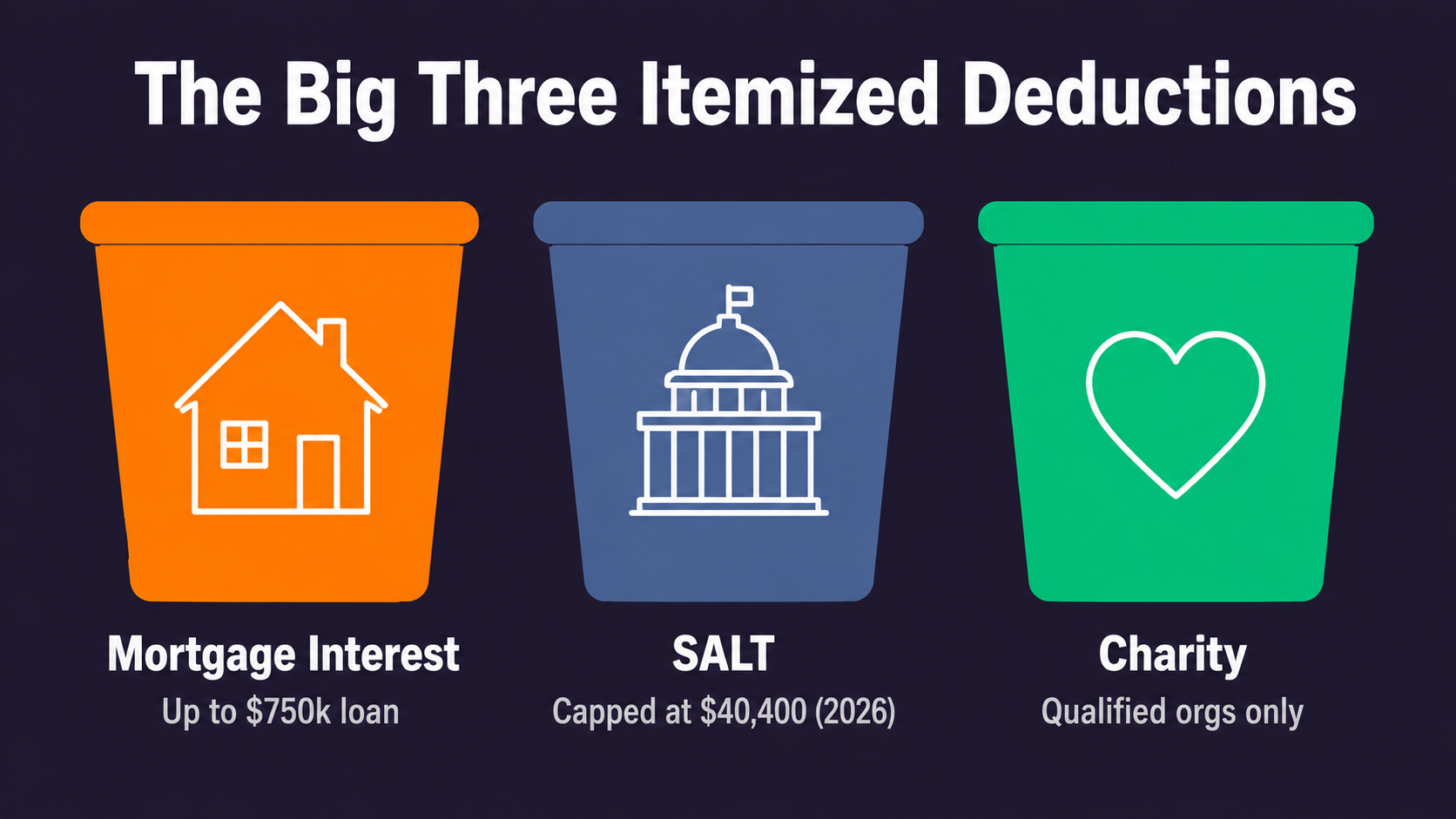
The Three Buckets That Make Itemizing Worth It
If you're going to beat the standard deduction, it almost always comes down to three categories. Most people who itemize do it because of one or more of these.
1. Mortgage Interest
You can deduct the interest paid on a home loan up to a principal of $750,000 (for loans taken after Dec 2017).
Only the interest — not the principal portion of your payment. In the early years of a mortgage, interest is most of your payment, which is why new homeowners often suddenly switch to itemizing.
2. SALT (State And Local Taxes)
You can deduct state income tax, local tax, and property tax — but the total is capped.
For years, that cap was a brutal $10,000. Under the One Big Beautiful Bill Act, the cap jumped to $40,400 (joint filers, 2026) — with a phase-out for high earners (MAGI above ~$505,000) and a scheduled reset back to $10,000 in 2030 unless extended.
Translation: if you live in a high-tax state and own property, you can finally deduct most or all of what you pay. The cap matters way less than it used to — unless you're a very high earner or filing married-separately (where the cap is halved).
3. Charitable Contributions
Donations to qualified 501(c)(3) organizations are deductible. Cash, goods, or appreciated stock.
What's not deductible:
- The value of your time volunteering;
- Money given directly to an individual (most GoFundMes);
- Political campaign donations.
For donations over $250, keep the written acknowledgement from the charity.
1. A married couple paid $28,000 in state income tax and $14,000 in property tax in 2026. Under the new SALT cap of $40,400 for joint filers, what's the maximum they can deduct on their federal return? Enter the dollar amount, no symbols.
2. Which of these can NOT be claimed as a charitable deduction?
Thanks for your feedback!
Ask AI

Ask AI

Ask anything or try one of the suggested questions to begin our chat
