The 0% Long-Term Capital Gains Bracket
Swipe to show menu
The Legal Hack Most High Earners Don't Know Exists
There's a sentence buried in the tax code that financial advisors quietly use for their wealthier clients — but rarely tell you about:
Some people pay zero federal tax on long-term capital gains. Legally. Every year.
You don't have to be poor. You don't need a loophole. You just need to know the number.
The 2026 Thresholds
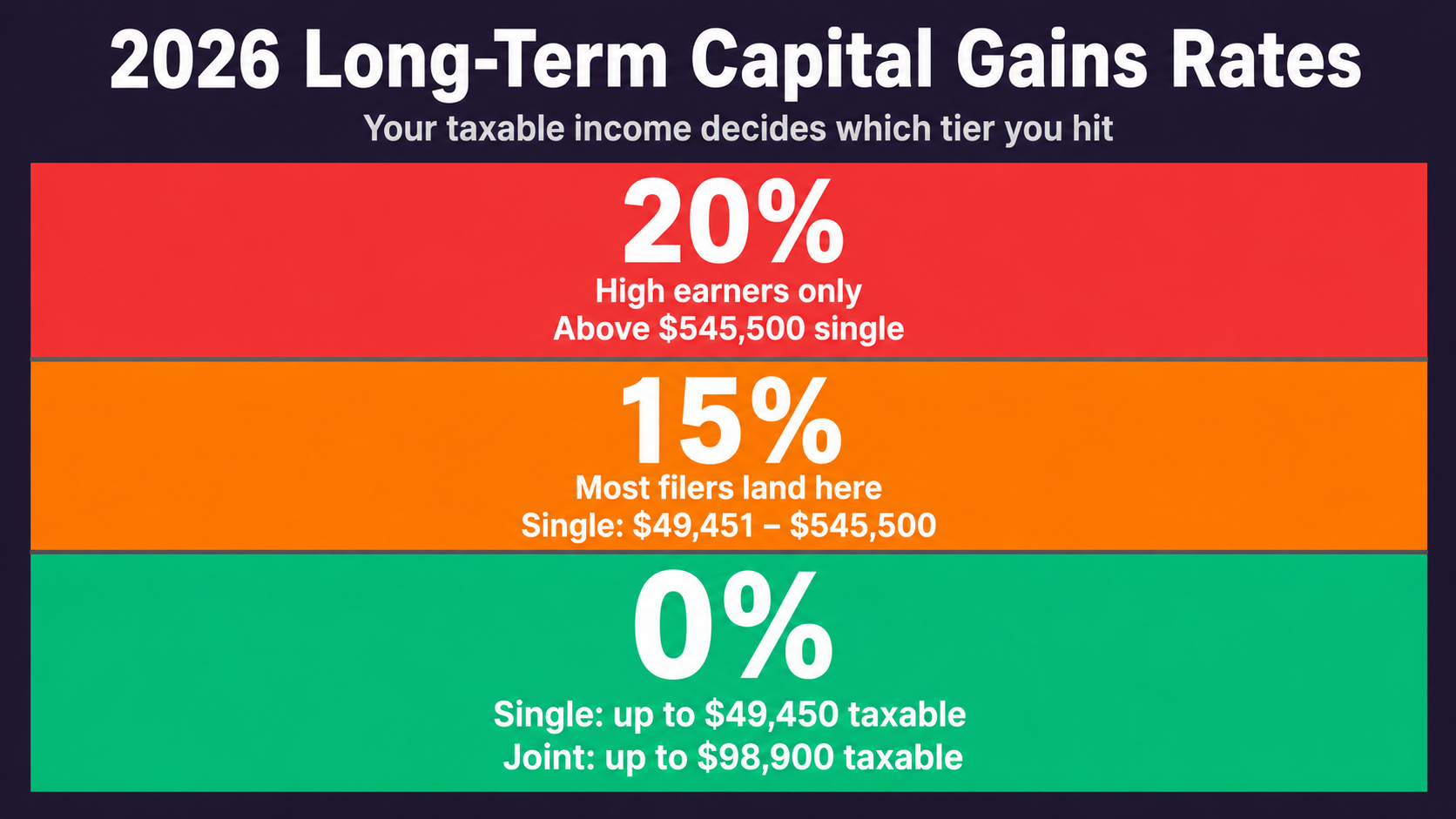
If your taxable income falls below these amounts, your long-term capital gains are taxed at 0%:
- Single → up to $49,450;
- Married filing jointly → up to $98,900;
- Head of household → up to $66,200.
Above those numbers, you pay 15%. Way above (around $545,500 single / $613,700 joint), you pay 20%.
What "Taxable Income" Really Means
This is the part that breaks people's brains. Taxable income is not your salary. It's what's left after the standard deduction.
For 2026:
- A single filer can earn up to $49,450 + $16,100 = $65,550 in gross income and still hit the 0% bracket;
- A married couple can earn up to $98,900 + $32,200 = $131,100 combined and still hit it.
That's a household pulling in over $131k a year — paying $0 in federal tax on long-term gains. This is not an exotic strategy. This is the law.
How To Actually Use This
The 0% bracket isn't just for retirees on fixed income. Real situations where it matters:
- Gap year — between jobs, in grad school, on parental leave;
- Early retirement — before Social Security or pension income kicks in;
- Sabbatical — a year off with low W-2 income;
- Low-income years for couples — one spouse takes a break.
The move: in those years, deliberately sell appreciated stock up to the 0% threshold. The IRS forgives the capital gains tax on those dollars. Then you can immediately rebuy the same stock (this isn't a wash sale — wash sale rules only apply to losses, not gains).
You just reset your cost basis higher — for free. Future gains get measured from the new, higher starting point.
This single move can save a household tens of thousands of dollars over a lifetime. Most people never hear about it.
1. A married couple has $80,000 in taxable income for 2026 and sells stock with a $10,000 long-term gain. The 0% bracket goes up to $98,900 for joint filers. What's their federal tax on this capital gain?
2. A single filer has $40,000 of taxable income in 2026. The 0% long-term capital gains bracket for singles extends to $49,450. What's the maximum long-term gain she can realize this year and still pay $0 in federal capital gains tax? Enter the dollar amount with no symbols.
Thanks for your feedback!
Ask AI

Ask AI

Ask anything or try one of the suggested questions to begin our chat
The 0% Long-Term Capital Gains Bracket
The Legal Hack Most High Earners Don't Know Exists
There's a sentence buried in the tax code that financial advisors quietly use for their wealthier clients — but rarely tell you about:
Some people pay zero federal tax on long-term capital gains. Legally. Every year.
You don't have to be poor. You don't need a loophole. You just need to know the number.
The 2026 Thresholds
If your taxable income falls below these amounts, your long-term capital gains are taxed at 0%:
- Single → up to $49,450;
- Married filing jointly → up to $98,900;
- Head of household → up to $66,200.
Above those numbers, you pay 15%. Way above (around $545,500 single / $613,700 joint), you pay 20%.
What "Taxable Income" Really Means
This is the part that breaks people's brains. Taxable income is not your salary. It's what's left after the standard deduction.
For 2026:
- A single filer can earn up to $49,450 + $16,100 = $65,550 in gross income and still hit the 0% bracket;
- A married couple can earn up to $98,900 + $32,200 = $131,100 combined and still hit it.
That's a household pulling in over $131k a year — paying $0 in federal tax on long-term gains. This is not an exotic strategy. This is the law.
How To Actually Use This
The 0% bracket isn't just for retirees on fixed income. Real situations where it matters:
- Gap year — between jobs, in grad school, on parental leave;
- Early retirement — before Social Security or pension income kicks in;
- Sabbatical — a year off with low W-2 income;
- Low-income years for couples — one spouse takes a break.
The move: in those years, deliberately sell appreciated stock up to the 0% threshold. The IRS forgives the capital gains tax on those dollars. Then you can immediately rebuy the same stock (this isn't a wash sale — wash sale rules only apply to losses, not gains).
You just reset your cost basis higher — for free. Future gains get measured from the new, higher starting point.
This single move can save a household tens of thousands of dollars over a lifetime. Most people never hear about it.
Thanks for your feedback!
