Tax-Advantaged Accounts Ranked
Swipe to show menu
The Order That Saves You The Most Money
You have a paycheck. You want to invest some of it. There are five or six different accounts you could use — and the order you fill them matters a lot.
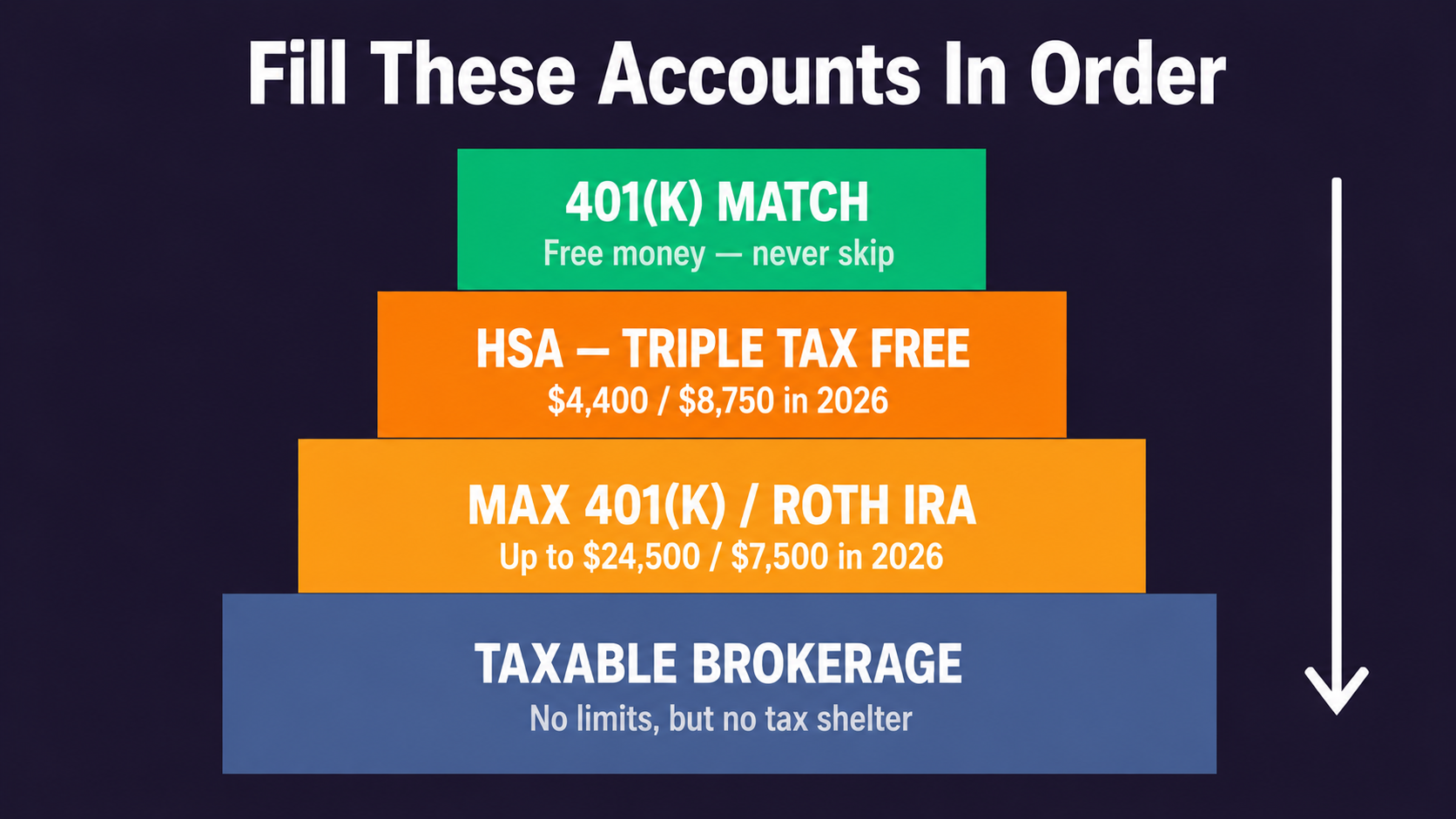
Here's the ranking most financial planners agree on. Follow it from top to bottom.
1. 401(k) Up To The Employer Match
If your employer matches your 401(k) contributions, that's free money — typically a 50% to 100% instant return. Nothing else in finance comes close.
Fill this first. Even if you don't max it out, get every dollar of the match.
2. HSA (If You're Eligible) — The Quiet King
The Health Savings Account is the only triple-tax-advantaged account in the entire U.S. tax code:
- Contributions are tax-deductible (just like a 401(k));
- Growth is tax-free (just like a Roth);
- Withdrawals for medical expenses are tax-free (no other account does this).
It's basically a 401(k), Roth IRA, and FSA combined into one. And after age 65, you can use the money for anything — you just pay ordinary income tax on non-medical withdrawals (same treatment as a Traditional IRA).
2026 HSA contribution limits:
- Self-only coverage → $4,400;
- Family coverage → $8,750;
- Age 55+ catch-up → +$1,000.
The catch: you need to be enrolled in a High-Deductible Health Plan (HDHP) to contribute.
3. Max Out Your 401(k) Or Roth IRA
After the match and HSA, push toward maxing out a 401(k) or contributing to a Roth IRA, depending on your income and tax-bracket situation:
- 2026 401(k) limit → $24,500 (+$8,000 catch-up at 50+, +$11,250 super catch-up at 60–63);
- 2026 IRA/Roth IRA limit → $7,500 (+$1,100 catch-up at 50+).
Roth IRA income limits (2026): phase-out at $153,000–$168,000 single, $242,000–$252,000 joint.
4. Taxable Brokerage
After all tax-advantaged accounts are filled, anything extra goes into a regular brokerage. Less tax efficiency, but no contribution caps and no withdrawal rules.
Why The HSA Wins Long-Term
Here's the move advanced investors make:
- Contribute the max to the HSA every year;
- Don't spend it on current medical bills — pay those out of pocket;
- Invest the HSA in index funds;
- Save every medical receipt;
- Decades later, withdraw tax-free using the old receipts — or just use it as a stealth retirement account.
A $4,400 contribution invested at 7% for 30 years grows to about $33,500 — completely tax-free if used for medical expenses (and you'll have those in retirement, guaranteed).
Most people use their HSA like a debit card. They're leaving the best account in the U.S. tax code on the table.
Thanks for your feedback!
Ask AI

Ask AI

Ask anything or try one of the suggested questions to begin our chat
