Tax-Loss Harvesting & Wash Sale Rules + Bridge
Swipe to show menu
Turning Losing Investments Into A Tax Refund
Here's a strategy most people only learn about after they've lost out on it for years: tax-loss harvesting.
The idea is brutally simple. The IRS lets you use investment losses to cancel out investment gains — and then a little bit of your salary on top.
How Tax-Loss Harvesting Works
You sell an investment that's down. The loss does three things:
- Offsets capital gains dollar-for-dollar. Made $5,000 on one stock, lost $5,000 on another? Net gain = $0. Tax owed = $0;
- Offsets up to $3,000 of ordinary income per year if losses exceed gains. That's worth up to $1,100+ at higher tax brackets;
- Carries forward forever. If you have an $18,000 loss with no gains to offset, you can use $3,000 against your salary this year — and carry the remaining $15,000 to future years.
The smart move at year-end: review your portfolio for losers, sell them to bank the loss, and immediately reinvest in a similar but not identical asset to keep your market exposure.
The Wash Sale Rule — The One Trap
The IRS doesn't let you sell at a loss and immediately rebuy the same thing. That would be a "fake" loss.
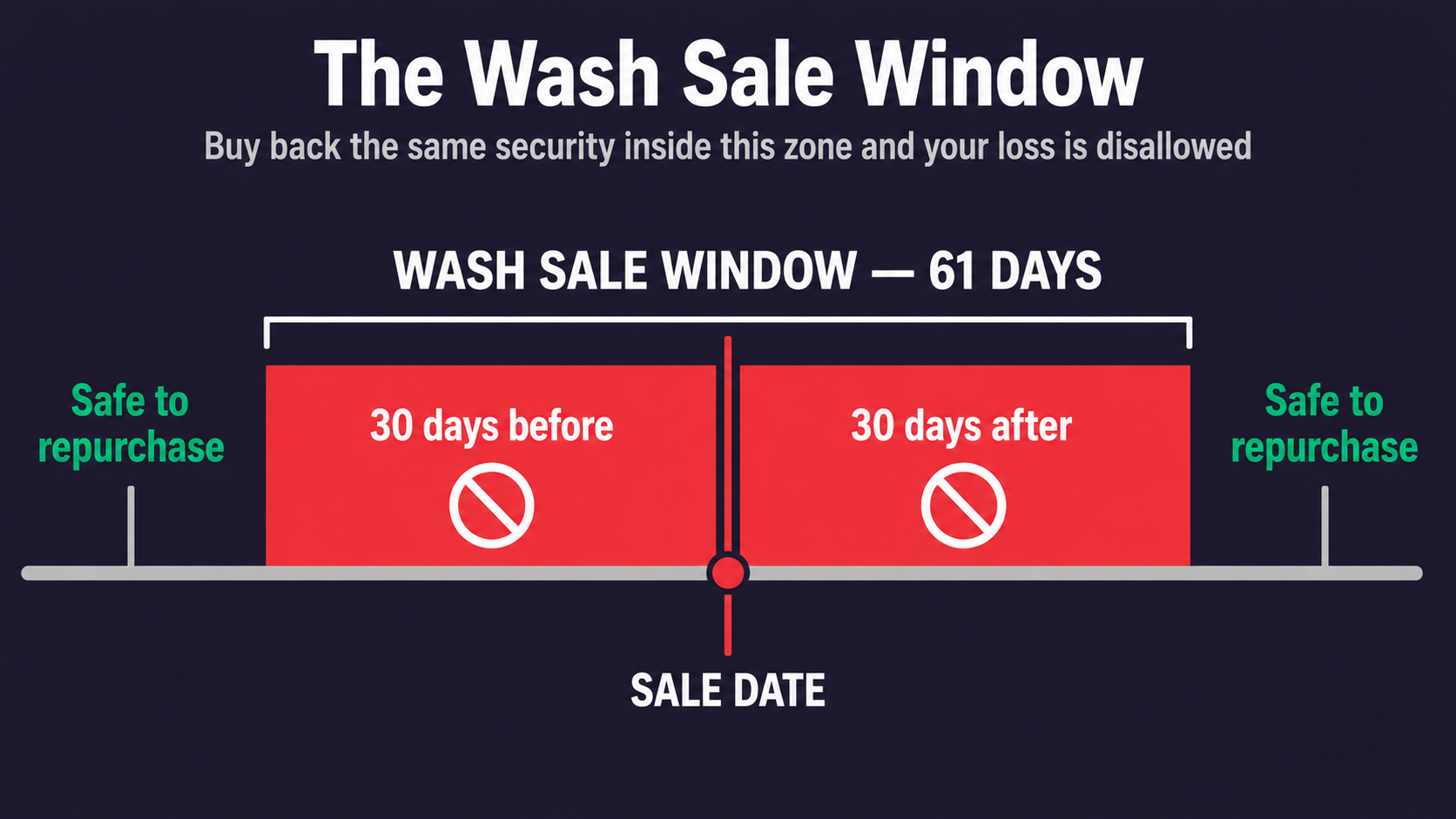
The wash sale rule: if you buy back the same or "substantially identical" security within 30 days before or after the sale, the loss is disallowed. The window is 61 days total — 30 days before, the day of sale, and 30 days after.
What Counts As "Substantially Identical"
- ❌ Sell VTI (Vanguard Total Stock Market ETF), buy VTI back next week → wash sale;
- ❌ Sell Apple stock, buy Apple stock back → wash sale;
- ✅ Sell VTI, buy ITOT (iShares total market ETF — similar but not identical) → fine;
- ✅ Sell Apple, buy Microsoft → fine.
The rule applies across all your accounts, including your spouse's and your IRA. People accidentally trigger this when their 401(k) auto-buys an index fund on the same day they sell that fund in their brokerage.
A Realistic Year-End Move
December is harvest season. Here's the typical playbook:
- Scan your taxable accounts for investments down 10%+ from your purchase price;
- Sell to bank the loss;
- Immediately buy a similar-but-not-identical replacement (e.g., S&P 500 ETF → total market ETF);
- Wait at least 31 days before buying back the original, if you still want it.
Done right, this can shave hundreds or thousands off your tax bill without changing your investment thesis at all. You still own the market — you just collected the IRS rebate on the way through.
Next Up: Real-Life Tax Moves
You now know how to:
- Tell brackets and rates apart, and stop overpaying on raises;
- Hold long enough to get long-term rates — and find the 0% bracket;
- Pick the right account for the right asset;
- Rank tax-advantaged accounts in the right order;
- Harvest losses without tripping wash sale rules.
Section 3 is where it gets practical. Real life. The W-4 you've been ignoring. Quarterly taxes if you have a side hustle. State tax tricks. When to fire your CPA. What an audit actually looks like. And the year-end checklist that ties everything in this course together.
1. David sold a stock at a loss on October 15. What is the earliest date he can repurchase the same stock without triggering the wash sale rule? Enter the date as MM/DD.
2. Maria realized $12,000 in long-term capital gains this year and $8,000 in capital losses. What can she do with the net result?
Thanks for your feedback!
Ask AI

Ask AI

Ask anything or try one of the suggested questions to begin our chat
Tax-Loss Harvesting & Wash Sale Rules + Bridge
Turning Losing Investments Into A Tax Refund
Here's a strategy most people only learn about after they've lost out on it for years: tax-loss harvesting.
The idea is brutally simple. The IRS lets you use investment losses to cancel out investment gains — and then a little bit of your salary on top.
How Tax-Loss Harvesting Works
You sell an investment that's down. The loss does three things:
- Offsets capital gains dollar-for-dollar. Made $5,000 on one stock, lost $5,000 on another? Net gain = $0. Tax owed = $0;
- Offsets up to $3,000 of ordinary income per year if losses exceed gains. That's worth up to $1,100+ at higher tax brackets;
- Carries forward forever. If you have an $18,000 loss with no gains to offset, you can use $3,000 against your salary this year — and carry the remaining $15,000 to future years.
The smart move at year-end: review your portfolio for losers, sell them to bank the loss, and immediately reinvest in a similar but not identical asset to keep your market exposure.
The Wash Sale Rule — The One Trap
The IRS doesn't let you sell at a loss and immediately rebuy the same thing. That would be a "fake" loss.
The wash sale rule: if you buy back the same or "substantially identical" security within 30 days before or after the sale, the loss is disallowed. The window is 61 days total — 30 days before, the day of sale, and 30 days after.
What Counts As "Substantially Identical"
- ❌ Sell VTI (Vanguard Total Stock Market ETF), buy VTI back next week → wash sale;
- ❌ Sell Apple stock, buy Apple stock back → wash sale;
- ✅ Sell VTI, buy ITOT (iShares total market ETF — similar but not identical) → fine;
- ✅ Sell Apple, buy Microsoft → fine.
The rule applies across all your accounts, including your spouse's and your IRA. People accidentally trigger this when their 401(k) auto-buys an index fund on the same day they sell that fund in their brokerage.
A Realistic Year-End Move
December is harvest season. Here's the typical playbook:
- Scan your taxable accounts for investments down 10%+ from your purchase price;
- Sell to bank the loss;
- Immediately buy a similar-but-not-identical replacement (e.g., S&P 500 ETF → total market ETF);
- Wait at least 31 days before buying back the original, if you still want it.
Done right, this can shave hundreds or thousands off your tax bill without changing your investment thesis at all. You still own the market — you just collected the IRS rebate on the way through.
Next Up: Real-Life Tax Moves
You now know how to:
- Tell brackets and rates apart, and stop overpaying on raises;
- Hold long enough to get long-term rates — and find the 0% bracket;
- Pick the right account for the right asset;
- Rank tax-advantaged accounts in the right order;
- Harvest losses without tripping wash sale rules.
Section 3 is where it gets practical. Real life. The W-4 you've been ignoring. Quarterly taxes if you have a side hustle. State tax tricks. When to fire your CPA. What an audit actually looks like. And the year-end checklist that ties everything in this course together.
Thanks for your feedback!
