Capital Gains — Short-Term Vs Long-Term
Swipe to show menu
You now know how the tax system works. This section is where the real money lives.
Almost every "legal tax hack" you've ever heard about — billionaires paying lower rates than their secretaries, the 0% bracket nobody talks about, the magic of HSAs — comes from one fact: the tax code treats investment income very differently from your paycheck.
In Section 1, we played defense (deductions, credits). In Section 2, we play offense. By the end, you'll know:
- How holding a stock for one extra day can cut your tax bill in half;
- How to legally pay $0 in capital gains tax (yes, really);
- Which accounts to fill first — and which one beats everything else.
Let's start with the rule that costs people the most money.
The $7,000 Mistake That Took 11 Months And 29 Days
Two friends, Jake and Ben, bought the same stock on January 1st. Both made $20,000 of profit.
- Jake sold on December 15th (held 11 months and 14 days);
- Ben sold on January 5th of the following year (held 12 months and 4 days).
They're both in the 24% federal bracket.
- Jake's tax bill: $4,800;
- Ben's tax bill: $3,000.
Same investment. Same gain. Ben kept $1,800 more — just by waiting three weeks.
Why The Holding Period Matters So Much
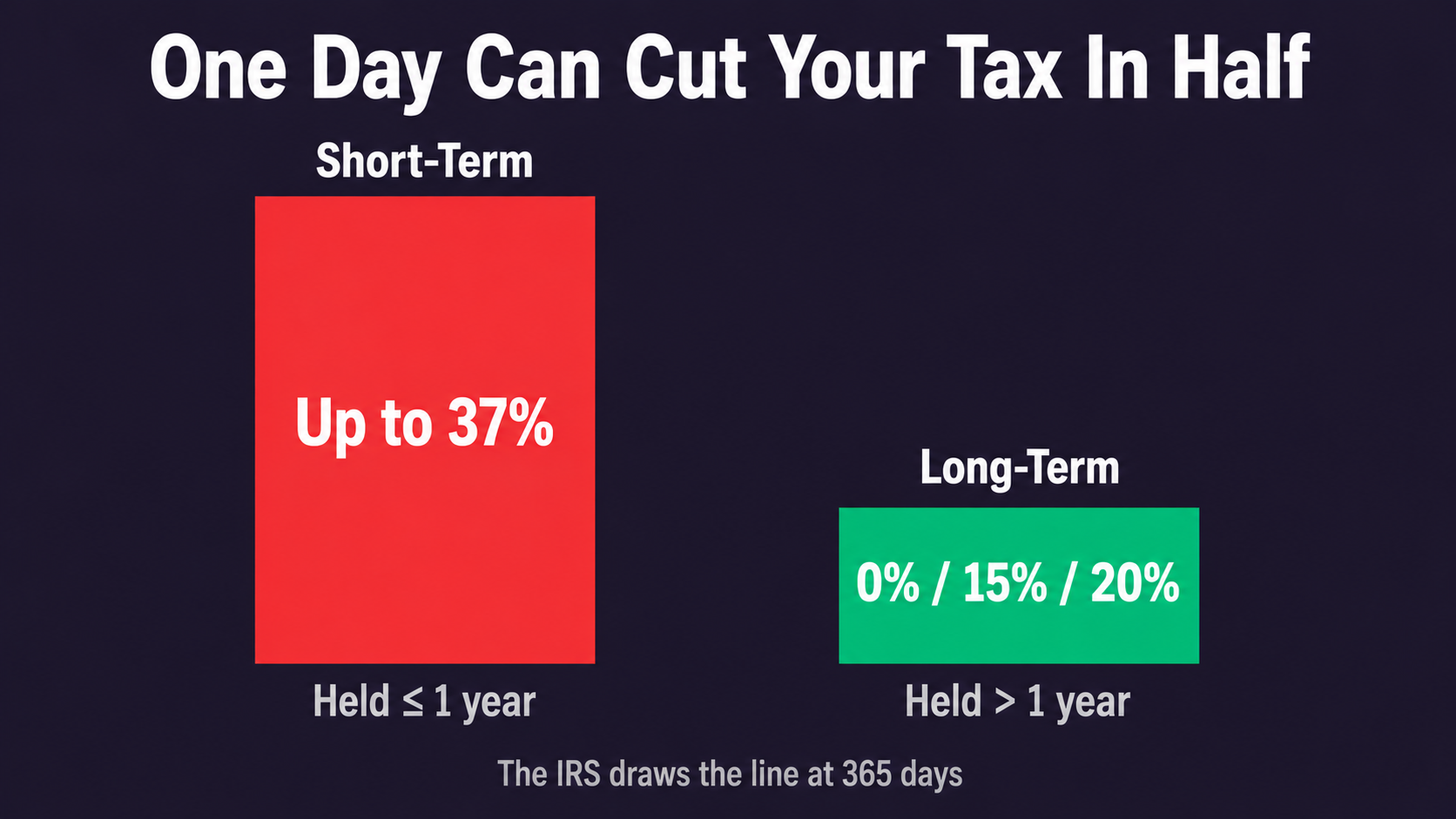
The IRS draws a line at one year:
- Short-term capital gain — held one year or less. Taxed at your ordinary income rate (the same rate as your paycheck — up to 37%);
- Long-term capital gain — held more than one year. Taxed at a special, much lower rate — 0%, 15%, or 20%.
That's it. One year and one day. The difference between paying full ordinary income tax and paying a fraction of it.
When Selling Early Still Makes Sense
Holding for more than a year is usually the right call. But not always:
- If the stock is tanking and you've already lost confidence;
- If a better opportunity is on the table;
- If selling early harvests a loss (we'll cover this in Chapter 6).
The point isn't to obsess over the calendar. It's to know what the calendar costs you — so the decision is conscious, not accidental.
1. Mark bought a stock for $5,000 and sold it 10 months later for $15,000. He's in the 32% federal bracket. How much federal tax does he owe on this gain? Enter the dollar amount with no symbols.
2. Lisa bought shares on March 15, 2025. What is the earliest date she can sell them and qualify for long-term capital gains treatment?
Thanks for your feedback!
Ask AI

Ask AI

Ask anything or try one of the suggested questions to begin our chat
