The W-4 And Withholding Optimization
Swipe to show menu
You've made it. Sections 1 and 2 taught you how the system works and how to legally pay less. Section 3 is where you become the person friends call in March.
This section is practical. No big philosophical concepts — just the stuff you actually need to do:
- How to set up your paycheck so the IRS doesn't owe you (or vice versa);
- What to do if you have a side hustle or freelance income;
- When to move states for taxes — and when it's a trap;
- TurboTax vs. CPA vs. EA vs. CFP — when each is worth it;
- What an audit actually looks like (spoiler: way less scary than you think);
- A year-end checklist that ties this whole course together.
Let's start with something that sounds great but is actually losing you money.
Why A Big Tax Refund Is Actually A Bad Thing
Every spring, you'll see people post a screenshot: "Got my $6,000 refund! Time to celebrate!"
It feels like winning. It's not.
A tax refund is your own money — handed back to you by the IRS after they held onto it for an entire year. Interest-free. You loaned the government $6,000 with no return.
If that same $6,000 had been spread across the year — about $500 extra per paycheck — you could have:
- Paid down credit card debt at 22% interest;
- Maxed out an HSA or Roth IRA;
- Built an emergency fund;
- Earned ~5% in a high-yield savings account ($150+ for free).
What The W-4 Actually Does
When you start a job, you fill out a Form W-4. This tells your employer how much federal tax to withhold from each paycheck. Get it right → your withholding roughly matches your real tax bill, and you owe (or are owed) almost nothing in April.
Most people fill it out once on day one and never touch it again. That's the mistake.
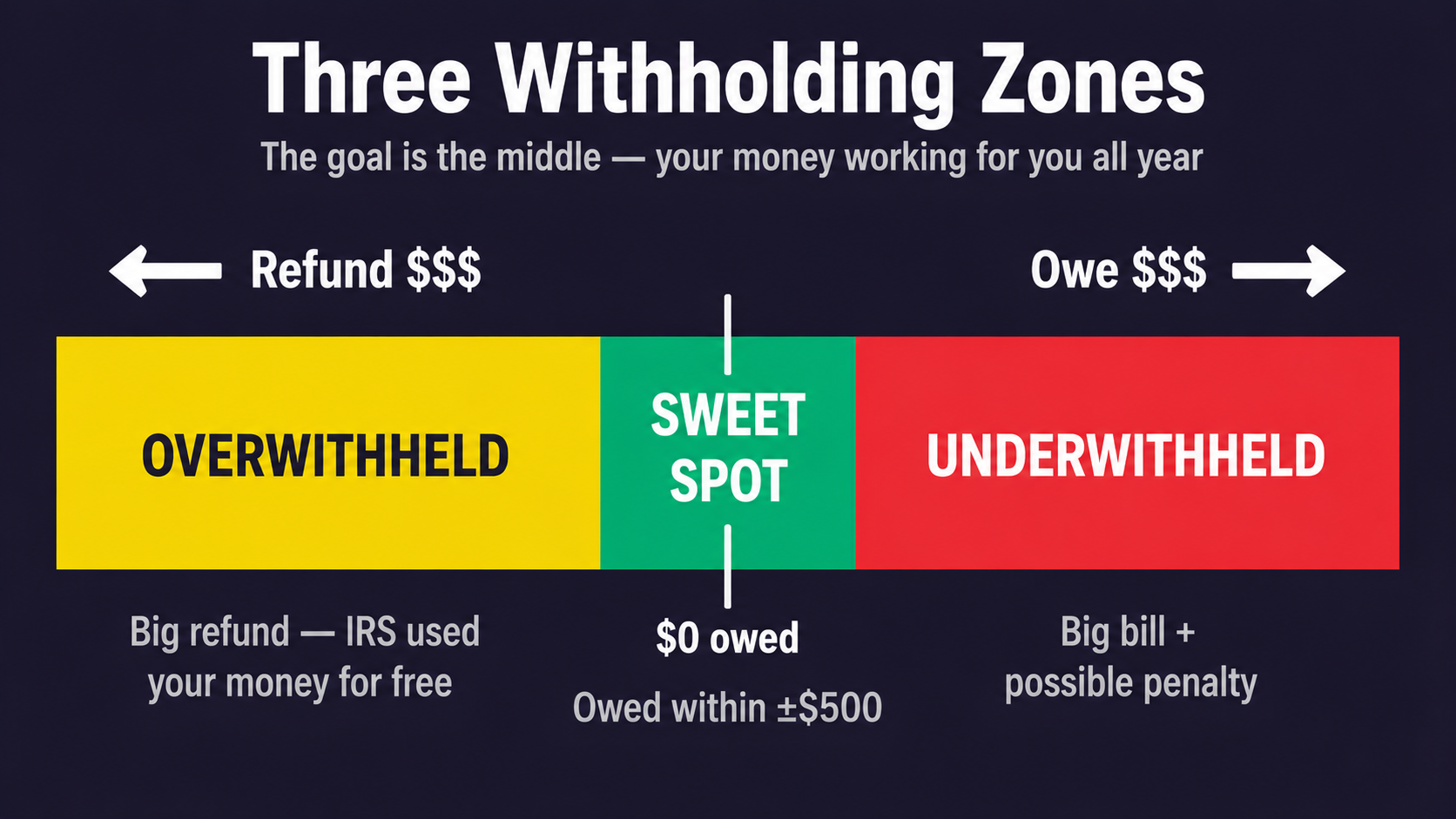
Three Withholding Zones
- Big refund zone — you withheld way more than you owed. The IRS gives it back. Feels nice. Costs you opportunity;
- Sweet spot — within ±$500 either way. You used your money all year and didn't get a surprise bill;
- Big bill zone — you withheld way too little. Owe thousands at filing. May owe an underpayment penalty on top.
When To Update Your W-4
File a new one any time your life changes meaningfully:
- New job, second job, or side income;
- Got married or divorced;
- Had a kid or kid aged out of CTC eligibility;
- Spouse started or stopped working;
- Bought a home (mortgage interest changes itemizing math);
- Big year for capital gains or freelance income.
The IRS has a Tax Withholding Estimator on its website that takes 10 minutes and gives you exactly what to put on the form. Run it every January and again whenever life changes.

Withholding from your paycheck counts as paid evenly across the year — even if it all happened in your last December check. So if you discover in November that you've underpaid, you can crank up withholding for the final two months and retroactively avoid the underpayment penalty as if you'd paid it from January. Estimated tax payments don't get this treatment.
Thanks for your feedback!
Ask AI

Ask AI

Ask anything or try one of the suggested questions to begin our chat
The W-4 And Withholding Optimization
You've made it. Sections 1 and 2 taught you how the system works and how to legally pay less. Section 3 is where you become the person friends call in March.
This section is practical. No big philosophical concepts — just the stuff you actually need to do:
- How to set up your paycheck so the IRS doesn't owe you (or vice versa);
- What to do if you have a side hustle or freelance income;
- When to move states for taxes — and when it's a trap;
- TurboTax vs. CPA vs. EA vs. CFP — when each is worth it;
- What an audit actually looks like (spoiler: way less scary than you think);
- A year-end checklist that ties this whole course together.
Let's start with something that sounds great but is actually losing you money.
Why A Big Tax Refund Is Actually A Bad Thing
Every spring, you'll see people post a screenshot: "Got my $6,000 refund! Time to celebrate!"
It feels like winning. It's not.
A tax refund is your own money — handed back to you by the IRS after they held onto it for an entire year. Interest-free. You loaned the government $6,000 with no return.
If that same $6,000 had been spread across the year — about $500 extra per paycheck — you could have:
- Paid down credit card debt at 22% interest;
- Maxed out an HSA or Roth IRA;
- Built an emergency fund;
- Earned ~5% in a high-yield savings account ($150+ for free).
What The W-4 Actually Does
When you start a job, you fill out a Form W-4. This tells your employer how much federal tax to withhold from each paycheck. Get it right → your withholding roughly matches your real tax bill, and you owe (or are owed) almost nothing in April.
Most people fill it out once on day one and never touch it again. That's the mistake.
Three Withholding Zones
- Big refund zone — you withheld way more than you owed. The IRS gives it back. Feels nice. Costs you opportunity;
- Sweet spot — within ±$500 either way. You used your money all year and didn't get a surprise bill;
- Big bill zone — you withheld way too little. Owe thousands at filing. May owe an underpayment penalty on top.
When To Update Your W-4
File a new one any time your life changes meaningfully:
- New job, second job, or side income;
- Got married or divorced;
- Had a kid or kid aged out of CTC eligibility;
- Spouse started or stopped working;
- Bought a home (mortgage interest changes itemizing math);
- Big year for capital gains or freelance income.
The IRS has a Tax Withholding Estimator on its website that takes 10 minutes and gives you exactly what to put on the form. Run it every January and again whenever life changes.
Withholding from your paycheck counts as paid evenly across the year — even if it all happened in your last December check. So if you discover in November that you've underpaid, you can crank up withholding for the final two months and retroactively avoid the underpayment penalty as if you'd paid it from January. Estimated tax payments don't get this treatment.
Thanks for your feedback!
