Quarterly Estimated Taxes
Swipe to show menu
The IRS Doesn't Wait Until April
If you have a W-2 job, your employer handles taxes for you. They withhold each paycheck. Easy.
The moment you earn money outside that system — freelance gigs, a side hustle, Etsy sales, Uber, rental income, big capital gains — the IRS expects you to pay your taxes throughout the year. Not all at once in April.
This is called quarterly estimated taxes, and skipping it costs penalties.
Who Actually Has To Pay
You generally must make estimated payments if both are true:
- You expect to owe $1,000 or more in federal tax after withholding;
- Your withholding (if any) won't cover the safe harbor amounts below.
Side hustlers earning a few hundred dollars a year? Usually fine. Earning $20,000 from freelancing with no withholding? Yes, you owe quarterlies.
The Four Due Dates
Quarterly taxes don't actually line up with calendar quarters (because the IRS):
- Q1 → April 15;
- Q2 → June 15;
- Q3 → September 15;
- Q4 → January 15 of the following year.
The Safe Harbor — Your Penalty Shield
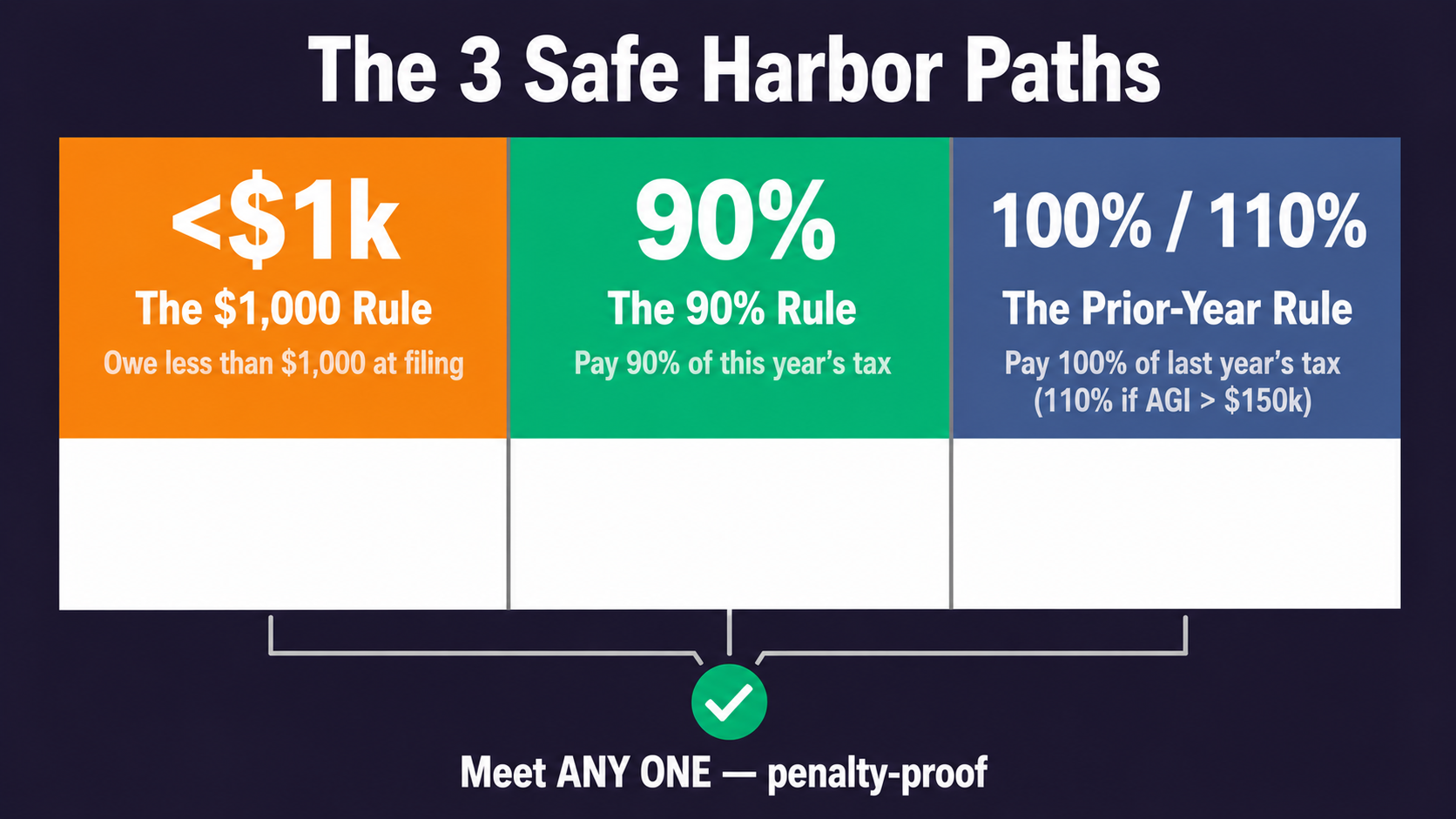
You don't need to predict your taxes perfectly. The IRS gives you three safe harbor paths — meet any one of them, and they can't charge an underpayment penalty:
- The $1,000 rule — owe less than $1,000 at filing after withholding and credits;
- The 90% rule — pay at least 90% of this year's total tax through the year;
- The 100%/110% rule — pay at least 100% of last year's total tax (110% if your prior-year AGI was above $150,000, or $75,000 if married filing separately).
The third one is gold for most people. You already know last year's tax bill exactly. Just divide it by four, pay that each quarter, and you're penalty-proof — even if you earn way more this year.
The Pro Move: Just Crank Up Your W-4
Here's a tax-pro trick almost nobody talks about.
If you have both a W-2 job and side income, you don't need to mess with quarterly payments at all. Just increase the withholding on your W-2 to cover your side hustle taxes too.
Why this is so powerful: as we covered last chapter, withholding is treated as paid evenly across the year, no matter when it actually happened. So you can be wildly behind in November, increase your withholding for one or two paychecks to catch up, and the IRS treats you as if you'd been paying perfectly from January 1.
Estimated payments don't get this magic. They're tracked by the date you sent them. Late = penalty.
1. Jess paid $12,000 in total federal tax last year. Her prior-year AGI was $90,000 (below the $150k threshold). To meet the prior-year safe harbor for this year, what's the minimum total amount she must pay across all four quarterly payments? Enter the dollar amount with no symbols.
2. Tom freelances on the side of his W-2 job. In November, he realizes he's underpaid his taxes by $4,000 and is heading for a penalty. What's the cleanest fix?
Thanks for your feedback!
Ask AI

Ask AI

Ask anything or try one of the suggested questions to begin our chat
Quarterly Estimated Taxes
The IRS Doesn't Wait Until April
If you have a W-2 job, your employer handles taxes for you. They withhold each paycheck. Easy.
The moment you earn money outside that system — freelance gigs, a side hustle, Etsy sales, Uber, rental income, big capital gains — the IRS expects you to pay your taxes throughout the year. Not all at once in April.
This is called quarterly estimated taxes, and skipping it costs penalties.
Who Actually Has To Pay
You generally must make estimated payments if both are true:
- You expect to owe $1,000 or more in federal tax after withholding;
- Your withholding (if any) won't cover the safe harbor amounts below.
Side hustlers earning a few hundred dollars a year? Usually fine. Earning $20,000 from freelancing with no withholding? Yes, you owe quarterlies.
The Four Due Dates
Quarterly taxes don't actually line up with calendar quarters (because the IRS):
- Q1 → April 15;
- Q2 → June 15;
- Q3 → September 15;
- Q4 → January 15 of the following year.
The Safe Harbor — Your Penalty Shield
You don't need to predict your taxes perfectly. The IRS gives you three safe harbor paths — meet any one of them, and they can't charge an underpayment penalty:
- The $1,000 rule — owe less than $1,000 at filing after withholding and credits;
- The 90% rule — pay at least 90% of this year's total tax through the year;
- The 100%/110% rule — pay at least 100% of last year's total tax (110% if your prior-year AGI was above $150,000, or $75,000 if married filing separately).
The third one is gold for most people. You already know last year's tax bill exactly. Just divide it by four, pay that each quarter, and you're penalty-proof — even if you earn way more this year.
The Pro Move: Just Crank Up Your W-4
Here's a tax-pro trick almost nobody talks about.
If you have both a W-2 job and side income, you don't need to mess with quarterly payments at all. Just increase the withholding on your W-2 to cover your side hustle taxes too.
Why this is so powerful: as we covered last chapter, withholding is treated as paid evenly across the year, no matter when it actually happened. So you can be wildly behind in November, increase your withholding for one or two paychecks to catch up, and the IRS treats you as if you'd been paying perfectly from January 1.
Estimated payments don't get this magic. They're tracked by the date you sent them. Late = penalty.
Thanks for your feedback!
