Prompts For Brainstorming And Idea Generation
Swipe to show menu
AI is a genuinely useful thinking partner for generative work — but only if you prompt it correctly. The default response to a vague brainstorming request is a list of obvious, generic ideas that you could have thought of yourself in two minutes.
Getting ideas that are actually useful requires prompts that push the model beyond the first layer of obvious associations — and techniques that use AI as a thinking partner rather than just an idea dispenser.
Why Default Brainstorming Prompts Fail
When you type give me ideas for [topic], the model produces
what is statistically most common in its training data —
which is, almost by definition, what everyone else has already
thought of.
The ideas that feel obvious to you will feel obvious to AI for the same reason: they're the ones most frequently associated with the topic in text.
To get past this, your prompt needs to do one or more of the following:
- Constrain the idea space in an unusual way — forcing the model to look at the problem from a different angle;
- Specify the type of idea you're looking for — conventional, unconventional, contrarian, or high-risk;
- Add friction deliberately — ask for ideas that are hard to execute, ideas that would be rejected by most people, or ideas that solve a related but different problem;
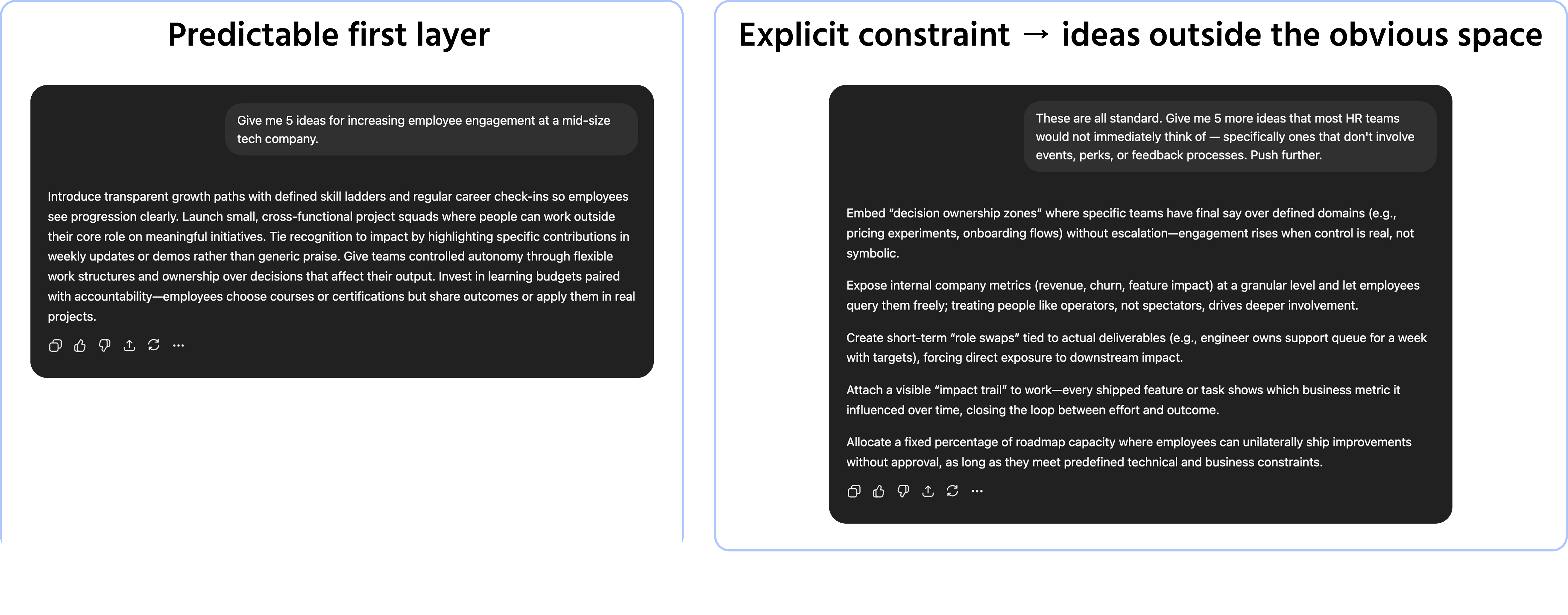
- Use iteration — ask for a first batch, then push further by asking for alternatives to the ones that feel too safe.
Core Brainstorming Prompt Templates
For generating a range of ideas:

Generate [number] ideas for [topic or problem]. Context: [who this is for, what constraints apply, what has already been tried or rejected]
Include at least:
- [number] conventional, low-risk ideas;
- [number] unconventional ideas that most teams wouldn't immediately consider;
- [number] ideas that would require significant resources or change to execute.
Format: idea name + one sentence description.
For pushing beyond the obvious:
You just gave me a list of ideas for [topic].
Now give me [number] more — but this time, explicitly avoid anything that appeared in your first list or that would be the first thing anyone would suggest. Push further.
For structured divergent thinking:
Generate ideas for [problem] from the following three perspectives:
- What would a competitor do that we haven't tried?
- What would we do if budget were not a constraint?
- What would we do if we had to solve this in 48 hours?
Give [number] ideas per perspective.
Using AI As A Thinking Partner, Not Just An Idea Generator
The most productive brainstorming sessions with AI aren't one-shot requests — they're dialogues. You can use the model to push your own thinking in ways that go beyond generating a list:
Challenge your assumptions:
Here is our current approach to [problem]. What are the three biggest assumptions baked into this approach? What would happen if each one turned out to be wrong?
Generate objections:
Here is an idea I'm considering: [describe idea]. Act as a skeptic who wants to find reasons this won't work. Give me the five strongest objections to this idea.
Force combinations:
Here are two unrelated ideas: [idea A] and [idea B]. Generate three ways to combine elements of both into a single solution for [problem].
Reframe the problem:
I've been trying to solve [problem] by [current approach]. What if I'm solving the wrong problem? What related or underlying problem might actually be worth solving instead?
Practice: From Generic To Genuinely Useful
Pick any problem or creative challenge you're currently working on. Run through this sequence:
- Start with a standard brainstorm prompt —
give me [number] ideas for [topic]— and collect the output; - Identify the two or three ideas that feel most generic or predictable;
- Send a follow-up that explicitly excludes that category of thinking and asks for a different angle;
- From the second round, pick the most interesting idea and ask AI to generate three objections to it.
After this sequence, you'll have a set of ideas that have been pushed further, stress-tested, and refined — in under ten minutes.
1. Why do default brainstorming prompts often produce obvious ideas, and what can you do in your prompts to get more original responses?
2. Which of the following are effective ways to use AI as a thinking partner during brainstorming, according to the chapter?
Thanks for your feedback!
Ask AI

Ask AI

Ask anything or try one of the suggested questions to begin our chat
