Combining Techniques — When One Isn't Enough
Swipe to show menu
Zero-shot, few-shot, and chain-of-thought are not mutually exclusive. The most effective prompts for complex professional tasks often combine two or more of these techniques in a single input — using each one to address a different dimension of what you need.
Knowing how to layer techniques is what separates a functional prompt from a highly effective one for high-stakes or recurring tasks.
How The Techniques Complement Each Other
Each technique solves a different problem:
- Zero-shot tells the model what to do;
- Role prompting tells the model how to approach it;
- Few-shot shows the model what the output should look like;
- Chain-of-thought ensures the model reasons carefully before producing the output.
When combined, they cover different failure modes simultaneously. A prompt with a clear task (zero-shot) + a role + an example of the desired format (few-shot) + a reasoning instruction (chain-of-thought) is a highly specified brief — one that leaves very little room for the model to go off in the wrong direction.
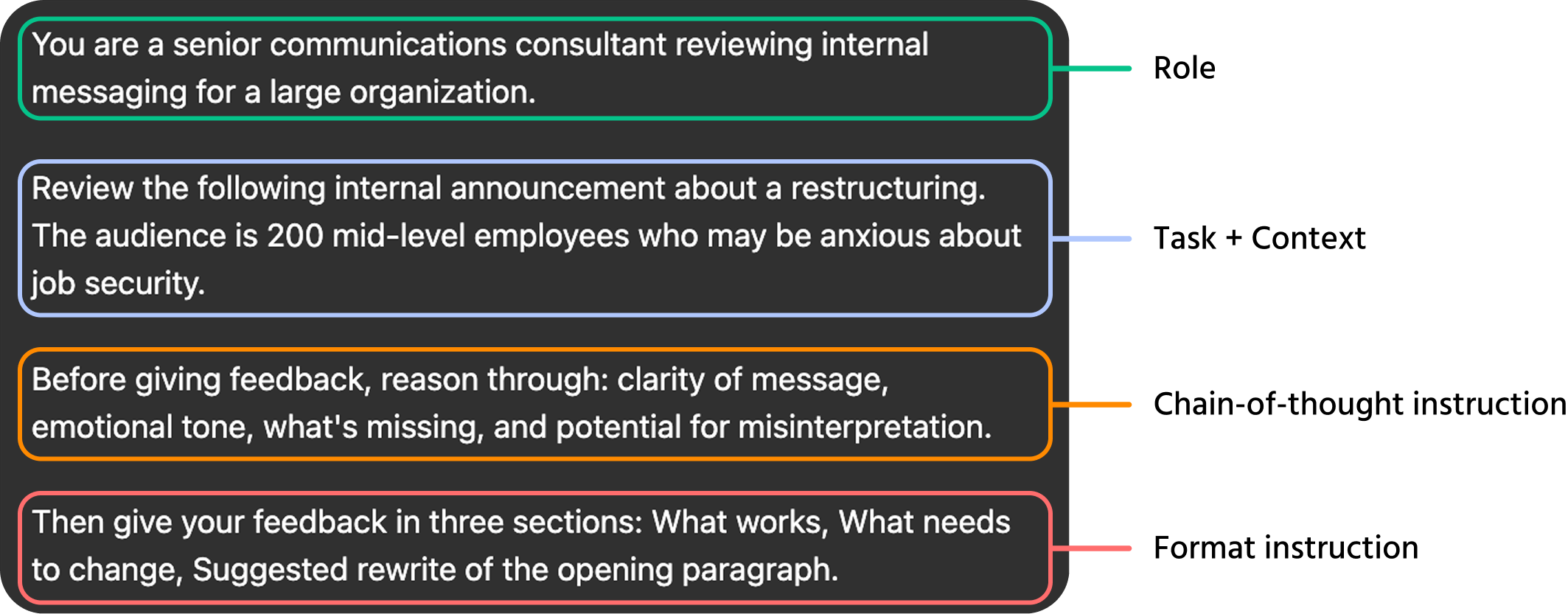
A Layered Prompt: Step By Step
Here's how you can build a combined prompt from scratch for a realistic task — evaluating a draft proposal:
Step 1 — Start with the task:

Review this project proposal and identify its weaknesses.
Step 2 — Add a role:
Act as a skeptical senior stakeholder who has seen many proposals fail due to unclear scope and unrealistic timelines.
Step 3 — Add chain-of-thought:
Before listing weaknesses, reason through each section: objectives, scope, timeline, and budget.
Step 4 — Add format:
Present your findings as a short table: Section / Issue / Suggested Fix. Maximum 6 rows.
The combined prompt:
Act as a skeptical senior stakeholder who has seen many proposals fail due to unclear scope and unrealistic timelines. Review the following project proposal. Before listing weaknesses, reason through each section — objectives, scope, timeline, and budget. Then present your findings as a short table: Section / Issue / Suggested Fix. Maximum 6 rows.
When Not To Combine Techniques
More structure is not always better. Combining techniques adds value when the task genuinely requires it — and adds friction when it doesn't.
You don't need a layered prompt when:
- The task is simple and the expected output is obvious;
- Speed matters more than precision on a low-stakes task;
- A well-written zero-shot prompt already produces what you need.
The rule: add a technique only when it solves a specific problem. If you can't articulate what problem the technique is solving, leave it out.
1. How do zero-shot, few-shot, role prompting, and chain-of-thought techniques complement each other when combined in a single prompt?
2. According to the chapter, in which situations is it NOT appropriate to combine multiple prompt engineering techniques
Thanks for your feedback!
Ask AI

Ask AI

Ask anything or try one of the suggested questions to begin our chat
