Chain-Of-Thought — Making AI Reason Step By Step
Swipe to show menu
For straightforward tasks — drafting a message, summarizing a document, generating a list — the model produces a response quickly and it's usually adequate. But for tasks that require analysis, structured reasoning, or decisions with multiple considerations, a quick response is often a shallow one.

Chain-of-thought prompting is the technique for changing this. By explicitly asking the model to reason through a problem step by step before delivering its answer, you get responses that are more structured, more considered, and more useful for complex professional tasks.
What Chain-Of-Thought Looks Like In Practice
You don't need special syntax. You need a phrase that signals to the model that you want the reasoning, not just the conclusion:
Think through this step by step before giving your answer;Before responding, identify the key considerations involved;Walk me through your reasoning, then give your recommendation;Break this problem down before drawing any conclusions.
Without chain-of-thought:
Should we launch this feature for all users or run a limited beta first?
The model will jump to a recommendation — possibly a reasonable one, but arrived at without visible reasoning.
With chain-of-thought:
Should we launch this feature for all users or run a limited beta first? Before answering, reason through the key trade-offs involved — risk, speed of learning, support load, and rollout reversibility. Then give your recommendation.
The model will surface the trade-offs explicitly before landing on a recommendation — which gives you something to react to, push back on, or use as the basis for a team discussion.
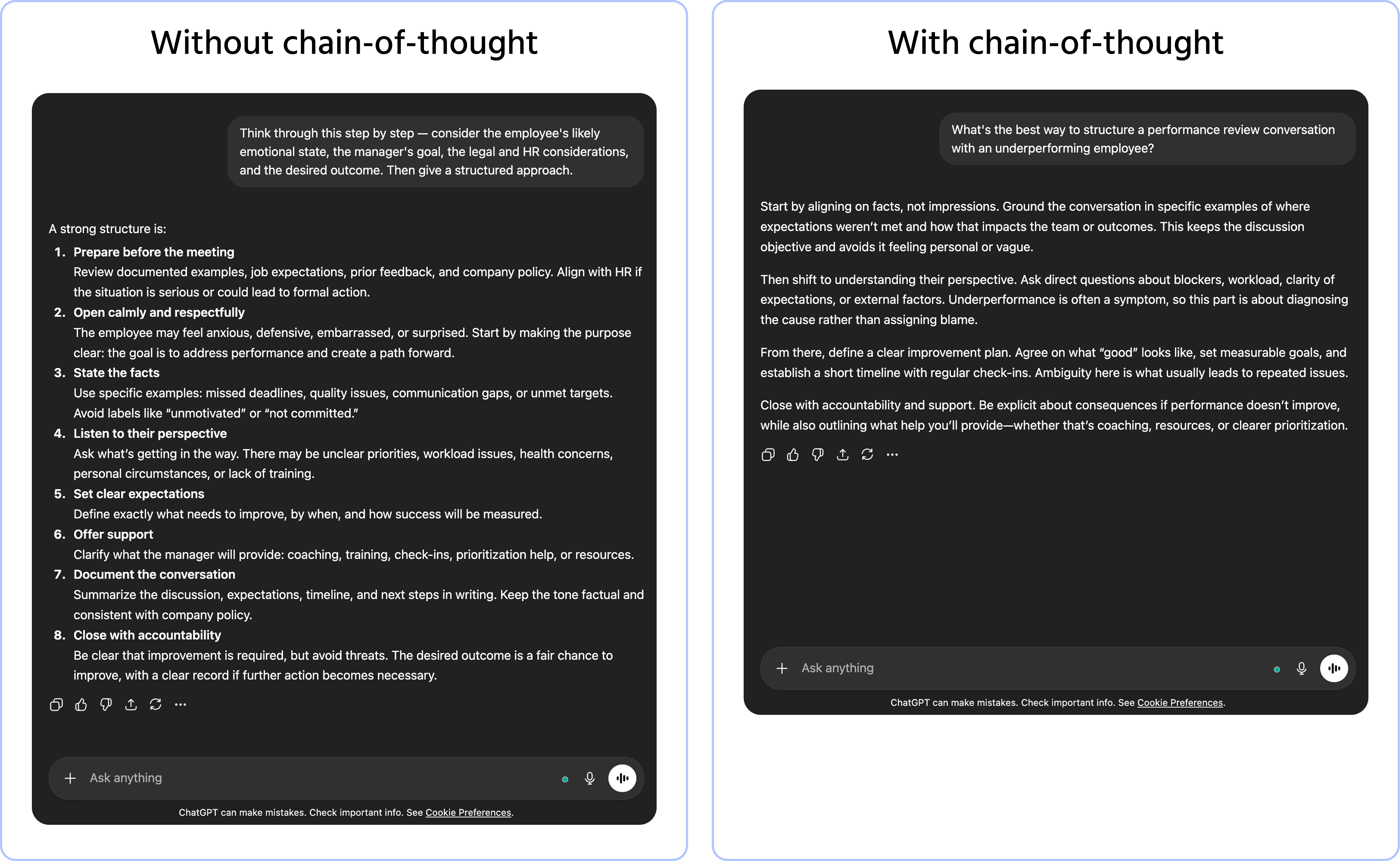
Where Chain-Of-Thought Adds The Most Value
This technique is worth using when:
- You're asking the model to make a recommendation or decision with multiple competing factors;
- You need the model to analyze something critically — a proposal, a plan, a piece of writing — rather than just describe it;
- You're using AI to prepare for a conversation or meeting and want to think through the angles in advance;
- The task involves weighing trade-offs where the conclusion depends on how the factors are balanced;
- You want output you can present to others — showing reasoning makes the output more credible and easier to discuss.
A Useful Variation: Ask For The Reasoning Separately
Sometimes you want the final answer in a clean format, but you also want to see the reasoning that led to it. You can ask for both explicitly:
Analyze the following proposal for potential risks. First, reason through each section and identify concerns. Then give me a summary of the top three risks in bullet points.
This gives you the structured output you need for a document or presentation, plus the full reasoning you can review — or share with stakeholders who want to understand the thinking behind the conclusions.
Thanks for your feedback!
Ask AI

Ask AI

Ask anything or try one of the suggested questions to begin our chat
