Iterating Your Prompt
Swipe to show menu
Everything in this section so far has been about writing a better first prompt. This chapter is about what to do when the first response isn't quite right — which is most of the time, even for experienced users.
Iteration is not a sign that you wrote a bad prompt. It is the normal, expected workflow when using AI effectively. The professionals who get the most value from AI are not the ones who get perfect results on the first try — they're the ones who know how to guide the conversation efficiently toward what they actually need.
Why Iteration Is Faster Than Perfecting The First Prompt
There's a temptation to spend a lot of time crafting the perfect prompt before sending it. In practice, the better approach is:
- Send a reasonably good prompt;
- Read the response and identify specifically what's wrong;
- Send a targeted follow-up that fixes that specific issue;
- Repeat until the output is usable.
This is faster than trying to anticipate every requirement in advance — because you often don't know exactly what you need until you see what you don't need.
A Framework For Diagnosing What Went Wrong
When a response misses the mark, the fix depends on what specifically failed. Use this diagnostic before writing your follow-up:
- Wrong content — the AI didn't understand the task or went in the wrong direction. Restate the task more explicitly or add missing context;
- Wrong format — the structure doesn't match what you need. Specify the exact format you want in the follow-up;
- Wrong tone — too formal, too casual, too vague, too long.
Name the problem and give a direction:
make this more directorreduce to under 80 words; - Wrong level of detail — too surface-level or too deep. Ask it to expand a specific section or cut everything except the key point;
- Fundamentally wrong direction — don't iterate on a bad foundation. Start a new prompt with the lessons from the failed attempt built in.
Useful Follow-Up Phrases By Problem Type
For length:
Cut this to under [X] words;Expand the second point into a full paragraph;Give me a one-sentence version of this.
For tone:
Make this more formal / more conversational;Remove the corporate language — write like a human;Make it more direct — fewer qualifiers.
For structure:
Reorganize this so the most important point comes first;Turn this into bullet points;Add a short summary at the top.
For content:
Keep the second paragraph, rewrite everything else;Add a specific example to support the third point;Remove anything about [topic] — it's not relevant here.
For alternatives:
Give me three different versions of the opening line;Try a completely different approach to this;What would this look like if it led with the problem instead of the solution?
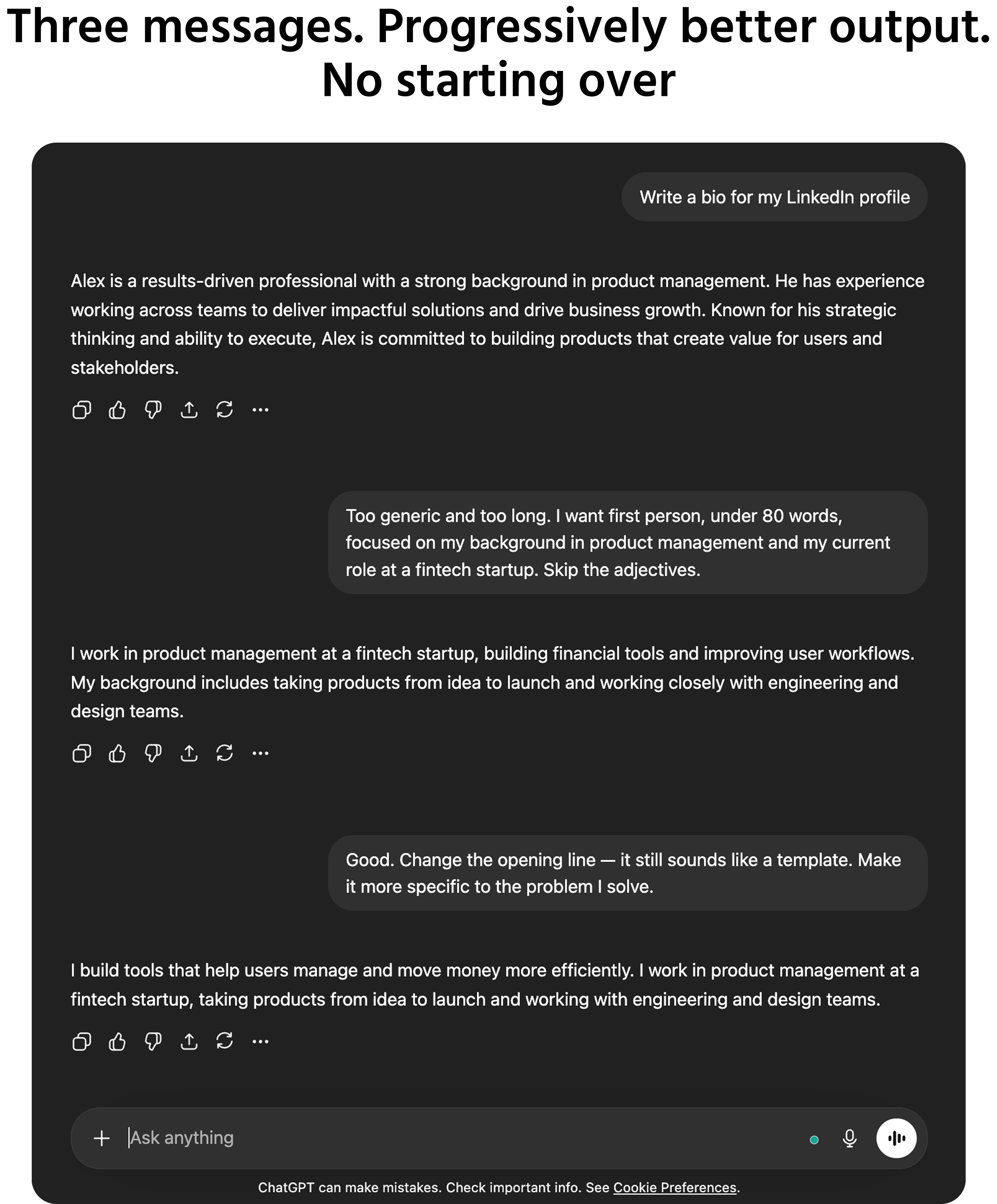
Practice: Three Iterations On One Prompt
Choose any task you'd normally do at work — an email, a summary, a short document. Write a reasonable first prompt using the four-component framework from Chapter 1.3. Send it.
Then:
- Identify the single most important thing that's wrong with the response;
- Send a targeted follow-up that addresses only that issue;
- Read the new response and repeat — one more targeted fix;
- After three exchanges, compare the third response to the first.
The goal is to build the habit of reading AI output critically and responding with precision — not rewriting the entire prompt from scratch every time.
In Section 2, you'll move from the fundamentals to the specific techniques that give you more control from the very first message.
1. Why is iterating your prompt typically faster and more effective than trying to perfect it before sending?
2. Which of the following issues are included in the framework for diagnosing what went wrong in an AI response, as described in this chapter?
Thanks for your feedback!
Ask AI

Ask AI

Ask anything or try one of the suggested questions to begin our chat
