Understanding Memory Layout of Structs
Swipe to show menu
Memory structures in the C programming language play a key role in understanding how data is stored and accessed in memory. When a structure is defined in C, the compiler determines how to place its members in memory based on alignment and padding rules.
Here's an overview of how basic memory allocation for structures works in C:

main.c
123456789101112131415#include <stdio.h> // simple struct struct Test { char x; // 1 byte int y; // 4 bytes }; int main() { struct Test example; printf("Size of struct Test: %zu\n", sizeof(example)); printf("Address of example.x (char): %p\n", &example.x); printf("Address of example.y (int): %p\n", &example.y); return 0; }
As expected, such a structure should occupy 5 bytes: 1 byte for char x, 4 bytes for int y, but this will be 8 bytes.
Why is the size of the structure much larger than we expected?
This occurs because the compiler can insert padding between members to ensure that each member begins at an address that is a multiple of its size.
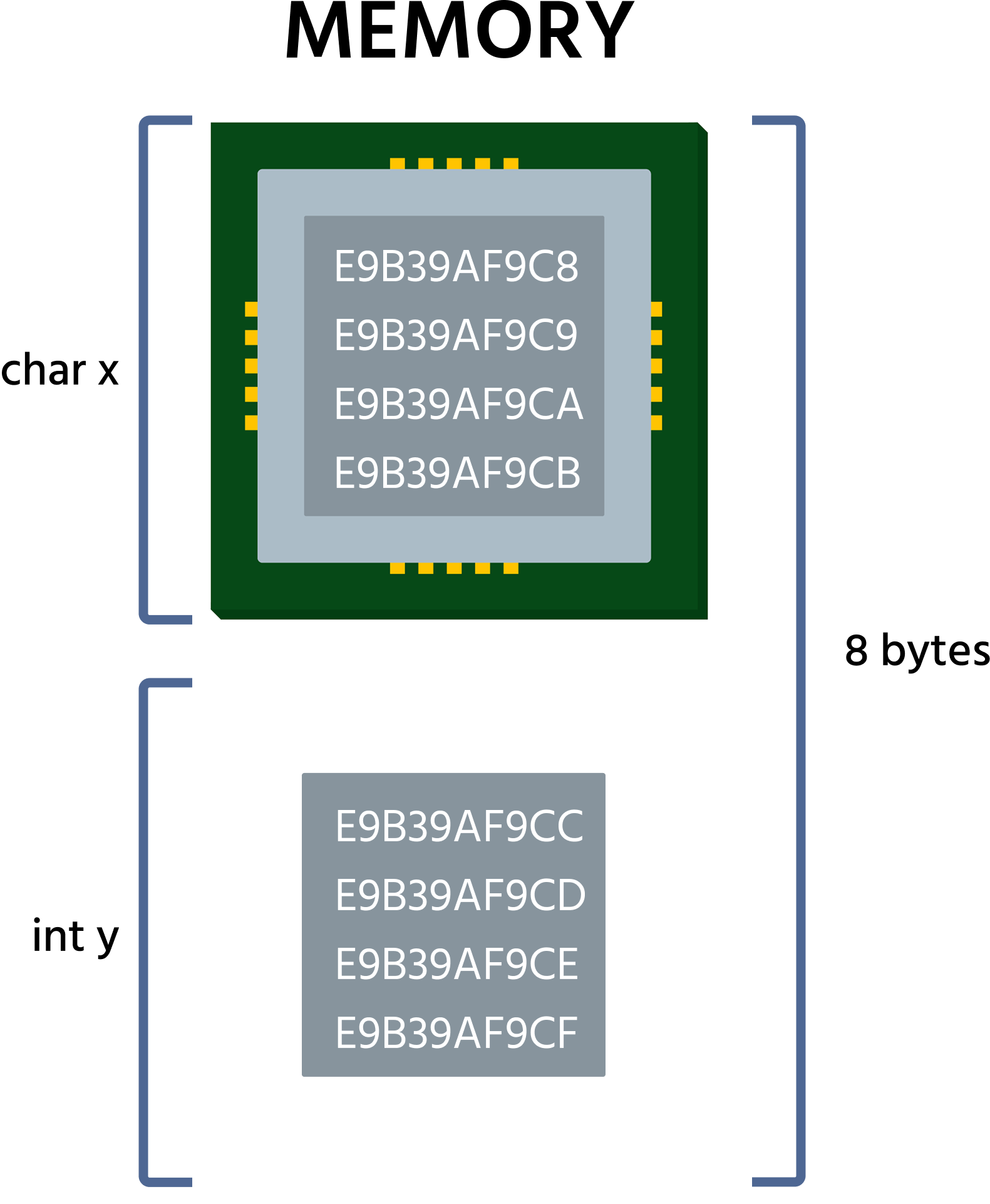
In the image, you can see that the first part of memory (lighter section) belongs to the variable char x, which takes up just one byte. After that, there are three empty bytes — this is padding, automatically added by the compiler to ensure that the next element starts at the correct address. Following the padding, the variable int y is stored, which occupies four bytes.
As a result, the structure takes up a total of eight bytes: one for char, three for alignment, and four for int.
This layout exists to help the processor access data more efficiently. Without alignment, accessing structure members would take more time, and the program would run slower.
Thanks for your feedback!
Ask AI

Ask AI

Ask anything or try one of the suggested questions to begin our chat
Understanding Memory Layout of Structs
Memory structures in the C programming language play a key role in understanding how data is stored and accessed in memory. When a structure is defined in C, the compiler determines how to place its members in memory based on alignment and padding rules.
Here's an overview of how basic memory allocation for structures works in C:
main.c
123456789101112131415#include <stdio.h> // simple struct struct Test { char x; // 1 byte int y; // 4 bytes }; int main() { struct Test example; printf("Size of struct Test: %zu\n", sizeof(example)); printf("Address of example.x (char): %p\n", &example.x); printf("Address of example.y (int): %p\n", &example.y); return 0; }
As expected, such a structure should occupy 5 bytes: 1 byte for char x, 4 bytes for int y, but this will be 8 bytes.
Why is the size of the structure much larger than we expected?
This occurs because the compiler can insert padding between members to ensure that each member begins at an address that is a multiple of its size.
In the image, you can see that the first part of memory (lighter section) belongs to the variable char x, which takes up just one byte. After that, there are three empty bytes — this is padding, automatically added by the compiler to ensure that the next element starts at the correct address. Following the padding, the variable int y is stored, which occupies four bytes.
As a result, the structure takes up a total of eight bytes: one for char, three for alignment, and four for int.
This layout exists to help the processor access data more efficiently. Without alignment, accessing structure members would take more time, and the program would run slower.
Thanks for your feedback!
