Notice: This page requires JavaScript to function properly.
Please enable JavaScript in your browser settings or update your browser.
ディープラーニング オンラインコース(証明書付き)
ディープラーニング

ディープラーニング講座

目標に合わせてコースを選択可能。基礎からディープラーニングの高度なスキルまで対応。
4.4
評価は以下に基づく 216 レビュー.
1,919 学習者
すでに登録済み
身につけたスキル:
AI Ethics Fundamentals AI Transparency AwarenessAccountability in AI Activation Function AnalysisAdversarial Training ConceptsAlgorithm Evaluation and ComparisonAnalyzing GAN Training ChallengesAnomaly detection evaluation Applying RNNs to NLP tasks (sentiment analysis) Approximation TheoryAttention Mechanisms TheoryAutoregressive GenerationCatastrophic Forgetting AnalysisChain-of-ThoughtプロンプティングClassification Loss AnalysisClassification metrics (Accuracy, Precision, Recall, F1, ROC–AUC) Clustering evaluation (Silhouette, Davies–Bouldin, Calinski–Harabasz) Compression Trade-off ReasoningContinual Learning TheoryConvolutional Neural NetworksCritical Analysis of NTK LimitationsCross-validation techniquesData Leakage PreventionData PreprocessingData Privacy Concepts Diffusion Model TheoryDiffusion Models Dimensionality reduction evaluation Distributional Analysis of Neural NetworksDocument Chunking and IndexingDrift Detection FundamentalsEnd-to-end model development and evaluationEntropy and CompressionEntropy and Rate–Distortion AnalysisEthical AI PrinciplesEthical Decision-Making Evaluation Metrics for Generative AIExplainable AI FundamentalsExpressivity of Neural NetworksFailure Analysis in RAGFailure Mode DiagnosisFairness and Bias Analysis Feature ScalingFew-ShotプロンプティングFine-tuning Pre-trained ModelsGAN FundamentalsGANs Gaussian Process CorrespondenceGenerative AI Geometric InterpretabilityImage Processing with OpenCVImplementing recurrent networks in PyTorchImplicit Bias in Machine LearningImplicit Regularization in Deep NetworksIn-Context Learning TheoryInductive BiasInductive Bias ReasoningInfinite-Width Neural Network TheoryInformation Bottleneck and MDLInformation Theory BasicsInformation Theory in NLPInformation-Theoretic LossesIsolation Forest ImplementationKernel Regression DynamicsKnowledge Distillation TheoryKnowledge Integration in LLMsKolmogorov–Smirnov TestLLM Failure ModesLarge-Width Limit TheoryLatent Space GeometryLatent Space ReasoningLayer-wise Representation AnalysisLimits of LLM GeneralizationLinear Algebra for Deep LearningLocal Outlier Factor AnalysisLoss Function Selection and ComparisonLow-Rank Matrix IntuitionManifold IntuitionMarkov Chains in Generative ModelingMathematical Formulation of GANsMathematical Foundations of AttentionMathematical Foundations of Loss FunctionsMaximum-Margin SolutionsMean Field Theory in Neural NetworksMean-CenteringMinimum-Norm SolutionsModel Scaling ConceptsModel Training and EvaluationModel-Based Drift DetectionMonitoring Model DegradationMulti-Head Attention ConceptsNatural Language HandlingNatural Language ProcessingNeural Network Architecture AnalysisNeural Network Compression TheoryNeural Network TheoryNeural NetworksNeural Tangent Kernel FormalismNormalization (L1, L2, Max)ODE Formulations in Generative ModelsObject Detection ApproachesOne-Class SVM for Novelty DetectionOptimization Constraints in Fine-TuningOptimization in Neural NetworksOutlier Detection FundamentalsPEFT Deployment ReasoningPEFT TheoryParameter Space GeometryPopulation Stability IndexPositional Encoding ConceptsPreprocessing PipelinesProcessing time series and sequential dataPrompt-Based GeneralizationPyTorch BasicsPython Data StructuresQuantization and Pruning MathematicsRAG Evaluation MetricsRAG Pipeline ArchitectureRAG System Design PatternsRegression Loss AnalysisRegression metrics (MSE, RMSE, MAE, R²) Regulatory AwarenessResponsible AI Frameworks Retrieval-Augmented Generation FundamentalsRisk Minimization TheorySampling StrategiesScore MatchingSelf-Attention IntuitionSelf-Attention MechanismSemantic Directions in LLMsSemantic Retrieval ConceptsStability–Plasticity Trade-OffsStandardizationStatistical Anomaly DetectionStatistical Drift MetricsStochastic Differential Equations (SDEs)Subword Tokenization AlgorithmsTensorFlow BasicsTheoretical Deep Learning InsightsTheoretical Foundations of Zero-Shot GeneralizationTheoretical Limits of LearningTokenization TheoryTrade-off Analysis in Model DesignTraining Dynamics in Mean Field RegimesTransfer Learning FundamentalsTransfer Learning in CVTransfer Learning in NLPTransformer Architecture TheoryTransformer Architecture UnderstandingTransformers Transparency Principles Understanding GAN VariantsUnderstanding RNNs, LSTMs, and GRUsUnderstanding Representation CollapseVAEs Variational Inference & ELBOVector Search TheoryVocabulary OptimizationWhitening and DecorrelationXAI Methods and Conceptsscikit-learnによる機械学習データクリーニングデータ前処理データ変換ニューラルネットワークハイパーパラメータチューニングパイプライン構築プロンプトの洗練プロンプトエンジニアリングの基礎知識プロンプト評価ベイズの定理ベクトルと行列モデルの学習と評価勾配降下法外れ値検出役割とコンテキストプロンプティング極限と導関数構造化出力設計欠損値補完特徴量エンコーディング特徴量エンジニアリング特徴量スケーリング特徴量選択確率の法則確率分布積分級数解析統計量線形変換行列分解関数と集合
もっと見る
短いクイズに挑戦して、目標に近づこう!

80,000
学生たちはすでにコースを成功裏に修了し、職場でそのスキルを活用しています
92%
利用者は当社のコースを有用と感じています
コース
コース
閲覧 ディープラーニング コースとプロジェクト
レベル
レッスンの種類
テクノロジー

コース

Introduction to Neural Networks with Python

Introduction to Neural Networks with Python

description 4 時間
description 25 章

上級

5 現在学習中

習得済みスキル: Neural Networks, Model Training and Evaluation, Data Preprocessing, Hyperparameter Tuning, Machine Learning with scikit-learn

コース

Introduction to NLP with Python

Introduction to NLP with Python

description 5 時間
description 29 章

上級

1 現在学習中

習得済みスキル: Natural Language Processing, Natural Language Handling

コース

Introduction to TensorFlow

Introduction to TensorFlow

description 2 時間
description 16 章

中級

2 現在学習中

習得済みスキル: TensorFlow Basics, Neural Networks, Python Data Structures, Data Preprocessing

コース

Recurrent Neural Networks with Python

Recurrent Neural Networks with Python

description 3 時間
description 22 章

中級

習得済みスキル: Understanding RNNs, LSTMs, and GRUs, Implementing recurrent networks in PyTorch, Processing time series and sequential data, Applying RNNs to NLP tasks (sentiment analysis) , End-to-end model development and evaluation

コース

Prompt Engineering Basics

Prompt Engineering Basics

description 1 時間
description 9 章

初心者

3 現在学習中

習得済みスキル: Prompt Engineering Fundamentals , Role and Context Prompting , Few-Shot Prompting , Chain-of-Thought Prompting , Structured Output Design , Prompt Refinement , Prompt Evaluation

コース

Mathematics for Data Science with Python

Mathematics for Data Science with Python

description 5 時間
description 51 章

初心者

9 現在学習中

習得済みスキル: Functions & Sets, Series Analysis , Limits & Derivatives , Integrals , Gradient Descent , Vectors & Matrices , Linear Transformations , Matrix Decomposition , Probability Rules , Bayes' Theorem, Statistical Measures , Probability Distributions

コース
Data Preprocessing and Feature Engineering with Python

Data Preprocessing and Feature Engineering with Python

description 1 時間
description 12 章

初心者

4 現在学習中

習得済みスキル: Data Cleaning , Missing Value Imputation , Outlier Detection , Feature Encoding , Feature Scaling , Data Transformation , Feature Engineering , Feature Selection , Pipeline Building

コース

PyTorch Essentials

PyTorch Essentials

description 3 時間
description 20 章

上級

1 現在学習中

習得済みスキル: PyTorch Basics, Neural Networks, Model Training and Evaluation

コース

Applied Computer Vision

Applied Computer Vision

description 4 時間
description 29 章

中級

2 現在学習中

習得済みスキル: Image Processing with OpenCV, Convolutional Neural Networks, Object Detection Approaches

コース

Evaluation Metrics in Machine Learning with Python

Evaluation Metrics in Machine Learning with Python

description 2 時間
description 16 章

中級

習得済みスキル: Classification metrics (Accuracy, Precision, Recall, F1, ROC–AUC) , Regression metrics (MSE, RMSE, MAE, R²) , Clustering evaluation (Silhouette, Davies–Bouldin, Calinski–Harabasz) , Dimensionality reduction evaluation , Anomaly detection evaluation , Cross-validation techniques

コース

Loss Functions in Machine Learning

Loss Functions in Machine Learning

description 2 時間
description 15 章

中級

習得済みスキル: Mathematical Foundations of Loss Functions, Risk Minimization Theory, Regression Loss Analysis, Classification Loss Analysis, Information-Theoretic Losses, Loss Function Selection and Comparison

コース

Transfer Learning Essentials with Python

Transfer Learning Essentials with Python

description 1 時間
description 11 章

初心者

1 現在学習中

習得済みスキル: Transfer Learning Fundamentals, Fine-tuning Pre-trained Models, Transfer Learning in CV, Transfer Learning in NLP

Codefinityの強み
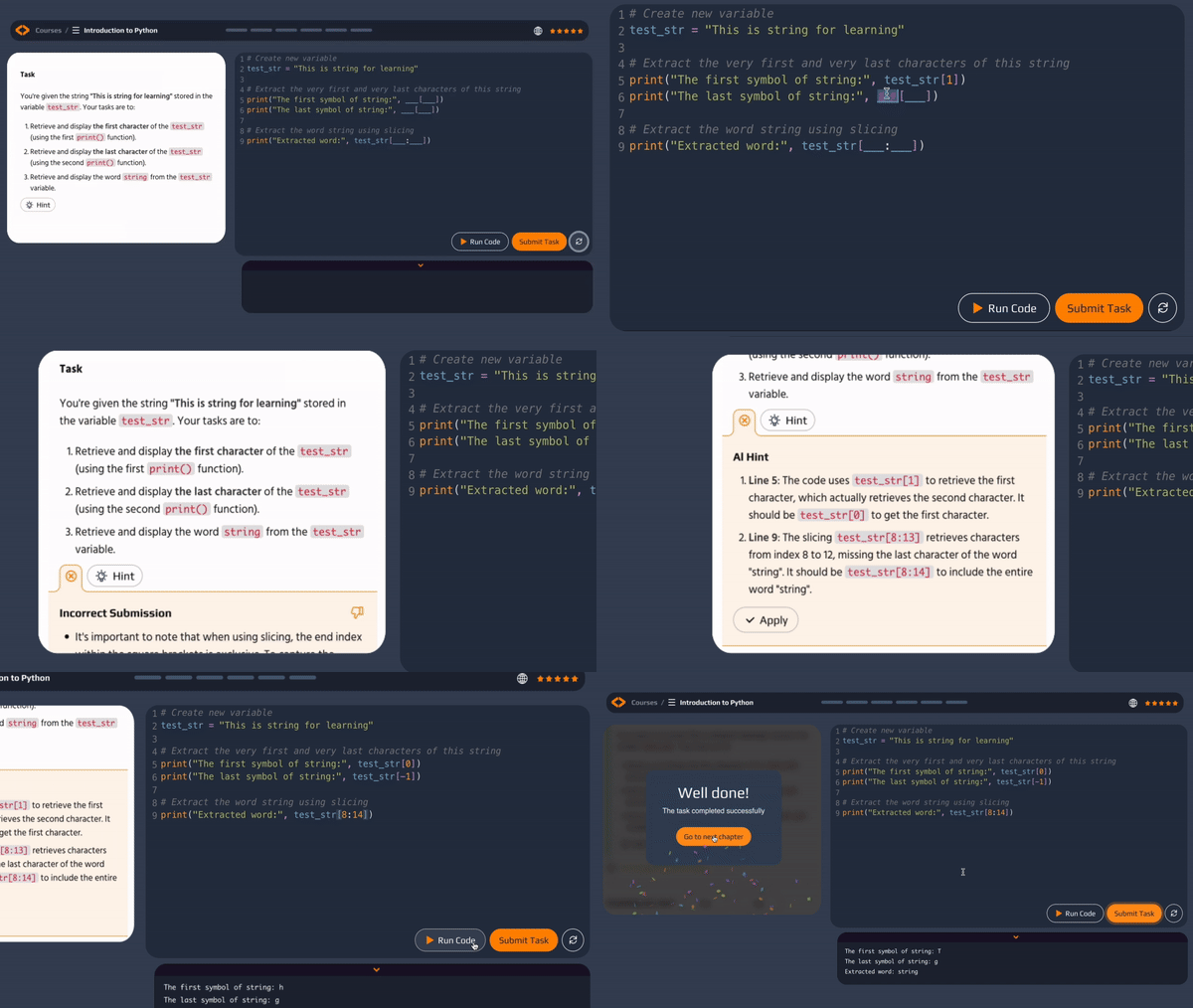
AI支援学習

テクノロジースキルの魅力を存分に味わいましょう!AIアシスタントがリアルタイムのフィードバック、パーソナライズされたヒント、エラーの説明を提供し、自信をもって学習できるようサポートします。

ワークスペース

ワークスペースを利用すれば、プラットフォーム上で直接プロジェクトを作成・共有できます。利便性のためにテンプレートもご用意しています

学習トラック

キャリア開発を自分でコントロールし、最新技術の習得への道を歩み始めましょう

実践的なプロジェクト

実践的なプロジェクトでポートフォリオを強化し、潜在的な雇用主に実務能力をアピールしましょう
AI-Assisted LearningAI-Assisted LearningAI-Assisted LearningAI-Assisted Learning
なぜCodefinityが際立っているのか
動画コンテンツ
ダウンロード可能な教材
権威ある証明書
インタラクティブな学習環境
誤りの修正
AIアシスタント
1つのサブスクリプションで全コンテンツにアクセス
Codefinity
yes
yes
yes
yes
yes
yes
yes
動画ベースの学習プラットフォーム
yes
yes
yes
no
no
no
no
Codefinity
動画ベースの学習プラットフォーム
動画コンテンツ
yesyes
ダウンロード可能な教材
yesyes
権威ある証明書
yesyes
インタラクティブな学習環境
yesno
誤りの修正
yesno
AIアシスタント
yesno
1つのサブスクリプションで全コンテンツにアクセス
yesno
キャリアの機会この分野で最も人気のある職業、平均給与、そして積極的に専門家を求める企業について学ぼう。
データサイエンティスト
機械学習エンジニア
NLPエンジニア
AIコンサルタント
ディープラーニングエンジニア
$149k
$197k
$246k
Min
Average
Max
年収
(米国平均)
Epic!
Roku
Meta
Airbnb
Dropbox
X
採用企業
*情報源: Glassdoor
トップ校の学生に選ばれた
うち30校を含む米国トップ30の大学
virginia
texas
michigan
duke
berkeley
yale
mit
brown
carnegie
rochester
california
connecticut
massachusetts
city-new-york
virginia
texas
michigan
duke
berkeley
yale
mit
virginia
texas
michigan
duke
berkeley
yale
mit
brown
carnegie
rochester
california
connecticut
massachusetts
city-new-york
virginia
texas
michigan
duke
berkeley
yale
mit
florida
illinois
colorado
indiana
new-york
cornell
columbia
notre-dame
florida
illinois
colorado
indiana
florida
illinois
colorado
indiana
new-york
cornell
columbia
notre-dame
florida
illinois
colorado
indiana

ディープラーニング講座: 主要情報と質問

ディープラーニング入門
ディープラーニングは、機械学習の一分野であり、多層のニューラルネットワークを用いることで、大量のデータから学習することを可能にします。ディープラーニングのコースでは、画像認識、自然言語処理(NLP)、生成モデルなどの概念が紹介されます。受講者はTensorFlowやPyTorchといったフレームワークを用いて、画像生成、テキスト生成、データ駆動型の意思決定などの課題に取り組みます。これらのコースは、AI技術に関する専門知識を身につけたい方にとって非常に有益です。
当社ディープラーニングコースの利点
当社のディープラーニングコースは、業界で使用されている最新技術やツールに関する包括的かつ実践的なトレーニングを提供します。実際のデータセットを用いた演習を通じて、問題解決力や技術力を高め、先端技術分野でのキャリアに備えることができます。
ディープラーニングコース修了後のキャリア機会
ディープラーニングコース修了者は、データサイエンティスト、機械学習エンジニア、AI研究者、ディープラーニングスペシャリストなど、医療から自動運転車まで幅広い業界で活躍できます。
ディープラーニングの選択肢
ディープラーニングに興味のある初心者は、「ニューラルネットワーク入門」から始め、基礎概念や応用を理解した上で、より高度な学習に進むことを推奨します。
修了証明書について
Codefinityのディープラーニングコースを修了すると、修了証明書が発行されます。これは履歴書の強化につながり、業界のリーダーからもスキルと学習意欲の証として認められています。
ディープラーニングとは何か、なぜ重要なのか?
ディープラーニングは、3層以上のニューラルネットワークを用いる機械学習の一分野です。予測分析の自動化を可能にし、自動運転車や顔認識システムなど、AIの革新を支える重要な技術です。
当社ディープラーニングコース受講の利点は?
当社のディープラーニングコースに参加することで、業界の専門家から学び、最先端ツールを用いた実践的な経験を積み、最新技術を反映したカリキュラムにアクセスできます。これらのコースは、ディープラーニングを用いた複雑な課題に対応するための深い理解と実践的スキルを身につけることを目的としています。
ディープラーニングコース修了後に探せるキャリア機会は?
ディープラーニングコース修了後は、AI研究者、自律システムエンジニア、ディープラーニングアナリスト、医療や金融サービス分野のAI応用担当など、テクノロジー分野で需要の高い多様なキャリアパスを選択できます。
初心者に最適なディープラーニングコースは?
初心者には、「ニューラルネットワーク入門」が、ディープニューラルネットワークの概念を視覚的にわかりやすく紹介しており、分野未経験者に最適なスタートとなります。
適切なディープラーニングコースの選び方は?
適切なディープラーニングコースを選ぶには、現在の理解度と学習目標を評価してください。ニューラルネットワークの技術的基礎や実践的応用に興味がある場合は、中級レベルの「ニューラルネットワーク入門」コースが最適です。より高度な機械学習フレームワークを学びたい方には、「TensorFlow入門」や「PyTorch Essentials」が、上級者向けに複雑かつ詳細な内容を提供します。
当社でオンラインディープラーニングコースを受講するメリットは?
Codefinityのオンラインディープラーニングコースは、自分のペースや都合に合わせて学習できる柔軟性、最先端のコンテンツへのアクセス、専門家や仲間からのサポートが得られるため、学習体験が向上します。
ディープラーニングコースを成功させるためのコツ
継続的な学習、定期的な実践、他の受講者との交流、フォーラムへの参加、プロジェクトを通じた知識の応用が重要です。現実的な目標を設定し、コーススケジュールに沿って進めることで、学習効果を最大化できます。
ディープラーニングコースの受講費用は?
トレーニング費用は、サブスクリプションの種類や期間によって異なります。正確かつ詳細な料金情報や割引については、当社の支払いページをご覧ください。
ディープラーニングで必要な主要スキルは?
ディープラーニングで優れた成果を上げるには、強固な数学力、プログラミング(特にPython)の習熟、機械学習の理解が必要です。分析的思考力や問題解決能力も重要です。
ディープラーニングはテクノロジー業界にどのような影響を与えているか?
ディープラーニングは、より複雑かつ知的なシステムの開発を可能にすることで、テクノロジー業界に大きな影響を与えています。音声認識、言語翻訳、画像処理などの分野で進歩を支え、機械の可能性を拡大し続けています。
ディープラーニングの学習開始方法は?
ニューラルネットワークの基礎を紹介する入門コースから始め、徐々により複雑なテーマに取り組んでください。コミュニティプロジェクトに参加し、最新の研究や動向にも注目しましょう。
ディープラーニングは独学できますか?
はい、多くのリソースが利用可能なため、独学でディープラーニングを学ぶことも可能です。ただし、Codefinityのような体系的なコースでは、より包括的な学習パス、専門家の指導、仲間からのサポートが得られ、独学では得にくいメリットがあります。
利用者の声
参加する 150万以上 CodefinityにおけるAIとデータスキルの向上
さあ、始める準備はできましたか?
Pro最高のイントロオファー$12 /月年額請求

benefit250以上の高評価コース
benefit修了証明書
benefit全てのコースにAIアシスタント付き
benefit40+ hands-on Real-world projects
benefitパーソナライズされた学習トラック
benefit無制限のワークスペース
Ultimateキャリア向上に必要なすべて$25 /月年額請求

benefit250以上の高評価コース
benefit修了証明書
benefit全てのコースにAIアシスタント付き
benefit40+ hands-on Real-world projects
benefitパーソナライズされた学習トラック
benefit無制限のワークスペース
上位のコース: ディープラーニング カテゴリー
1.
Pythonによるニューラルネットワーク入門
時間4 時間
章25
2.
Introduction to NLP with Python
時間5 時間
章29
3.
Introduction to TensorFlow
時間2 時間
章16
4.
Recurrent Neural Networks with Python
時間3 時間
章22
5.
プロンプトエンジニアリング基礎
時間1 時間
章9
1. Pythonによるニューラルネットワーク入門
時間時間
4
章
25
2. Introduction to NLP with Python
時間時間
5
章
29
3. Introduction to TensorFlow
時間時間
2
章
16
4. Recurrent Neural Networks with Python
時間時間
3
章
22
5. プロンプトエンジニアリング基礎
時間時間
1
章
9
何か問題が発生したようで申し訳ありません。何が起こりましたか?
some-alt