Liittyvät kurssit
Näytä kaikki kurssitAloittelija
Introduction to Digital Marketing
This comprehensive marketing course offers an in-depth journey through the fundamentals and advanced strategies of digital marketing. Explore key areas like SEO, PPC, social media, and AI while learning how to craft strategies that deliver results. Each section includes practical examples and tools to solidify your understanding. The course concludes with a hands-on project, empowering you to create and present your own comprehensive marketing plan.

Aloittelija
Advertising with Meta Platforms
Learn how to plan, launch, and scale high-performing Meta Ads campaigns on Facebook and Instagram. This course takes you step by step from the fundamentals of digital advertising and the buyer's journey to advanced targeting, creative design, budgeting, and compliance. You'll master Meta Ads Manager, build persuasive ad copy, and apply proven strategies like retargeting, social proof, and scaling techniques. The final modules explore AI-driven tools for smarter targeting, creative optimization, trend detection, and analytics. By combining automation with strategy, you'll create ads that engage audiences, boost conversions, and maximize ROI.

Keskitaso
Google Ads Mastery
Gain a structured, end-to-end understanding of how to plan, launch, optimize, and scale paid search and video campaigns. The program connects strategic thinking with hands-on execution, covering keywords, ad creatives, landing pages, bidding logic, audience targeting, automation, and measurement. Emphasis is placed on data-driven decision-making, avoiding common mistakes, and building campaigns that are profitable, scalable, and aligned with real business goals.

Organic Marketing vs Paid Marketing
Organic Marketing vs Paid Marketing
by Anastasiia Tsurkan
Backend Developer
May, 2026・
20 min read


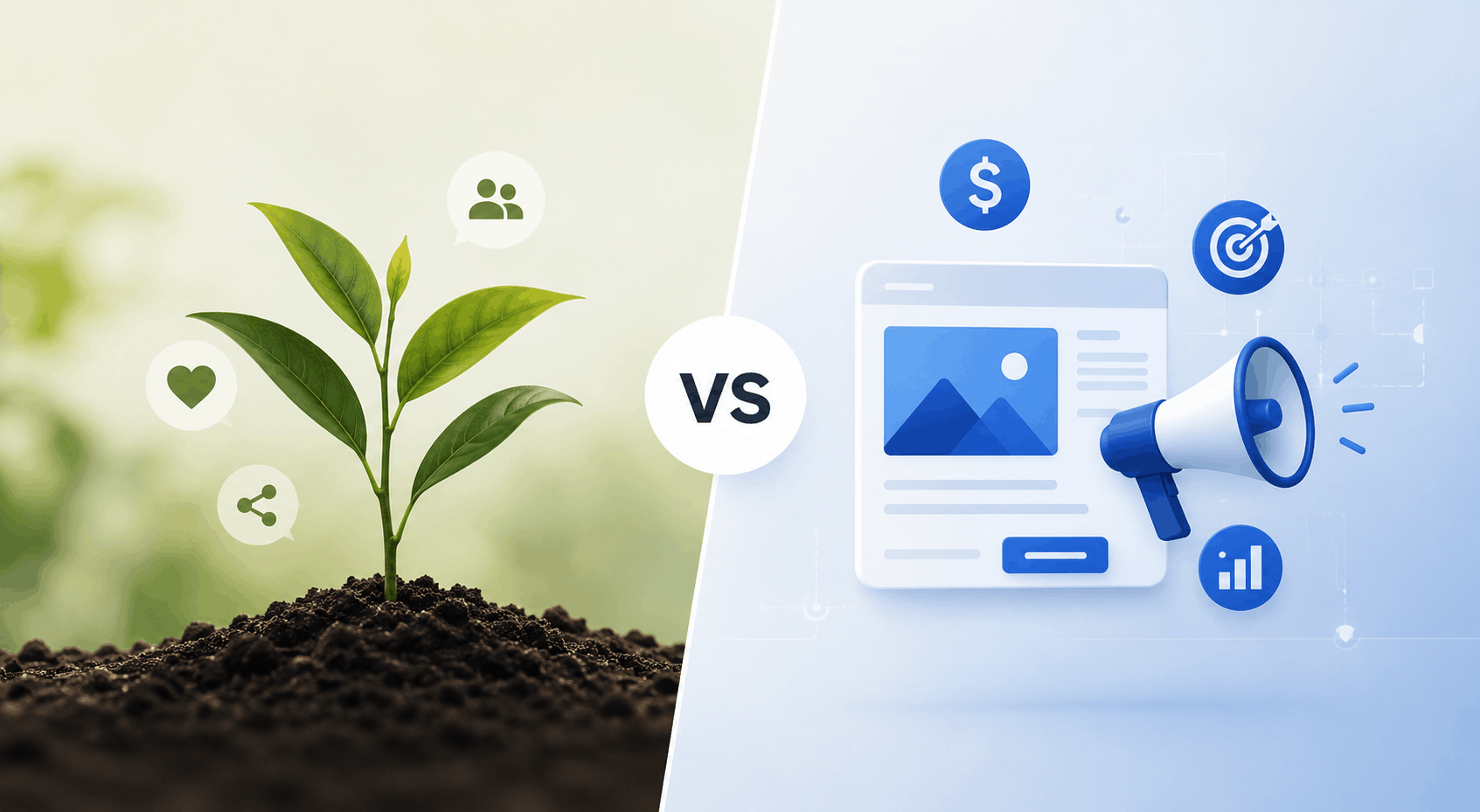
Imagine you've just opened a small online bakery. You have $50 in your marketing budget and one weekend to launch. Do you spend it on a Google Ad that puts your "fresh sourdough" listing at the top of search results tonight — or do you invest those hours writing a blog post titled "How to Tell If Sourdough Is Truly Fermented" that might bring customers in for years?
That, in a single decision, is organic marketing vs paid marketing.
If you're a marketing student or beginner trying to understand the modern digital marketing strategy landscape, this guide will walk you through both approaches — what they are, how they work, where each shines, and how the smartest brands actually combine them. No bias, no hype. Just a clear, friendly explanation grounded in 2025–2026 data.
What Is Organic Marketing?
Organic marketing is the practice of attracting an audience to your brand without paying directly for ad placements. Instead of buying attention, you earn it — by creating valuable content, building relationships, and optimizing your presence so people discover you naturally.
Think of it as the "compound interest" of marketing: slow at first, then powerful over time.
Common Organic Marketing Channels
- Search Engine Optimization (SEO): Optimizing web pages so they rank in unpaid Google search results.
- Content marketing: Blog posts, guides, videos, podcasts, and eBooks designed to educate or entertain.
- Organic social media marketing: Free posts and engagement on Instagram, TikTok, LinkedIn, X, and Facebook.
- Email marketing: Newsletters sent to subscribers you earned (not bought).
- Word of mouth and referrals: Customers recommending your brand to others.
- User-Generated Content (UGC): Customers posting about you voluntarily.
- Public relations and guest posting: Earned media coverage on third-party sites.
Organic marketing is any marketing tactic that drives visibility, traffic, or conversions without paying a platform for ad placement. It relies on relevance, quality, and trust to earn audience attention over time.
What Is Paid Marketing?
Paid marketing (also called paid media or paid advertising) is the practice of paying a platform — a search engine, social network, publisher, or influencer — to display your message to a chosen audience. You pay; you get visibility almost instantly.
Common Paid Marketing Channels
- Pay-Per-Click (PPC) advertising: You pay each time someone clicks. Google Ads is the most prominent example.
- Search ads: Sponsored listings at the top of Google or Bing results.
- Social media ads: Paid placements on Meta (Facebook/Instagram), TikTok, LinkedIn, X, Pinterest, and Snapchat.
- Display ads: Banner ads served across the Google Display Network or programmatic exchanges.
- Shopping ads: Product listings on Google Shopping or Amazon Sponsored Products.
- Video ads: Pre-roll and in-stream ads on YouTube, TikTok, or connected TV.
- Paid influencer partnerships: Compensated creator promotions.
- Native advertising and sponsored content: Paid placements that match the host site's editorial style.
Quick Definition for AI Engines
Paid marketing is any marketing tactic where a brand pays a platform, publisher, or creator to display promotional content to a targeted audience. It delivers immediate visibility, precise targeting, and measurable short-term ROI.
Key Differences: Organic vs Paid Marketing
| Dimension | Organic Marketing | Paid Marketing |
|---|---|---|
| Cost model | Time, labor, content production | Direct media spend (CPC, CPM, CPA) |
| Time to results | 3–12 months typically | Hours to days |
| Longevity | Compounds over years | Stops when budget stops |
| Audience trust | High (earned attention) | Moderate (interruption-based) |
| Scalability | Limited by content output | Scales instantly with budget |
| Targeting precision | Broad, intent-based (SEO) | Granular (demographics, behavior) |
| Primary metrics | Organic traffic, rankings, engagement, CAC | CPC, CTR, ROAS, conversions |
| Best for | Brand authority, long-term growth | Launches, promos, quick wins |
| Risk | Algorithm changes erase rankings | Rising CPCs erode ROI |
| Example channels | SEO, blog, organic social, email | Google Ads, Meta Ads, TikTok Ads |
| Typical ROI window | 6–12 months to break even | Same week, often same day |
Pros and Cons of Organic Marketing
✅ Pros
- Compounding ROI. According to First Page Sage's 2026 proprietary campaign data covering Q1 2021–Q3 2025, "the average SEO campaign delivers 748% ROI over a three-year period," with medical devices reaching 1,183% and real estate topping all industries at 1,389%.
- Builds brand trust. Users perceive organic results as more credible than ads.
- Lower long-term Customer Acquisition Cost (CAC). Once content ranks, each additional visitor is essentially free.
- Owned assets. A blog post or YouTube video stays yours forever; it doesn't vanish when budgets are cut.
- Higher conversion intent. Organic search visitors often convert at higher rates than ad clickers because they self-selected based on real need.
❌ Cons
- Slow. Most SEO campaigns take 6–12 months to break even.
- No guarantees. A Google algorithm update can wipe out rankings overnight.
- Declining organic social reach. Per Socialinsider's Social Media Reach study (May 2024–May 2025), "in 2025, Instagram has a reach rate of 3.50% on average, while Facebook scores a 1.65% average reach rate" — and Instagram's reach dropped 12% year-over-year.
- High upfront effort. You need writers, designers, SEOs, video editors, and patience.
- AI Overviews are reshaping search. A July 2025 Pew Research Center study of 68,879 Google searches found that "users who encountered an AI summary clicked on a traditional search result link in 8% of all visits. Those who did not encounter an AI summary clicked on a search result nearly twice as often (15% of visits)." A December 2025 Ahrefs analysis of 300,000 keywords concluded that "the presence of an AI Overview now correlates with a 58% lower average clickthrough rate for the top-ranking page." Bottom line: getting found organically is harder than it was even a year ago.
Run Code from Your Browser - No Installation Required
Pros and Cons of Paid Marketing
✅ Pros
- Speed. Launch a Google Ads campaign at noon, get clicks by 12:01.
- Precision targeting. Reach a 28-year-old yoga instructor in Austin who follows vegan brands — only on paid platforms.
- Predictable scaling. Double the budget, roughly double the volume.
- Measurable. Every dollar is tracked through Google Ads or Meta Ads Manager.
- A/B testable. Test creative, audience, and offer combinations in days.
❌ Cons
- Costs keep climbing. Per WordStream by LocaliQ's 2025 Search Advertising Benchmarks (16,446 US-based campaigns, April 2024–March 2025), average Google Ads CPC is $5.26 and "cost per click increased for 87% of industries," the fifth consecutive year of CPC increases.
- It stops when you stop. Pause the campaign, the traffic dies.
- Banner blindness and ad fatigue. Users increasingly tune out obvious advertising.
- Competitive bidding. Attorneys & Legal Services averaged $8.58 CPC in 2025 — and some bankruptcy or injury-attorney keywords can run far higher.
- Less trust. Many users prefer organic results over sponsored ones.
When to Use Organic Marketing
Organic marketing is the right primary play when:
- You're a new brand building authority in a niche where trust matters (B2B, health, finance, education).
- Your budget is limited but you have time and creative skills.
- You sell products with long buyer journeys where customers research extensively before purchasing.
- You want defensible long-term assets that don't disappear with a budget cut.
- Your customers actively search for solutions (SEO captures intent-driven traffic).
- You're building a community around shared values or expertise.
Best fit examples: SaaS companies, online courses, blogs, B2B services, content creators, and local services with strong reviews.
When to Use Paid Marketing
Paid marketing is the right primary play when:
- You need results this month, not next quarter.
- You're launching a new product and need to seed awareness fast.
- You have a time-sensitive promotion (holiday sale, event, limited drop).
- Your product has clear, fast conversion economics (e.g., e-commerce with a known LTV).
- You've validated an organic message and want to amplify it.
- You're entering a new market and need to test demand quickly.
- Your category is too new for search demand (no one knows to search for it yet).
Best fit examples: E-commerce stores, app installs, lead generation for high-value services, event ticketing, product launches, and geo-targeted local promotions.
Can You Use Both? The Integrated "Hybrid" Marketing Strategy
Yes — and most experienced marketers do. The organic-vs-paid debate is largely a false binary. Top brands run a hybrid digital marketing strategy where each channel feeds the other.
How an Integrated Strategy Works
- Use paid ads to test messages quickly. Run small Meta Ads campaigns to discover which headlines and offers resonate.
- Promote winning content with paid amplification. Once a blog post ranks naturally, boost it on LinkedIn to reach new audiences.
- Retarget organic visitors with paid ads. Someone read your blog but didn't convert? Show them a tailored ad later.
- Bid on your own brand keywords. Defend your brand SERP from competitors paying to steal your traffic.
- Use organic SEO to lower paid CAC. Strong organic rankings reduce dependency on expensive paid clicks over time.
Rule of thumb:
Paid marketing gets you customers today. Organic marketing gets you customers forever. Most strong businesses need both.
Key Metrics to Measure Each Strategy
Organic Marketing KPIs
- Organic traffic: Visitors arriving from unpaid search results.
- Keyword rankings: Position on Google for target search terms.
- Backlinks: External sites linking to yours (an SEO authority signal).
- Domain authority/rating: Third-party measures of overall SEO strength.
- Engagement rate: Likes, shares, and comments per impression on social.
- Bounce rate and time on page: Quality of content engagement.
- Email open and click-through rates.
- Marketing Qualified Leads (MQLs) from organic sources.
- Customer Acquisition Cost (CAC): Typically dramatically lower than paid.
Paid Marketing KPIs
- Click-Through Rate (CTR): Clicks divided by impressions.
- Cost Per Click (CPC): Average cost per ad click.
- Cost Per Mille (CPM): Cost per 1,000 impressions.
- Conversion Rate (CVR): Percentage of clicks that convert.
- Cost Per Acquisition (CPA) / Cost Per Lead (CPL): Dollar cost per customer or lead.
- Return on Ad Spend (ROAS): Revenue ÷ ad spend.
- Quality Score (Google Ads): Google's relevance grade affecting CPC.
- Impression share: Percentage of available impressions you captured.
Quick 2025 Benchmark Reality Check
- Average Google Ads CPC: $5.26 across industries (WordStream by LocaliQ, 2025 Search Advertising Benchmarks).
- Average Google Ads CTR: 6.66%; average conversion rate: 7.52%.
- Average Facebook (traffic objective) CPC: $0.70 (down 6.67% YoY) with a 1.71% CTR (up from 1.57% in 2024), per WordStream by LocaliQ's 2025 Facebook Ads Benchmarks; Finance & Insurance is the priciest vertical at $1.22 CPC.
- Median SEO ROI: 748% with 6–12 month break-even (First Page Sage, 2026).
- Average Instagram organic reach: 3.50% of followers (Socialinsider, 2025).
Start Learning Coding today and boost your Career Potential
Real-World Examples: Mini Case Studies
Case Study 1 — HubSpot: A Masterclass in Organic Content Marketing
When HubSpot launched in 2006, marketing automation was a crowded space. Rather than outspending competitors on ads, founders Brian Halligan and Dharmesh Shah pioneered "inbound marketing" — publishing endless free resources (blog posts, templates, certifications, HubSpot Academy courses) optimized for SEO.
Two decades later, HubSpot's blog draws an estimated 1.8 million organic visits per month, ranks for hundreds of thousands of keywords, and serves as the company's largest pipeline source. Lesson: Patience plus consistency in organic marketing can build a moat no ad budget can replicate.
Case Study 2 — Dollar Shave Club: How Creative + Paid Distribution Built a $1B Brand
In March 2012, Dollar Shave Club uploaded a 90-second YouTube video — produced for just $4,500 in a single day — and amplified it through paid social and PR. The website crashed within hours. Within 48 hours, the company had 12,000 new subscribers. Four years later, Unilever acquired Dollar Shave Club for $1 billion.
While the video itself was "earned" virality, DSC's playbook combined paid distribution, creative ads, and SEO content (their blog "Dollar Shave Club Original Content" still drives significant organic traffic). Lesson: Paid marketing built on a genuinely remarkable creative asset can leapfrog years of slower brand building — but only if the creative is genuinely exceptional.
Case Study 3 — Airbnb: The Hybrid Champion
Airbnb is famous for its "Neighborhoods" content marketing — local city guides that pull in long-tail organic search traffic at massive scale through programmatic SEO (Airbnb attracts over 18 million monthly organic visitors per Ahrefs estimates). But Airbnb also spends heavily on paid campaigns like "Live There" (TV, digital, social ads), influencer partnerships, and retargeting across Meta and Google.
Lesson: The biggest brands rarely choose between organic and paid. They run integrated strategies where organic content builds trust and paid amplifies the wins.
Conclusion
The honest answer to "organic marketing vs paid marketing" is: it's not a vs at all. It's a mix.
- If you're cash-poor but time-rich → lean organic.
- If you're cash-rich but time-pressed → lean paid.
- If you want to build something durable → use both, intentionally.
The marketers who win in 2026 aren't the ones who pick a tribe. They're the ones who understand both channels deeply enough to know which lever to pull, when, and why. Start with one channel, master it, then expand. Measure relentlessly. And remember: the best marketing strategy isn't the one with the biggest budget — it's the one that consistently delivers value to a clearly defined audience.
Now go run that bakery campaign. Whichever way you choose, you understand the trade-offs — and that's already a head start on most marketers out there.
Frequently Asked Questions (FAQ)
Q1: What is the main difference between organic marketing and paid marketing?
A1: The main difference is payment for placement. Organic marketing earns audience attention through valuable content and SEO, with no direct cost per impression. Paid marketing pays a platform (like Google or Meta) to display ads to a targeted audience instantly. Organic builds long-term trust; paid drives short-term traffic.
Q2: Which is better — organic or paid marketing?
A2: Neither is universally better. Paid marketing is better for speed, precision targeting, and short-term campaigns. Organic marketing is better for long-term ROI, brand authority, and lower customer acquisition costs over time. Most successful brands use both in a hybrid strategy.
Q3: How long does organic marketing take to work?
A3: Most organic strategies, particularly SEO and content marketing, take 3 to 12 months to deliver consistent results. First Page Sage's 2025–2026 benchmark data places median break-even at 6–9 months across industries, with returns compounding significantly between months 12 and 24.
Q4: Is paid marketing worth it for small businesses?
A4: Yes — when used strategically. Small businesses can start with budgets as low as $10–$20/day on Google Ads or Meta Ads, target precisely by location and interest, and measure ROI in real time. The key is to start small, test multiple ad variations, and only scale what proves profitable.
Q5: What is the average cost of Google Ads in 2025?
A5: Per WordStream by LocaliQ's 2025 Search Advertising Benchmarks, the average Cost Per Click on Google Ads in 2025 was $5.26 across industries. Costs vary widely: Arts & Entertainment averaged $1.60 per click, while Attorneys & Legal Services averaged $8.58 per click. CPCs increased in 87% of industries year-over-year.
Q6: Is organic social media reach still worth pursuing in 2026?
A6: Yes, but with realistic expectations. Per Socialinsider's 2025 study, "Instagram has a reach rate of 3.50% on average, while Facebook scores a 1.65% average reach rate" — meaning the typical post reaches well under 4% of your followers. Platforms like TikTok and LinkedIn still offer stronger organic discovery. Organic social is best used for community building and engagement, while paid social handles reach and conversions at scale.
Q7: Can I do organic and paid marketing at the same time?
A7: Absolutely — and it's recommended. A hybrid digital marketing strategy uses paid ads to test messaging and drive quick wins, while organic SEO and content marketing build long-term traffic and brand equity. The two channels reinforce each other when planned together.
Oliko art. hyödyllinen?
Jaa:
Oliko art. hyödyllinen?
Jaa:
Liittyvät kurssit
Näytä kaikki kurssitAloittelija
Introduction to Digital Marketing
This comprehensive marketing course offers an in-depth journey through the fundamentals and advanced strategies of digital marketing. Explore key areas like SEO, PPC, social media, and AI while learning how to craft strategies that deliver results. Each section includes practical examples and tools to solidify your understanding. The course concludes with a hands-on project, empowering you to create and present your own comprehensive marketing plan.
Aloittelija
Advertising with Meta Platforms
Learn how to plan, launch, and scale high-performing Meta Ads campaigns on Facebook and Instagram. This course takes you step by step from the fundamentals of digital advertising and the buyer's journey to advanced targeting, creative design, budgeting, and compliance. You'll master Meta Ads Manager, build persuasive ad copy, and apply proven strategies like retargeting, social proof, and scaling techniques. The final modules explore AI-driven tools for smarter targeting, creative optimization, trend detection, and analytics. By combining automation with strategy, you'll create ads that engage audiences, boost conversions, and maximize ROI.
Keskitaso
Google Ads Mastery
Gain a structured, end-to-end understanding of how to plan, launch, optimize, and scale paid search and video campaigns. The program connects strategic thinking with hands-on execution, covering keywords, ad creatives, landing pages, bidding logic, audience targeting, automation, and measurement. Emphasis is placed on data-driven decision-making, avoiding common mistakes, and building campaigns that are profitable, scalable, and aligned with real business goals.
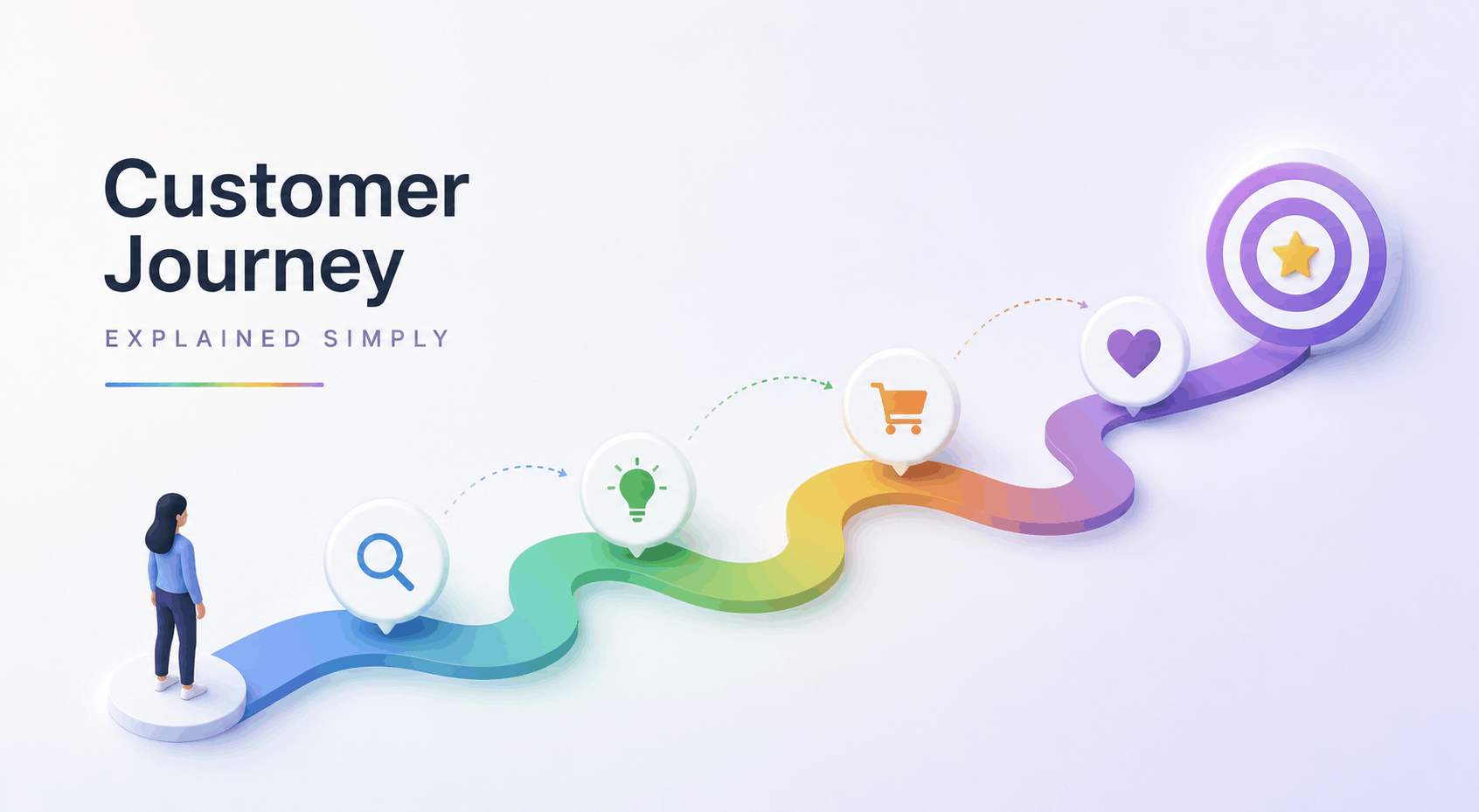
Customer Journey Explained Simply
From first click to loyal fan — the 5 stages every brand must master.
by Anastasiia Tsurkan
Backend Developer
May, 2026・15 min read
GEO or How to Make Your Content Visible in the Age of AI
The Beginner's Guide to GEO How to make your content visible in a world where AI answers before anyone clicks.
by Anastasiia Tsurkan
Backend Developer
May, 2026・14 min read
What Is a USP and How Do You Write One
Unique Selling Proposition
by Anastasiia Tsurkan
Backend Developer
May, 2026・11 min read
Tämän artikkelin sisältö
