Verwandte Kurse
Alle Kurse anzeigenAnfänger
Introduction to Digital Marketing
This comprehensive marketing course offers an in-depth journey through the fundamentals and advanced strategies of digital marketing. Explore key areas like SEO, PPC, social media, and AI while learning how to craft strategies that deliver results. Each section includes practical examples and tools to solidify your understanding. The course concludes with a hands-on project, empowering you to create and present your own comprehensive marketing plan.

Mittelstufe
Digital Marketing Analytics and Experimentation
Gain a structured understanding of how marketing performance is measured, analyzed, and improved across channels. The material covers essential metrics, tracking frameworks, and analytics tools used to evaluate web, SEO, social, paid media, email, and e-commerce performance. It also explores data preparation, dashboarding, attribution models, experimentation, and forecasting. By connecting insights to budget decisions and ROI optimization, the focus shifts from reporting numbers to driving smarter, evidence-based marketing decisions.
Customer Journey Explained Simply
From first click to loyal fan — the 5 stages every brand must master.

by Anastasiia Tsurkan
Backend Developer
May, 2026・
15 min read


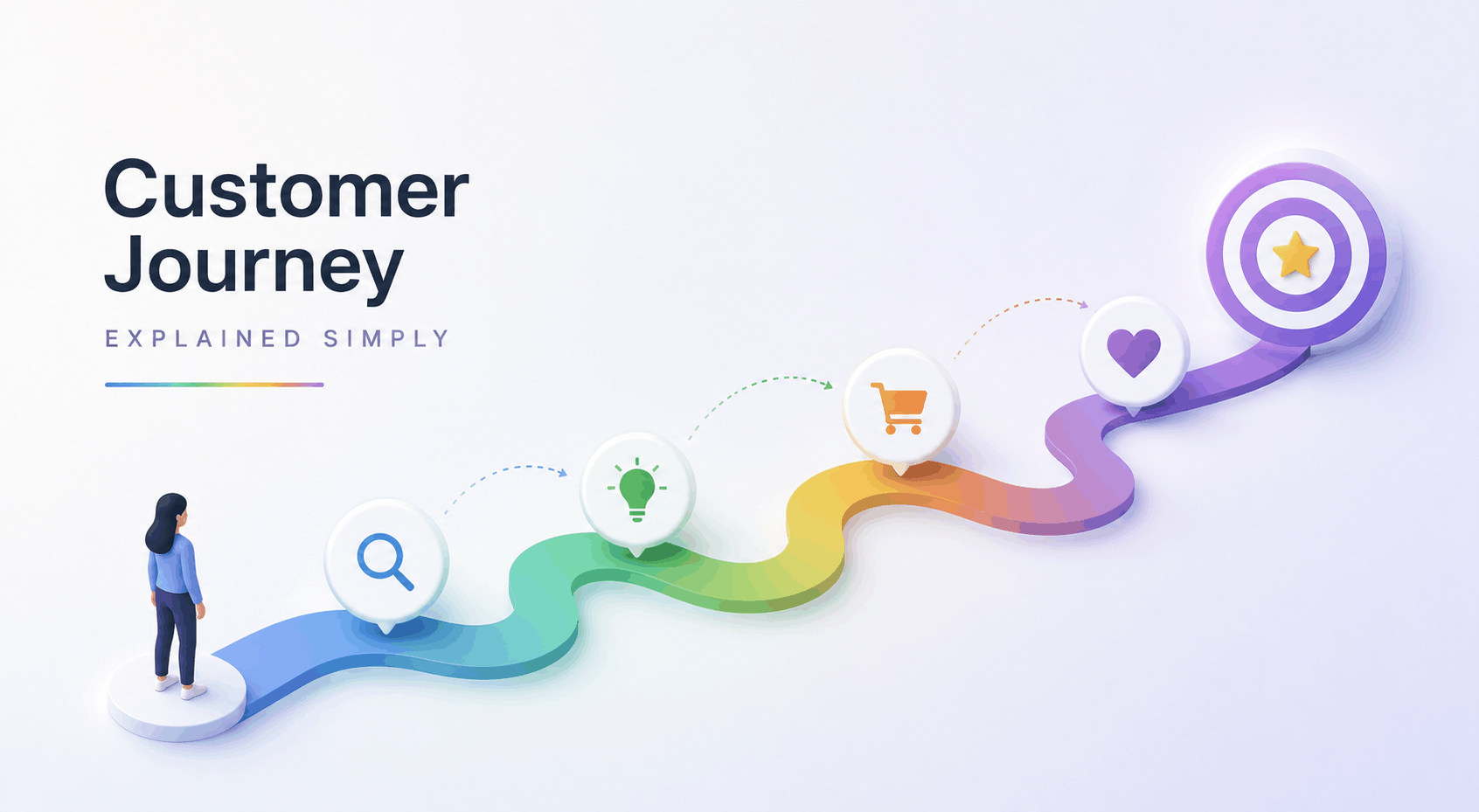
What Is a Customer Journey, Really?
Think about the last time you bought something — not an impulse grab at the checkout line, but something you actually thought about. Maybe a new laptop, a gym membership, or even just a new brand of coffee. You didn't just appear in the store with money in hand. Something happened before that. And something happened after.
That entire sequence — from the first moment a problem entered your awareness, all the way through to whether you told a friend about the product a year later — is the customer journey.
It sounds simple. It isn't.
The customer journey is the complete sum of experiences a person has while interacting with your brand. It's not a funnel (funnels are about your sales process, not the customer's experience). It's not a campaign. It's not a touchpoint. It's all of it, stitched together — messy, nonlinear, deeply human.
Understanding it properly is one of the most powerful things a business can do.
Why Most Businesses Get This Wrong
Most companies think about customers only when they're ready to buy.
This is like a restaurant only caring about you when you're already seated at the table. What about when you were driving by and noticed the sign? What about when your friend mentioned it at lunch? What about when you looked it up at 11pm and couldn't find a menu on their website? By the time you walked through the door, a hundred small moments had already shaped your expectations — and the restaurant missed every one of them.
The average business sees maybe 20% of the customer journey. The customer lives 100% of it.
This gap is where trust is lost, sales disappear, and competitors win.
The Stages of a Customer Journey
There's no single universally agreed-upon model, but the most useful frameworks all share a core arc. Here it is, broken down honestly.
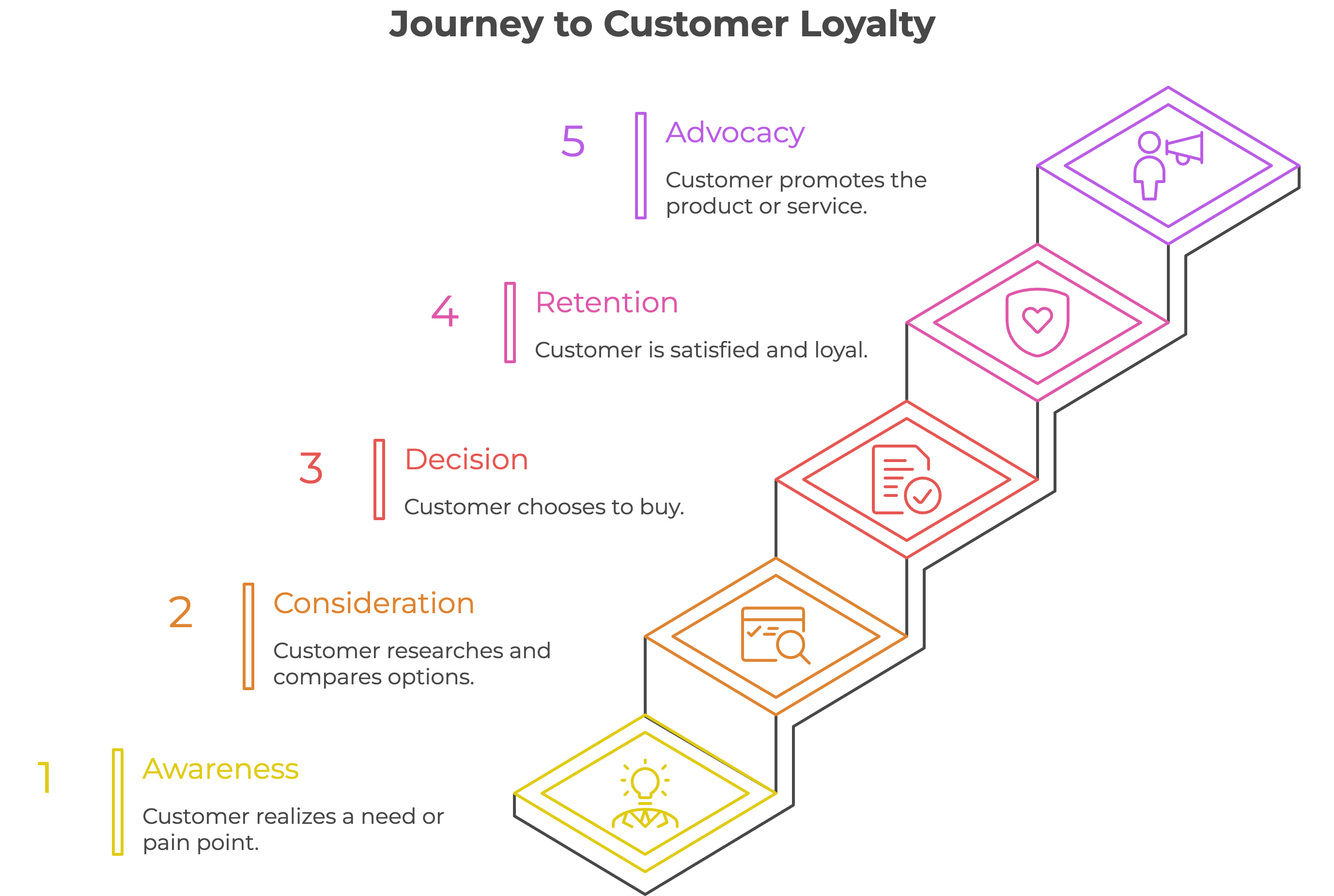
Stage 1: Awareness — "I Have a Problem"
Before someone can want your product, they need to recognize a need. Sometimes they name it clearly ("I need a faster computer"). More often, the need is fuzzy ("I feel stuck at work and don't know why").
At this stage, the customer isn't looking for you. They're looking for understanding. They're reading articles, watching videos, asking friends, noticing patterns in their own frustration.
What your brand should be doing here: Showing up with useful, non-salesy content that helps people understand their problem better. The goal isn't to pitch — it's to be the brand that made them feel seen before they even knew they needed you.
The biggest mistake companies make in the awareness stage is talking about themselves. Nobody cares yet. They care about their problem.
Stage 2: Consideration — "What Are My Options?"
Now the person knows what they need. They start researching. They compare. They read reviews, watch demonstrations, ask for recommendations in online communities, and build a mental shortlist.
This stage is long, often longer than businesses expect. For a SaaS tool, it might be a week. For a house, it might be two years. The length doesn't matter as much as the quality of information available at each moment of that search.
What your brand should be doing here: Making comparison easy and honest. Providing detailed information. Being present on the platforms where people research (not just the ones you prefer). Addressing objections before they become reasons to leave.
A critical insight: People in the consideration stage are often comparing you to doing nothing. The real competition isn't your industry rival — it's inertia. If you can't explain clearly why acting now beats staying put, you'll lose to apathy.
Stage 3: Decision — "I'm Going to Buy"
This is where most marketing budgets are spent. Discounts, retargeting ads, sales calls, limited-time offers. And while this stage matters, it's often the least interesting one — because by the time someone reaches a decision, the real battle was won (or lost) in the stages before.
That said, friction at the decision stage is a silent killer. A checkout process with too many steps. A pricing page that's confusing. A sales rep who calls four times in one day. A return policy buried in fine print. Any one of these can undo everything built before.
What your brand should be doing here: Removing friction. Making it easy to say yes. Providing one last, clear reason to choose you — whether that's a guarantee, a testimonial from someone just like them, or simply a frictionless experience that signals you take quality seriously.
Stage 4: Retention — "Am I Still Happy I Bought This?"
Here's where most customer journey conversations stop. Here's also where most businesses make their most expensive mistake.
Acquiring a new customer costs, depending on the industry, five to seven times more than retaining an existing one. Yet the average company spends the majority of its marketing budget chasing new customers while neglecting the ones they already have.
Retention isn't just about loyalty programs and email newsletters. It's about whether the product actually delivers what it promised. It's about how support feels when something goes wrong. It's about whether the brand keeps showing up with value after the money has been collected.
What your brand should be doing here: Delivering on the promise. Reaching out proactively — not just when it's time to renew. Helping customers get more value from what they already have. Treating post-purchase communication as an investment, not an afterthought.
The retained customer is also the one who moves to the next stage, which is where real growth lives.
Stage 5: Advocacy — "Let Me Tell Someone About This"
Word of mouth has always been the most trusted form of marketing. In the age of review platforms, social media, and community forums, it's also the most scalable.
An advocate doesn't just buy again. They bring you customers you could never reach with advertising. They defend you when someone criticizes you online. They write reviews, refer friends, and give you the kind of endorsement that no budget can buy.
But advocacy isn't manufactured. You can't incentivize your way to genuine enthusiasm. Referral programs can amplify advocacy, but they can't create it from scratch. Advocacy is the natural result of a customer journey done right at every stage.
The question to ask: not "how do we get more reviews?" but "what experience are we creating that would make someone want to tell a friend?"
Run Code from Your Browser - No Installation Required

The Hidden Layer: Emotion
All of this — awareness, consideration, decision, retention, advocacy — is the visible skeleton of the journey. But the real thing animating it is emotion.
Customers don't make decisions based purely on logic, even when they think they do. They buy based on how something makes them feel, and then justify the decision with logic afterward.
At every stage of the journey, there's an emotional current running underneath:
- In awareness: "Does someone understand what I'm going through?"
- In consideration: "Can I trust this brand not to waste my time or money?"
- In decision: "Will I regret this?"
- In retention: "Do they still care about me now that they have my money?"
- In advocacy: "Will recommending this reflect well on me?"
A brand that answers these emotional questions well — at every stage, consistently — builds something that no competitor can easily copy: a relationship.
Touchpoints vs. Moments That Matter
A touchpoint is any interaction between a customer and your brand. Ads, emails, the website, the packaging, the customer service call, the app, the invoice — all touchpoints.
But not all touchpoints are equal. Researchers at McKinsey found that customer journeys, not individual touchpoints, are what drive satisfaction and loyalty. A single brilliant touchpoint surrounded by mediocre ones will not save the overall experience. Consistency matters more than occasional excellence.
That said, within every journey there are a handful of moments that matter more than others — high-stakes moments where trust is either built or destroyed. The first use of a product. The first time something goes wrong. The renewal moment. The complaint that was handled badly. Getting these moments right should be a strategic priority, not an operational afterthought.
How to Map a Customer Journey (Without Overcomplicating It)
Customer journey mapping is a tool — not a ritual. The goal is clarity, not a beautiful diagram that lives in a PowerPoint and never gets used again.
A useful journey map answers these questions:
-
Who is the customer? Not a demographic ("25–40, urban, college-educated") but a person with specific goals, fears, habits, and frustrations. Give them a name if it helps.
-
What is the job they're trying to do? What outcome are they hiring your product to deliver?
-
What are they thinking, feeling, and doing at each stage? This requires actual customer research — interviews, surveys, support ticket analysis — not internal assumption.
-
Where do they experience friction? Where do they drop off, feel confused, or feel disappointed?
-
Where are the emotional high points and low points? What moments create delight? What moments create doubt?
-
What does your brand do well here, and where are the gaps?
The map that comes out of these questions is worth more than any generic template downloaded from the internet.
Start Learning Coding today and boost your Career Potential
The Customer Journey in a Digital World
Digital has made the customer journey both more complex and more measurable — which is a double-edged gift.
On one hand, customers now interact with brands across more channels than ever: social media, search engines, review sites, comparison tools, direct websites, physical stores, apps, email, messaging apps, podcasts, and more. The journey is rarely linear. Someone might discover you on Instagram, research you on YouTube, abandon a cart on your website, get retargeted on Google, and finally buy through a referral link from a blog they'd bookmarked months ago.
On the other hand, every one of those digital interactions leaves a signal. Analytics, heatmaps, session recordings, email open rates, support ticket patterns — all of this data, properly read, is the customer telling you what they need at each stage.
The challenge isn't gathering data. The challenge is connecting the dots across channels to understand the journey as a whole — and then acting on what you find.
What a Great Customer Journey Feels Like (From the Inside)
Here's a test. Think about a brand you genuinely love. Not one you use because it's convenient or cheap. One you'd actually recommend without being asked.
Chances are, that brand:
- Helped you understand something before asking for anything
- Made you feel like they knew what you needed without you having to over-explain
- Delivered on what they promised — or made it right when they didn't
- Treated you like a person, not a transaction
- Kept showing up with value even after the purchase
That's not magic. That's a customer journey that was designed, tested, and cared for deliberately.
The Most Honest Thing You Can Say About the Customer Journey
It's never finished.
Markets change. Customer expectations evolve. New competitors raise the bar. What delighted someone three years ago is now the baseline. The businesses that treat the customer journey as a living system — one that needs constant listening, adjustment, and investment — are the ones that build durable loyalty.
The ones that treat it as a project that can be completed, packaged, and shelved will find themselves watching their best customers drift quietly toward whoever was paying more attention.
The customer journey is, at its core, the story of a relationship. And like all relationships, it requires showing up — consistently, honestly, and with genuine care for the other person's experience.
Get that right, and the business results follow. Get the business results right while ignoring that — and they won't last.
War dieser Artikel hilfreich?
Teilen:
War dieser Artikel hilfreich?
Teilen:
Verwandte Kurse
Alle Kurse anzeigenAnfänger
Introduction to Digital Marketing
This comprehensive marketing course offers an in-depth journey through the fundamentals and advanced strategies of digital marketing. Explore key areas like SEO, PPC, social media, and AI while learning how to craft strategies that deliver results. Each section includes practical examples and tools to solidify your understanding. The course concludes with a hands-on project, empowering you to create and present your own comprehensive marketing plan.
Mittelstufe
Digital Marketing Analytics and Experimentation
Gain a structured understanding of how marketing performance is measured, analyzed, and improved across channels. The material covers essential metrics, tracking frameworks, and analytics tools used to evaluate web, SEO, social, paid media, email, and e-commerce performance. It also explores data preparation, dashboarding, attribution models, experimentation, and forecasting. By connecting insights to budget decisions and ROI optimization, the focus shifts from reporting numbers to driving smarter, evidence-based marketing decisions.
GEO or How to Make Your Content Visible in the Age of AI
The Beginner's Guide to GEO How to make your content visible in a world where AI answers before anyone clicks.
by Anastasiia Tsurkan
Backend Developer
May, 2026・14 min read
What Is a USP and How Do You Write One
Unique Selling Proposition
by Anastasiia Tsurkan
Backend Developer
May, 2026・11 min read

Organic Marketing vs Paid Marketing
Organic Marketing vs Paid Marketing
by Anastasiia Tsurkan
Backend Developer
May, 2026・20 min read
Inhalt dieses Artikels
