Related courses
See All CoursesBeginner
AI Tools for Task Automation
Explore how modern AI tools can transform the way you work and create. Learn to streamline daily tasks, generate high quality content, and speed up production using intuitive platforms built for productivity, design, audio, and video. Write faster, automate repetitive work, design stunning visuals, clean up recordings, and turn ideas into engaging videos with the help of AI. No technical background is required. Perfect for creators, marketers, educators, freelancers, and busy professionals who want to work smarter and get more done with less effort. Gain practical experience with tools that simplify complex tasks and unlock new creative potential.

Beginner
Understanding AI for Work
AI is no longer optional — it's part of how work gets done in 2026. This course gives you a practical foundation for working with AI tools confidently and responsibly. No coding required. You'll learn how modern AI actually works, how to get useful results from it, what to watch out for, and how to apply it in your specific role — whether you're in marketing, HR, analytics, or development.
Beginner
Practical AI for Work
Master the skills needed to use AI tools like Claude at work, even with no technical background. Learn how large language models work, write prompts that get precise results, connect tools like web search and spreadsheets to your work, and build your own AI assistant to handle real tasks.

How AI Will Replace Jobs in the Future
How AI Will Replace Jobs – And How It Won't

by Eugene Obiedkov
Full Stack Developer
Jul, 2026・
21 min read


With every new model release, whether it's GPT, Claude, or Gemini, the conversation about the future of work comes back around. Social media fills up with predictions of mass layoffs, professional communities have anxious discussions, and some people start seriously considering a career change. The concern is understandable: this isn't an abstract economic debate, it's about real people and their income.
The actual picture, though, is more nuanced than the headlines suggest. AI doesn't replace entire professions. It replaces tasks within them.
This article breaks things down into three categories: professions being automated first, professions being transformed but not eliminated, and professions that will stay human for a good while yet.
Automating Tasks ≠ Eliminating a Profession
AI doesn't think in terms of professions. It has no concept of what an "accountant" or a "marketer" is – to a model, that's just a word. It works with tasks: concrete, measurable, often repetitive ones. So the real risk isn't about job titles, it's about what the job is actually made of. Which parts of someone's daily responsibilities can be reduced to a rule, and which can't.
| Tasks at Risk | Tasks That Stay with Humans |
|---|---|
| Repetitive, routine operations | Creative decisions with no single right answer |
| Easily formalized into rules and templates | Complex decisions under incomplete information and accountability |
| Don't require physical interaction with an unpredictable environment | Physical dexterity in unpredictable conditions |
| Don't depend on human trust or empathy | Emotional connection, care, and building trust |
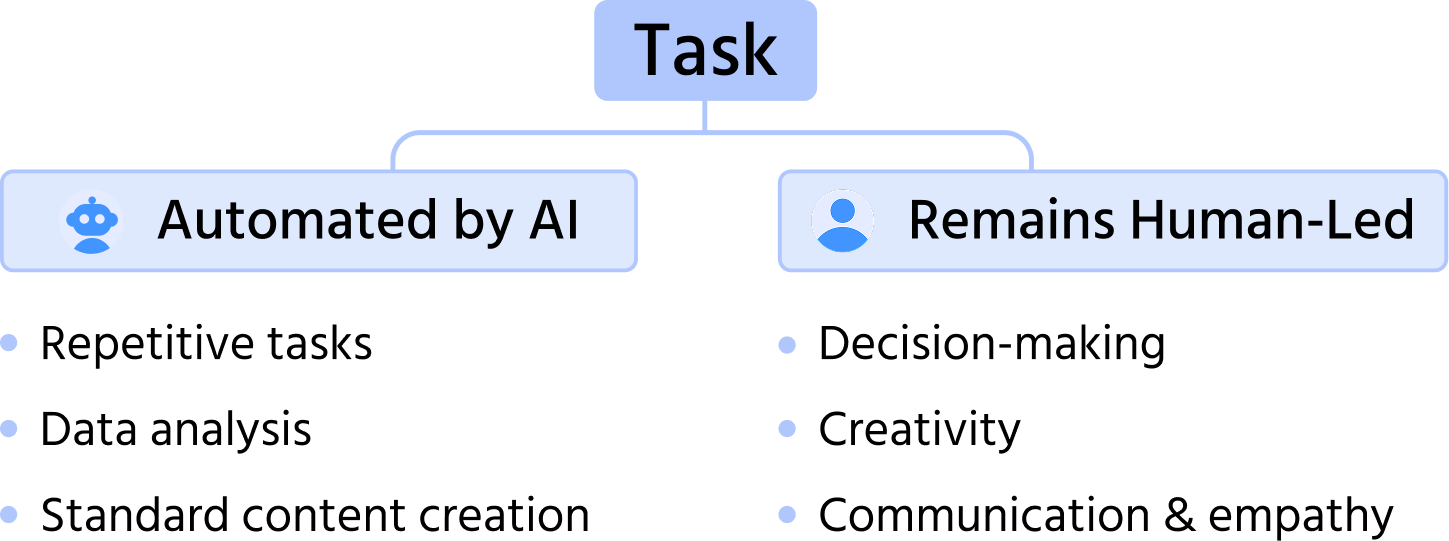
AI doesn't take over a profession as a whole, it takes over specific tasks inside it. From there, it's a question of what your particular job is made of, and how many of those tasks fall into the left-hand column.
High-Risk Professions
This category covers jobs where a significant share of the day-to-day work is already something a machine can do: faster, cheaper, with no time constraints. Demand for people in these roles will decline gradually, and the first parts to go are the repeatable, routine operations within the job, not the job as a whole.
First-Line Support Agents
AI-based chatbots can already carry on a full conversation, understand a customer's intent from free-form text rather than just menu clicks, pull data from a CRM, and resolve standard issues without a human. Processing a return, explaining how to change a plan, figuring out why a package didn't arrive — all routine for a system like this. It runs around the clock, in multiple languages at once, something that used to require an entire staff working shifts across regions.
A human steps in when the customer is genuinely upset, the question falls outside the script, or the resolution requires something the standard policy doesn't cover.
Data Entry Clerks
There's not much to argue about here. Optical character recognition paired with language models moves information from scans, PDFs, or photos into spreadsheets faster and more accurately than a person can, and without the fatigue-driven mistakes that creep in by row 500 at the end of a shift.
These systems can now also cross-check the data against itself, catching inconsistencies a tired human operator would have physically missed.
Junior Accountants and Payroll Specialists
Payroll calculations, invoice reconciliation, and standard tax reports were already being automated by software like QuickBooks long before AI entered the picture.
With language models layered in, the process gets smarter, not just faster: the system notices a sudden spike in some expense category and suggests an explanation, instead of just crunching the numbers mechanically.
Template-Content Copywriters
This isn't about writers with their own voice and point of view. It's about people writing standard product descriptions for an online store, rigidly structured SEO copy, or rewrites of other people's articles to dodge duplicate-content flags.
AI produces that kind of text in seconds. Good enough, not exceptional, but exceptional was never really the bar in that segment of the market to begin with.
Basic Translators
Not literary translation with its wordplay and nuance, and not a contract where every clause matters. Basic and technical translation: appliance manuals, business correspondence, simple documentation.
Current models handle this at a level that's indistinguishable from human work nine times out of ten, and they do it almost instantly.
Supporting Legal Assistants
Searching case law databases, drafting a standard lease or NDA from a template, doing a first pass through a large batch of documents before a deal — this used to take a junior associate hours, sometimes days. Now a draft is ready in minutes.
A human still handles the final review and carries the liability, but the volume of manual work has dropped sharply.
Drivers
One important caveat here: self-driving technology is advancing faster in lab conditions than regulation, insurance, and road infrastructure are catching up in the real world.
Widespread displacement isn't likely in the next few years. It's more of a fifteen-to-twenty-year horizon, and it varies a lot by country and type of transport. Long-haul trucking on highways gets automated well before city taxis navigating dense traffic.
Run Code from Your Browser - No Installation Required
Professions in Transition
The largest category by far: it includes most white-collar professions at the mid-to-senior skill level. The difference from the previous group is that AI can't do this work end-to-end, but it handles a specific, often the most time-consuming, part of it extremely well.
The profession doesn't disappear, it splits: into what a machine already handles, and what a person now needs to be good at to stay valuable. And that split is happening fast: work that counted as expert-level three years ago is a routine task for a language model with a decent prompt today.
Software Developers
Copilot, Claude, and similar tools already write a large share of boilerplate code, generate unit tests, catch common bugs, and suggest refactors. A junior developer who used to just write code against a finished spec is now competing with these tools, not with other juniors, and that's genuinely pushing up the bar for entry into the field.
In exchange, demand is growing for something else: designing system architecture end-to-end, doing a competent code review (including reviewing code the AI wrote, since it makes mistakes too), and figuring out why production broke at 2 a.m. when there's no ready-made answer anywhere online.
Marketers
Email copy, dozens of headline variants for an A/B test, banner ideas — seconds, and in several variations at once. That kind of brainstorm used to eat up a whole day for a team.
What's left for the human is what the algorithm still can't do: understand an audience at the level of "what actually annoys and motivates these people," build a long-term brand position, and decide which story to tell right now, given the market context and the company's reputation.
Journalists
Fact-checking routine news and writing short template pieces ("Company X's stock rose Y% following its earnings report") is nearly fully automated at this point, and a lot of news aggregators already rely on it.
Investigative journalism — where you have to earn a source's trust, piece together conflicting facts into a coherent story, and personally take responsibility for publishing something high-stakes — stays firmly human territory.
Teachers
Grading tests, generating exercises tailored to a specific student's level, even drafting an individual learning plan — education-focused AI tools already do all of this, and do it reasonably well.
But explaining a topic to a kid who still doesn't get it on the third try, in a different way each time, with patience and reading their reaction in the moment — that still calls for a live person. Teaching isn't just information transfer.
Doctors
AI reads MRI and X-ray scans, spots patterns in bloodwork, and in some narrow tasks (like detecting skin cancer from a photo) is already more accurate than the average physician.
But arriving at a final diagnosis that accounts for the full clinical picture, having an actual conversation with a patient about treatment, and taking responsibility for a decision in an ambiguous situation — that stays with the doctor. Probably for a long time, and not just because of the technology — it's a question of liability too.
Designers
Midjourney and similar tools can generate a hundred layout variations in the time it used to take to sketch one rough draft. That speeds up the "throw around ideas" phase enormously.
But someone still has to decide which of those hundred variations is the right one, and explain to the client why that one works for the brand. Taste and curation become the core skill, not technical execution.
A Real-World Example of AI Transformation
Software development is probably the clearest example of this shift: it shows exactly how a person's role changes once the routine part of the job gets handed to a machine.
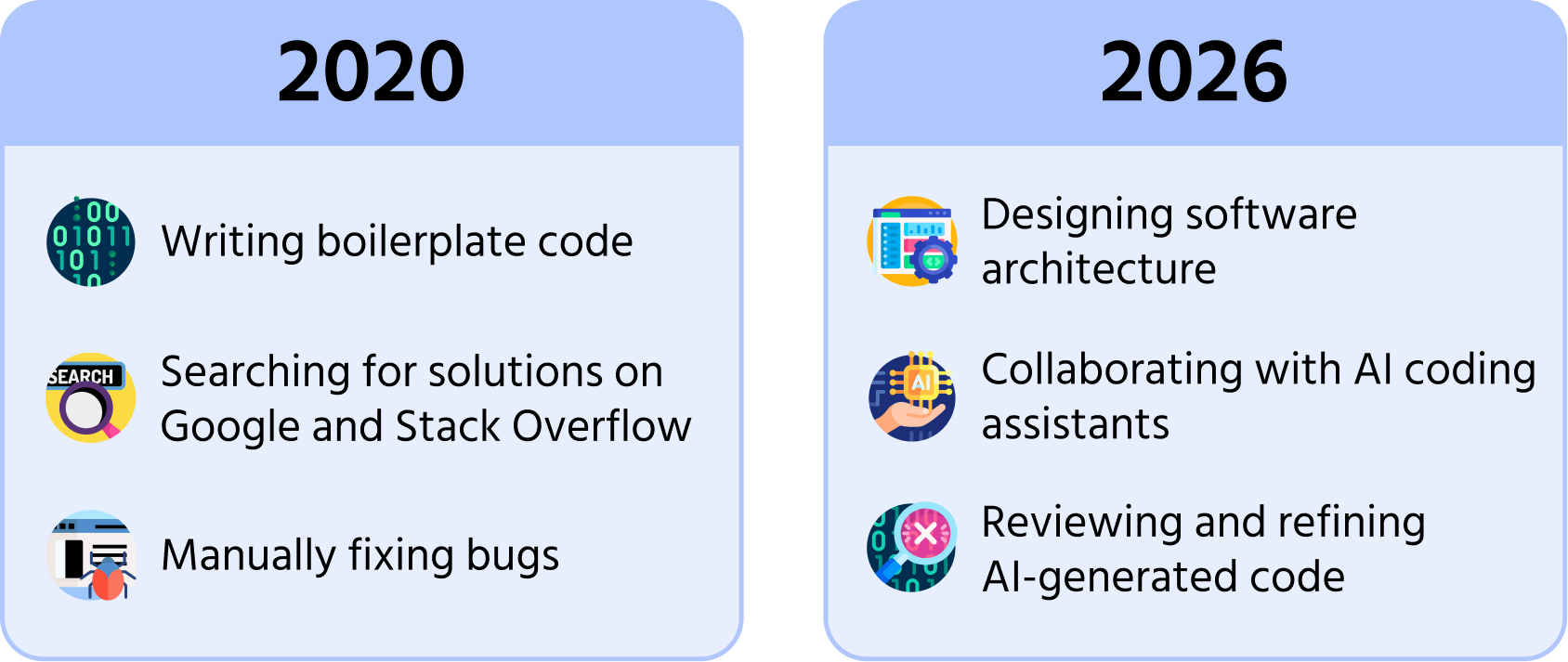
A junior developer's day in 2020 looked something like this: write boilerplate code against a spec, get stuck on a bug, spend half an hour searching Stack Overflow for a similar case, fix it by hand. In 2026, an AI assistant handles a lot of that routine work: the boilerplate, the searching, the first pass at debugging. What's left for the person is what always required experience anyway: designing the architecture, deciding which of the AI's suggested solutions actually fits the problem, and catching it when the assistant produces code that looks correct but isn't.
Professions That Are Safe
"Safe" in this context does not mean "immune to change". Over the next five to ten years, either AI remains physically incapable of performing this work, or people are not yet willing to entrust it to a machine, even where that is technically feasible.
This runs on different logic than the first two categories. Those were about a machine doing the task better or cheaper; this one is about the nature of the task itself requiring an unpredictable physical environment or human trust that doesn't transfer to an algorithm — at least not yet. Even here, AI is already showing up as a support tool, though, not as a replacement.
Therapists and Social Workers
There's plenty to debate about AI companions for therapy: they genuinely do a decent job with initial emotional support and they're available around the clock, which no human therapist can physically match.
But the deep work involved in a real crisis is built on trust between two specific people, on nonverbal cues, on the ability to pick up on what someone isn't saying out loud. That's not something an algorithm reproduces yet, no matter how convincing it sounds in a chat window.
Surgeons and Physical Therapists
Every patient's body is put together a little differently: blood vessels, tissue density, how they respond to a given procedure is unpredictable even for an experienced specialist. Precise motor skills in that kind of live, shifting environment is a task where even a less experienced but human surgeon still outperforms a robot.
Though robotic surgery is already widely used as a tool under human control, and that's not a small thing.
Electricians, Plumbers, and Construction Workers
Manual work in conditions that are a little different every time — an old house with a nonstandard layout, uneven walls, wiring some previous owner ran by eye thirty years ago with zero documentation. Robots are flatly worse at this kind of flexibility and on-the-spot improvisation.
There's also the physical access problem: automating work in hard-to-reach spaces just isn't economically worth it yet.
Executives and Strategists
Making decisions under genuinely incomplete information, with real accountability for outcomes affecting dozens or thousands of people, isn't just data analysis (which AI actually helps with quite a bit).
It's also being willing to personally own the consequences of the choice. There's no one else to pass that to besides a specific person with a name and a reputation attached.
Research Scientists
AI is excellent at analyzing large datasets, finding non-obvious correlations, even proposing hypotheses based on existing patterns.
But a genuinely new idea — the "what if" in an area no one has thought to ask about yet — remains largely human territory. That takes more than logic; it takes intuition built up over years.
Artists and Musicians
This isn't about the technical complexity of sound or image: AI is already pretty good at generating both. It's that audiences aren't paying just for the output, they're paying for the artist's identity and a live connection with them.
A concert by your favorite band isn't just sounds in the right order, it's a shared experience with specific people on a stage. Copying that is pointless, even where it's technically possible.
What to Actually Do about This
The point isn't to compete with AI on speed or volume: humans lose that race every time. The point is to use it as leverage and invest in exactly what it can't replicate: critical thinking, empathy, working under uncertainty, and the ability to curate a result rather than just generate one.
In practice, that looks something like this. A copywriter who uses AI for first drafts but owns the strategy and editing becomes more valuable, not less. A developer who can explain the architecture of a problem to an AI and clean up the bugs in its generated code works faster than a team doing everything by hand.
Start Learning Coding today and boost your Career Potential
Conclusion
AI doesn't eliminate work. It changes its shape, the same way the calculator, the internet, and email once did. Every time, some professions disappeared and new ones took their place. The difference this time is the speed at which it's happening.
FAQ
Q: Will AI completely eliminate certain professions?
A: Rarely in full. AI tends to automate specific tasks within a job rather than the entire role. Professions with a high share of repetitive, rule-based tasks — like data entry or template copywriting — will shrink the most, but even there, some human oversight usually remains.
Q: Which jobs are most at risk right now?
A: Roles built mostly around routine, formalizable tasks are most exposed: first-line customer support, data entry, junior accounting and payroll work, template-based copywriting, basic translation, and parts of legal assistant work. Driving is a longer-term risk due to regulatory and infrastructure delays, not a near-term one.
Q: Does this mean software developers are safe?
A: Not exactly safe, but not replaceable either. AI already handles a lot of boilerplate coding and debugging, which raises the bar for junior developers. What remains valuable is system architecture, code review, and solving problems that don't have a ready-made answer.
Q: What makes a profession "safe" from AI?
A: Two things, usually: an unpredictable physical environment (surgery, plumbing, construction) or a dependence on human trust and accountability that can't be outsourced to an algorithm (therapy, executive decision-making, scientific discovery).
Q: How soon will these changes happen?
A: It varies widely by profession. Some tasks, like data entry or basic translation, are already largely automated. Others, like widespread autonomous driving or fully AI-run customer service, are more likely a decade or more away due to regulation, trust, and infrastructure.
Q: If my job is at risk, what should I actually do?
A: Focus on the parts of the work AI can't replicate: judgment under uncertainty, creative decision-making, and building trust with people. Learning to use AI tools well, rather than competing with them, tends to make a person more valuable, not less.
Q: Is this the first time technology has reshaped the job market like this?
A: No. The calculator, the internet, and email all eliminated certain jobs while creating others. What's different this time is the speed at which the shift is happening.
Was this article helpful?
Share:
Was this article helpful?
Share:
Related courses
See All CoursesBeginner
AI Tools for Task Automation
Explore how modern AI tools can transform the way you work and create. Learn to streamline daily tasks, generate high quality content, and speed up production using intuitive platforms built for productivity, design, audio, and video. Write faster, automate repetitive work, design stunning visuals, clean up recordings, and turn ideas into engaging videos with the help of AI. No technical background is required. Perfect for creators, marketers, educators, freelancers, and busy professionals who want to work smarter and get more done with less effort. Gain practical experience with tools that simplify complex tasks and unlock new creative potential.
Beginner
Understanding AI for Work
AI is no longer optional — it's part of how work gets done in 2026. This course gives you a practical foundation for working with AI tools confidently and responsibly. No coding required. You'll learn how modern AI actually works, how to get useful results from it, what to watch out for, and how to apply it in your specific role — whether you're in marketing, HR, analytics, or development.
Beginner
Practical AI for Work
Master the skills needed to use AI tools like Claude at work, even with no technical background. Learn how large language models work, write prompts that get precise results, connect tools like web search and spreadsheets to your work, and build your own AI assistant to handle real tasks.
How to Learn Artificial Intelligence?
A Comprehensive Guide for Beginners

by Andrii Chornyi
Data Scientist, ML Engineer
Nov, 2024・15 min read

AI Agents in Intelligent Systems
Autonomous Agents
by Andrii Chornyi
Data Scientist, ML Engineer
May, 2024・9 min read

Understanding Temperature, Top-k, and Top-p Sampling in Generative Models
Temperature, Top-k, and Top-p Sampling
by Andrii Chornyi
Data Scientist, ML Engineer
Oct, 2024・9 min read

Content of this article
