Cursos relacionados
Ver Todos os CursosIniciante
AI Automation Workflows with n8n
n8n is a flexible automation platform for connecting apps, transforming data, and building AI-powered workflows. You'll develop strong fundamentals through real, practical examples, covering triggers, JSON handling, data-flow theory, AI integration, webhooks, and complete automation builds. The focus is on understanding how information moves through a workflow and how to structure that information so nodes and APIs behave predictably. The result is the ability to design, debug, and ship reliable automations that work end to end.

Iniciante
C++ Introduction
Start your path to becoming a skilled developer by mastering the foundational principles of programming through C++. Whether you're starting from scratch or already have some coding experience, this course will provide you with the solid foundation needed to become a proficient developer and open the doors to a wide range of career opportunities in software development and engineering. Let's study C++!

Iniciante
Java Basics
Learn the fundamentals of Java and its key features in this course. By the end, you'll be able to solve simple algorithmic tasks and gain a clear understanding of how basic console Java applications operate.

Are Junior Developers Being Replaced by AI
How AI changed entry-level software jobs and what junior developers must do to stay relevant

by Ihor Gudzyk
C++ Developer
Feb, 2026・
6 min read


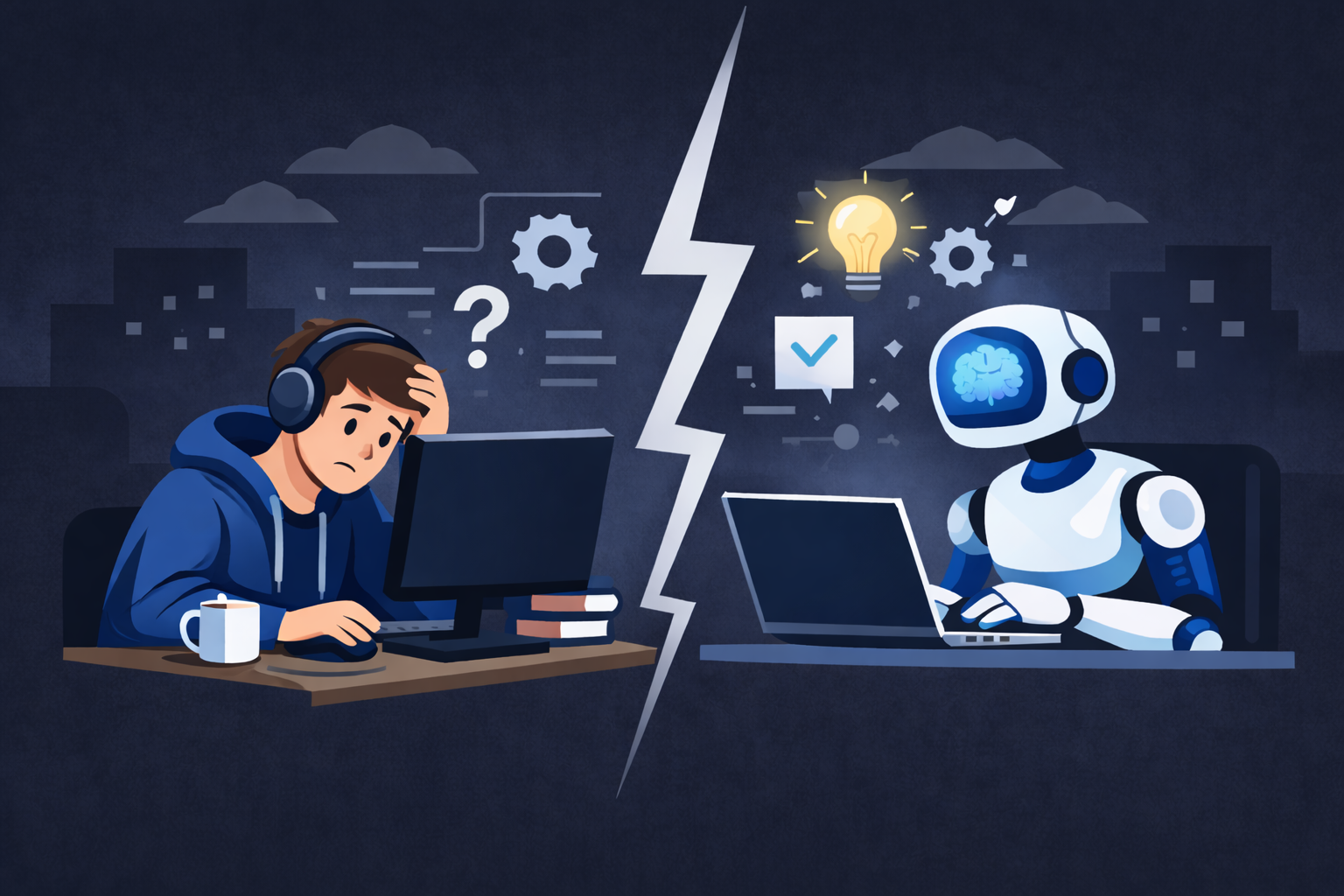
Over the last few years, AI tools have entered everyday software development. Code completion, bug fixing, documentation lookup, and even feature scaffolding are now automated.
As a result, many junior developers are asking the same question: Did AI take our jobs before we even started? The fear is understandable, but the conclusion is wrong.
What AI actually replaced
AI did not replace junior developers as people. It replaced junior-level work. Tasks that once justified entry-level roles are now automated:
- repetitive boilerplate code
- simple bug fixes
- syntax lookups and documentation searches
- basic feature scaffolding
These tasks were never the end goal of a junior role, they were stepping stones. AI simply removed the stepping stones.
Run Code from Your Browser - No Installation Required

Why companies hire fewer juniors now
This change did not happen in isolation. Several forces collided:
| Factor | What Changed | Impact on Junior Hiring |
|---|---|---|
| AI productivity boost | Senior developers can deliver more with AI assistance | Fewer entry-level hires are needed to support output |
| Smaller, leaner teams | Teams optimize for speed and efficiency | Less capacity for mentoring and supervision |
| Higher onboarding cost | Juniors require time before becoming productive | Companies delay or reduce junior hiring |
| Short-term business focus | Faster delivery is prioritized over long-term growth | Preference for immediately productive engineers |
Instead of announcing layoffs or policy changes, many companies quietly stopped opening traditional junior positions.
How the definition of entry-level changed
Entry-level roles used to focus on learning while doing basic work, with the expectation that most skills would be developed on the job. Today, entry-level means something different. Developers are expected to contribute with supervision rather than start from zero, take ownership of small features from start to finish, understand how their code fits into a larger system, and work productively with AI tools as part of their daily workflow. The title stayed the same, but the expectations clearly did not.
Start Learning Coding today and boost your Career Potential
What junior developers should focus on now
The path forward is not to compete with AI, but to use it intentionally. Junior developers should focus on:
- building small but complete projects
- understanding systems, not just syntax
- learning debugging and trade-offs
- treating AI as a collaborator, not an answer machine
These skills compound. Syntax does not. Junior developers were not replaced by AI. Unskilled junior roles were.
The career path still exists, but it now rewards awareness, ownership, and adaptability. Those who learn to think alongside AI will continue to grow. Those who rely only on memorization will struggle. This is not the end of entry-level development. It is the end of pretending that typing code was ever enough.
FAQs
Q: Are junior developer jobs disappearing because of AI?
A: No. Junior roles are changing, not disappearing. AI replaced many junior-level tasks, which raised expectations for what entry-level developers are expected to contribute.
Q: Is it still worth learning programming as a beginner in 2026?
A: Yes. Programming is still valuable, but beginners must learn how to think in systems, solve problems, and work alongside AI rather than relying only on memorizing syntax.
Q: Do companies still hire junior developers?
A: Yes, but fewer companies hire traditional juniors. Most now look for entry-level developers who can contribute productively with guidance instead of requiring full training from scratch.
Q: Should junior developers compete with AI tools?
A: No. The most successful juniors use AI as a productivity tool, reviewing its output, fixing mistakes, and applying judgment rather than treating it as a replacement for learning.
Q: What skills matter most for entry-level developers now?
A: Understanding fundamentals, debugging, system awareness, ownership of small features, and the ability to collaborate effectively with AI tools matter more than memorizing frameworks or syntax.
Q: Is this shift permanent or temporary?
A: The shift is likely permanent. AI-assisted development is becoming the standard, and entry-level roles will continue evolving around higher responsibility and real contribution.
Este artigo foi útil?
Compartilhar:
Este artigo foi útil?
Compartilhar:
Cursos relacionados
Ver Todos os CursosIniciante
AI Automation Workflows with n8n
n8n is a flexible automation platform for connecting apps, transforming data, and building AI-powered workflows. You'll develop strong fundamentals through real, practical examples, covering triggers, JSON handling, data-flow theory, AI integration, webhooks, and complete automation builds. The focus is on understanding how information moves through a workflow and how to structure that information so nodes and APIs behave predictably. The result is the ability to design, debug, and ship reliable automations that work end to end.
Iniciante
C++ Introduction
Start your path to becoming a skilled developer by mastering the foundational principles of programming through C++. Whether you're starting from scratch or already have some coding experience, this course will provide you with the solid foundation needed to become a proficient developer and open the doors to a wide range of career opportunities in software development and engineering. Let's study C++!
Iniciante
Java Basics
Learn the fundamentals of Java and its key features in this course. By the end, you'll be able to solve simple algorithmic tasks and gain a clear understanding of how basic console Java applications operate.
The 80 Top Java Interview Questions and Answers
Key Points to Consider When Preparing for an Interview

by Daniil Lypenets
Full Stack Developer
Apr, 2024・30 min read
How Python's GIL Works
Why a single lock defines the threading behavior of every CPython program – and what to do about it.
by Arsenii Drobotenko
Data Scientist, Ml Engineer
Mar, 2026・18 min read
Top 50 Python Interview Questions for Data Analyst
Common Python questions for DA interview

by Ruslan Shudra
Data Scientist
Apr, 2024・27 min read

Conteúdo deste artigo
