Cursos relacionados
Ver Todos os CursosHow AI Automation Efforts Can Lead to Massive Losses
Illusion of the AI Optimization

by Daniil Lypenets
Full Stack Developer
Feb, 2026・
9 min read


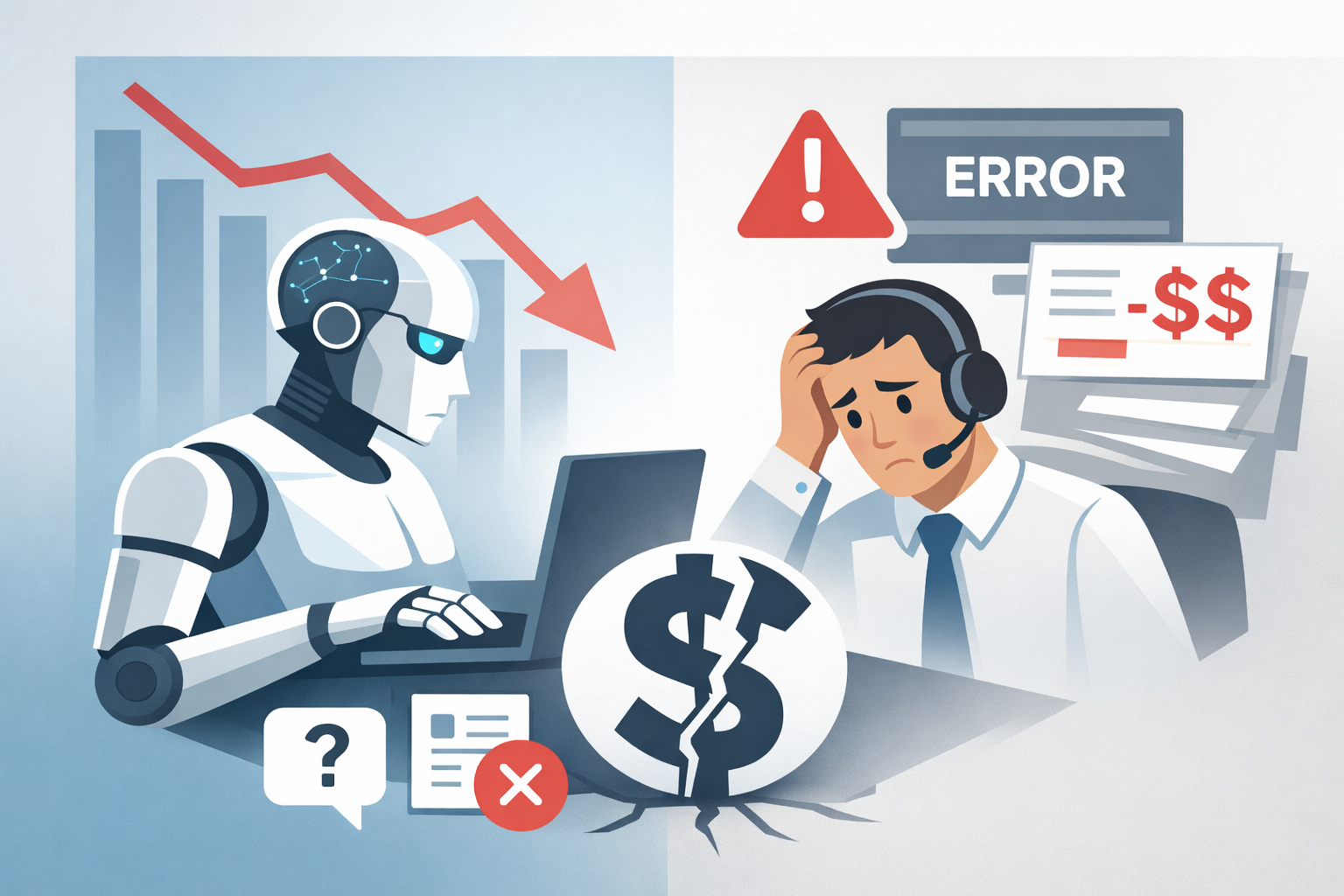
How AI Automation Efforts Can Lead to Massive Losses
Artificial intelligence is often presented as the ultimate efficiency engine. Reduce costs. Replace repetitive labor. Scale customer support instantly. Automate decision making.
In theory, this sounds rational. In practice, poorly designed AI automation strategies are already causing financial damage, reputational harm, operational breakdowns, and long term strategic losses.
The real danger is not AI itself. The danger is replacing human systems with AI agents in areas where judgment, nuance, context, and accountability are critical.
Especially in search, knowledge retrieval, and customer support.
Automation can reduce friction. But blind automation can multiply risk.
The Illusion of Cost Reduction
Executives often see AI as a direct replacement for salary expenses. A support agent costs money. A search analyst costs money. A QA specialist costs money. An AI agent appears cheaper.
However, cost savings on payroll can quickly be outweighed by hidden losses:
-
Incorrect answers that cause refunds and chargebacks;
-
Escalations that overwhelm remaining staff;
-
Compliance violations due to hallucinated information;
-
Customer churn caused by frustration;
-
Loss of trust that damages brand reputation.
When an AI system provides incorrect legal, medical, financial, or contractual information, the downstream impact can be exponential.
Human employees make mistakes. But they also escalate uncertainty. AI systems frequently deliver confident, incorrect answers.
Confidence without accountability is expensive.
When AI Replaces Support Teams
One of the most aggressive automation strategies in 2025 and 2026 has been replacing first line support teams with AI chat systems.
The problem is not that AI cannot answer simple questions. It can. The problem is that businesses underestimate edge cases.
Customer support conversations often include:
-
Ambiguous phrasing;
-
Emotional distress;
-
Complex billing history;
-
Multi step problem chains;
-
Policy exceptions;
-
Regulatory constraints.
AI agents tend to optimize for average scenarios. But real customer frustration lives in outliers.
When a human agent senses confusion, they ask clarifying questions. They detect emotional tone. They adapt language. They escalate unusual cases.
AI systems frequently do not recognize when they should stop answering.
The result is circular conversations, incorrect troubleshooting steps, and customers who feel ignored.
Frustrated customers rarely complain quietly. They leave. Or they post publicly.
In highly competitive markets, that damage compounds quickly.
Search Automation and the Risk of Wrong Information
Many companies now deploy AI powered internal search and knowledge assistants to replace human research roles.
The risk is subtle but serious.
Search systems based on large language models generate answers, not citations. Even when connected to internal databases, retrieval errors or context misinterpretation can produce misleading summaries.
If an AI assistant:
-
Misreads a contract clause;
-
Summarizes a policy incorrectly;
-
Omits a regulatory constraint;
-
Pulls outdated documentation.
the error may go unnoticed until a decision is executed.
In legal, healthcare, fintech, and enterprise environments, that mistake can translate into regulatory fines or litigation exposure.
Automation accelerates execution. It also accelerates error propagation.
A human researcher might take longer. But they also tend to validate uncertainty.
Run Code from Your Browser - No Installation Required

The Accountability Vacuum
AI systems do not carry responsibility.
When a human employee makes a mistake, there is a review process. Training adjustments. Policy revisions.
When an AI system makes a mistake, responsibility becomes diffused:
-
Was the prompt unclear;
-
Was the training data biased;
-
Was the integration faulty;
-
Was the model outdated.
This ambiguity delays corrective action.
In highly automated systems, small configuration errors can affect thousands of customers before detection.
Automation increases scale. Scale increases blast radius.
Over Automation and Strategic Myopia
Another major risk is strategic blindness.
Companies that aggressively automate may remove human touchpoints that generate qualitative insights.
Support agents surface recurring product problems. Sales teams detect shifts in buyer sentiment. Researchers notice emerging edge cases.
If those human signals disappear, leadership loses early warning systems.
AI may handle transactions efficiently, but it does not understand emerging market signals unless explicitly programmed and monitored.
Short term efficiency can erode long term adaptability.
Hallucinations at Enterprise Scale
Large language models generate responses based on probability patterns, not grounded reasoning.
Even with retrieval systems and guardrails, hallucinations remain a structural limitation.
In a consumer setting, a wrong answer may cause minor inconvenience.
In enterprise automation, hallucinations can:
-
Generate inaccurate compliance guidance;
-
Produce fabricated technical instructions;
-
Recommend invalid troubleshooting steps;
-
Misclassify high risk customers.
The danger is not occasional error. It is systemic repetition of error at scale.
Automation removes friction. Friction sometimes protects you.
Human Replacement vs Human Augmentation
There is a fundamental difference between using AI to assist humans and using AI to replace them.
Augmentation preserves oversight. Replacement removes it.
The most resilient organizations in 2026 are not those that eliminated people fastest. They are those that redesigned workflows so that AI handles structured tasks while humans retain:
-
Final decision authority;
-
Escalation review;
-
Edge case handling;
-
Policy interpretation;
-
Ethical oversight.
The cost of maintaining hybrid systems may appear higher initially. But the cost of large scale automation failure is significantly higher.
Start Learning Coding today and boost your Career Potential
Conclusion
AI automation is not inherently dangerous. Poorly designed automation is.
Replacing human agents with AI in search and support environments introduces risks that are often invisible in financial projections.
Automation increases speed. Speed amplifies mistakes. Mistakes at scale become losses.
Organizations that treat AI as an efficiency shortcut often discover that complexity does not disappear. It shifts.
The question is not whether to automate. The question is where automation increases resilience and where it removes necessary judgment.
Blind replacement is rarely strategic. Responsible integration is.
FAQ
Q: Is replacing customer support agents with AI always a bad idea?
A: No, but replacing them entirely without human oversight is risky. AI works well for structured, repetitive questions, but complex, emotional, or high stakes issues require human judgment. A hybrid model significantly reduces financial and reputational risk.
Q: Can AI search systems fully replace human researchers?
A: No. AI search systems can accelerate information retrieval, but they can misinterpret context, omit constraints, or summarize incorrectly. Human validation is essential when decisions have legal, financial, or regulatory consequences.
Q: Why do AI chat systems sometimes frustrate customers more than help them?
A: Because AI optimizes for common patterns, not individual nuance. It may fail to detect emotional signals, edge cases, or when escalation is required. Repetitive or incorrect responses create the perception that the company is not listening.
Q: Is hallucination still a real problem in 2026?
A: Yes. Although models are improving, hallucinations remain a structural limitation of probabilistic generation. Guardrails reduce risk but do not eliminate it, especially in high complexity enterprise environments.
Q: Does automation always reduce costs?
A: Not necessarily. Direct salary savings can be offset by increased refunds, compliance exposure, customer churn, reputational damage, and the cost of correcting systemic AI errors.
Q: What is the safest way to introduce AI automation?
A: Introduce AI as an augmentation layer rather than a full replacement. Keep humans in decision loops, monitor outputs continuously, define clear escalation triggers, and measure downstream impact instead of only short term cost reduction.
Q: Why do companies still rush to replace humans with AI?
A: Because efficiency metrics are easier to quantify than long term risk. Cost per ticket is measurable. Trust erosion and brand damage are harder to model until they become visible losses.
Q: Can full AI automation ever be safe?
A: Only in tightly constrained, low risk environments with well defined inputs and outputs. In dynamic, ambiguous, or high stakes domains, full automation significantly increases systemic vulnerability.
Este artigo foi útil?
Compartilhar:
Este artigo foi útil?
Compartilhar:
Cursos relacionados
Ver Todos os CursosHow to Learn Artificial Intelligence?
A Comprehensive Guide for Beginners

by Andrii Chornyi
Data Scientist, ML Engineer
Nov, 2024・15 min read

AI Agents in Intelligent Systems
Autonomous Agents
by Andrii Chornyi
Data Scientist, ML Engineer
May, 2024・9 min read

Understanding Temperature, Top-k, and Top-p Sampling in Generative Models
Temperature, Top-k, and Top-p Sampling
by Andrii Chornyi
Data Scientist, ML Engineer
Oct, 2024・9 min read

Conteúdo deste artigo
