Relaterade kurser
Visa samtliga kurserNybörjare
Introduction to Redis
This course will introduce you to the fundamentals of Redis and its use in real-world applications. We'll cover key Redis commands, data types, key expiration and transactions, as well as how to integrate Redis with Spring for efficient data caching.

Medelnivå
Redis Intermediate Concepts
Dive deeper into Redis by exploring its internal mechanisms, advanced data structures, and scaling strategies. This course is designed for learners who already understand the basics and want to master Redis for more complex, high-performance applications.
Nybörjare
Caching in Spring Boot with Redis
Learn how to implement and configure caching in Spring Boot applications using Redis. Explore Redis integration, Spring caching annotations, and practical strategies for managing cache and improving application performance in backend systems.
What Is Redis and What Is It Used For
A practical guide to Redis: how in-memory storage works, why it’s so fast, and how to use it for caching, sessions, and real-time features.

by Eugene Obiedkov
Full Stack Developer
Mar, 2026・
6 min read


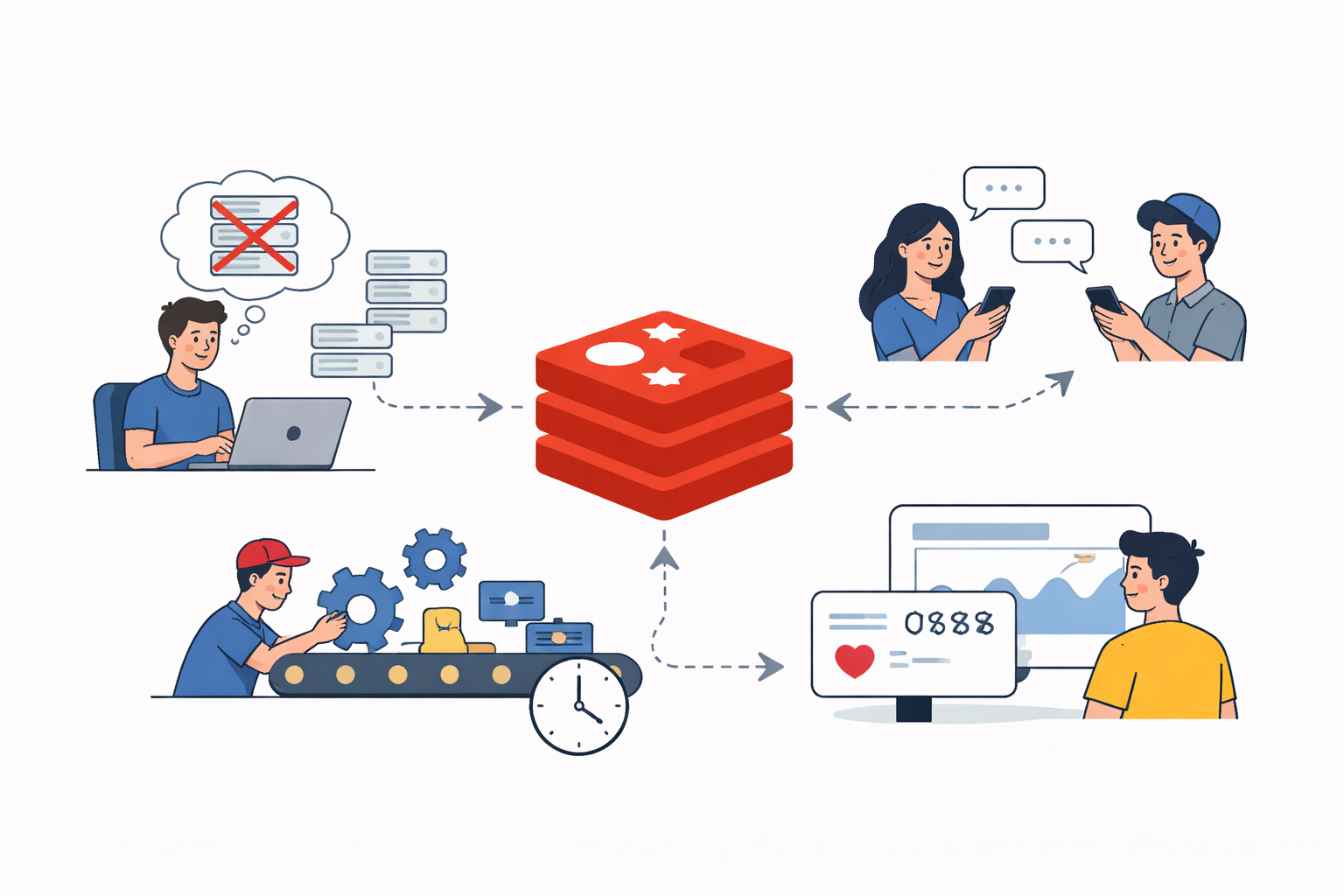
Redis is a high-performance data store that operates in memory. It’s widely used to speed up applications, cache data, and handle real-time workloads. Thanks to its speed and flexibility, Redis has become a go-to tool in modern backend development.
What Is Redis
Redis (Remote Dictionary Server) is an in-memory key–value database. This means data is stored in a simple format:
key -> value
Example:
"user:1:name" -> "John"
"user:1:age"  -> 25
The key advantage of Redis is that it keeps data in RAM instead of on disk like traditional databases. This allows operations to run extremely fast—typically in milliseconds.
At the same time, Redis can persist data to disk to prevent data loss after restarts.
How Redis Works
Imagine you have an application connected to a database like MySQL. Every time a user makes a request, the app queries the database, which takes time.
Redis sits between your app and the database:
Client → Redis → Database
Typical flow:
- A user requests data;
- The app checks Redis first;
- If the data is found, it’s returned instantly;
- If not, the app fetches it from the database, stores it in Redis, and returns it.
This pattern is called caching.
Run Code from Your Browser - No Installation Required

What Redis Is Used For
Caching
This is Redis’s primary role.
Example: an e-commerce app You request a product:
GET /products/1
Instead of hitting the database every time:
First request → fetch from DB and store in Redis
Next requests → serve directly from Redis
Example (pseudo-code):
String product = redis.get("product:1");

if (product == null) {
    product = database.getProduct(1);
    redis.set("product:1", product);
}
Result: significantly faster responses and reduced database load.
Storing User Sessions
When users log in, session data can be stored in Redis:
session:abc123 -> {userId: 1, role: "admin"}
Why Redis works well here:
- fast access;
- built-in expiration (TTL);
- automatic cleanup of old sessions.
Pub/Sub (Real-Time Messaging)
Redis supports a publish/subscribe model.
Example: a chat app
- A user sends a message;
- Redis publishes it to a channel;
- All subscribers receive it instantly.
User A → Redis channel → User B, User C
This is commonly used for chats, notifications, and live updates.
Queues and Background Jobs
Redis can act as a lightweight task queue.
Example:
- A user uploads an image;
- A job is added to Redis;
- A worker processes it asynchronously.
queue:images -> ["img1.jpg", "img2.jpg"]
Benefits:
- offloads work from the main app;
- enables async processing.
Counters and Analytics
Redis is great for tracking counters:
page:home:views -> 10234
Increment operation:
INCR page:home:views
Used for: likes, views, metrics and analytics.
When You Should Use Redis
You should consider using Redis when your application needs a noticeable performance boost, especially in cases where the same data is requested repeatedly. Instead of querying the main database every time, Redis allows you to store and quickly retrieve frequently accessed data, significantly reducing response time.
It is also a strong choice when your application relies on real-time processing, such as chat systems, live notifications, or streaming updates. In these scenarios, the speed of in-memory operations makes a clear difference in user experience.
Overall, Redis becomes especially valuable in systems where performance is critical and even small delays can impact scalability or user satisfaction.
Summary
Redis is a powerful tool for improving performance and enabling real-time features. While it’s most commonly used for caching, it also supports queues, messaging, and analytics.
Put simply: Redis helps make your application faster and more responsive without changing your core logic.
Start Learning Coding today and boost your Career Potential
FAQ
Q: What is Redis in simple terms?
A: Redis is an in-memory database that stores data as key–value pairs. It is designed for speed and is commonly used to cache data, manage sessions, and handle real-time features.
Q: Why is Redis so fast?
A: Redis is fast because it stores data in RAM instead of reading from disk. It also uses an efficient data model and a single-threaded architecture, which reduces overhead and avoids locking issues.
Q: Is Redis a replacement for a traditional database?
A: No, Redis is not meant to fully replace traditional databases like MySQL or PostgreSQL. It is typically used alongside them to improve performance, especially for caching and quick data access.
Q: What is caching and how does Redis help with it?
A: Caching means storing frequently accessed data in a fast storage layer. Redis helps by keeping this data in memory, allowing applications to retrieve it much faster than from a database.
Q: Can Redis store complex data structures?
A: Yes, Redis supports various data types such as strings, lists, sets, hashes, and sorted sets. This makes it flexible for different use cases beyond simple key–value storage.
Q: What happens to data in Redis after a restart?
A: Redis can be configured to persist data to disk. This means that even after a restart, the data can be restored, depending on the persistence settings.
Q: When should I not use Redis?
A: You should avoid using Redis as your only data store if your data is critical, requires complex queries, or exceeds available memory. It works best as a complementary tool, not a primary database.
Q: What are common real-world use cases for Redis?
A: Redis is commonly used for caching, session storage, real-time messaging (Pub/Sub), background job queues, and tracking counters like views or likes.
Var denna artikel nyttig?
Dela:
Var denna artikel nyttig?
Dela:
Relaterade kurser
Visa samtliga kurserNybörjare
Introduction to Redis
This course will introduce you to the fundamentals of Redis and its use in real-world applications. We'll cover key Redis commands, data types, key expiration and transactions, as well as how to integrate Redis with Spring for efficient data caching.
Medelnivå
Redis Intermediate Concepts
Dive deeper into Redis by exploring its internal mechanisms, advanced data structures, and scaling strategies. This course is designed for learners who already understand the basics and want to master Redis for more complex, high-performance applications.
Nybörjare
Caching in Spring Boot with Redis
Learn how to implement and configure caching in Spring Boot applications using Redis. Explore Redis integration, Spring caching annotations, and practical strategies for managing cache and improving application performance in backend systems.
Innehållet i denna artikel
