Курси по темі
Всі курсиEngineering Distributed Data Processing at Scale with MapReduce
Architectural Foundations Of Parallel Computation In Big Data
by Radomanova Sofia
Data Analyst
May, 2026・
5 min read


Introduction
In the era of Big Data, the primary bottleneck for software systems is often not CPU clock speed, but I/O and the sheer volume of data residing on disk. Traditional single-server processing models collapse when faced with petabyte-scale datasets. MapReduce, a programming model popularized by Google, solved this by shifting the paradigm from "moving data to the code" to "moving the code to the data." By abstracting away the complexities of parallelization, fault tolerance, and data distribution, MapReduce allows engineers to process massive datasets across thousands of commodity servers with mathematical reliability.
The Core Functional Stages: A Simplified View
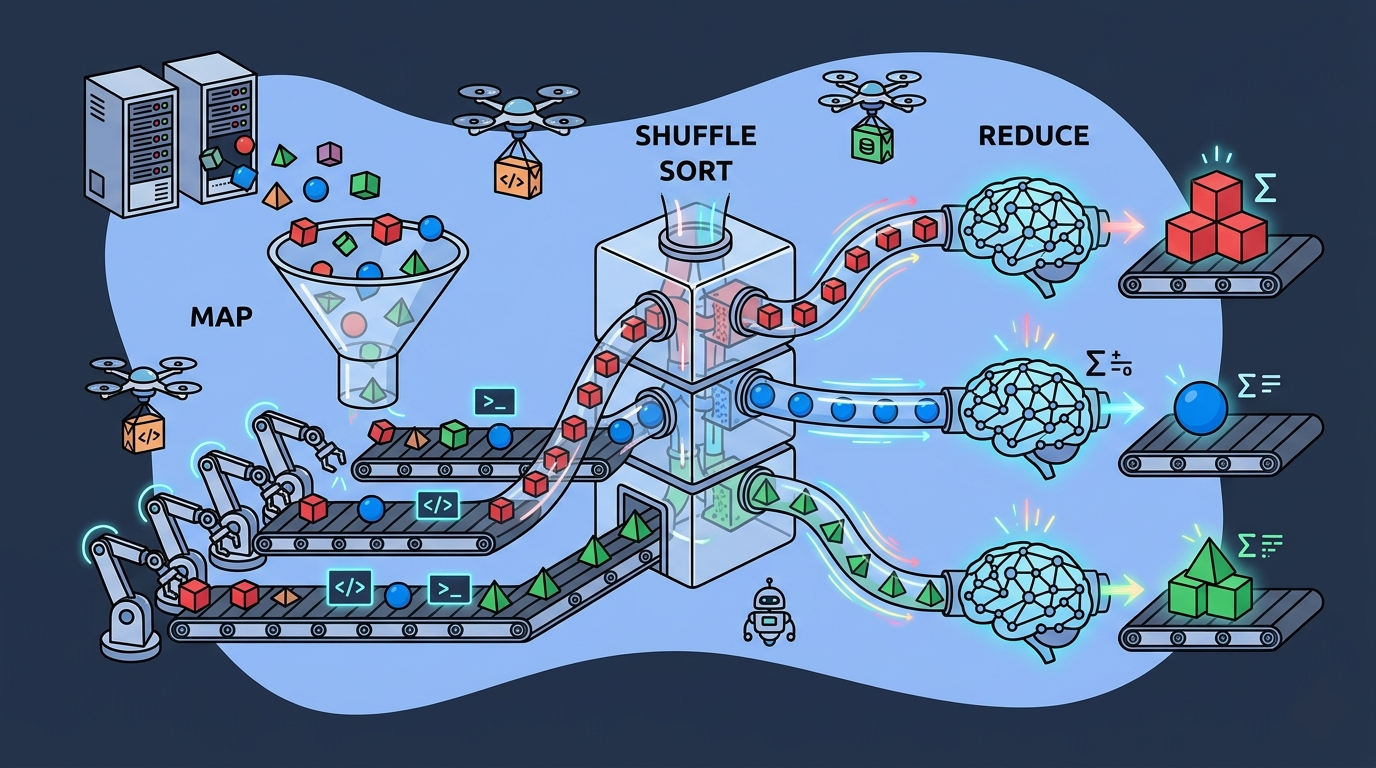
To understand MapReduce, imagine you are counting the total number of different colored marbles in ten massive warehouses. You could count them yourself (Single Server), which would take years, or you could hire a manager for each warehouse (Distributed Processing).
1. The Map Phase (The "Local Count")
Each warehouse manager (Mapper) goes through their specific inventory. Their job is not to give you the final total, but to create a list of what they see.
- Input: raw data (A box of marbles);
- Action: for every red marble found, they write down ("red", 1);
- Output: a long list of intermediate key-value pairs.
2. The Shuffle and Sort Phase (The "Logistics")
The "Shuffle" is the most critical architectural stage. This is where the central system takes all the lists from the managers and ensures that all "red" notes go to one person, all "blue" notes to another. This is complex because it involves moving data across a network, ensuring that the worker responsible for "red" receives every single "red" note from every warehouse.
3. The Reduce Phase (The "Final Tally")
The Reducer receives a pile of notes for a single color, for example: ("red", [1, 1, 1, 1]). Their job is simple: sum them up.
- Action: ;
- Output: the final result: ("red", 4).
Run Code from Your Browser - No Installation Required

Implementation: Word Count in Python
While production MapReduce often uses Java (Hadoop) or Scala (Spark), the logic is most clearly demonstrated using Python. This example simulates the MapReduce process on a text file.
def mapper(text_line):
    """
    Simulates the Map phase.
    Input: 'Hello world hello'
    Output: [('hello', 1), ('world', 1), ('hello', 1)]
    """
    results = []
    words = text_line.lower().split()
    for word in words:
        results.append((word, 1))
    return results

def reducer(key, list_of_values):
    """
    Simulates the Reduce phase.
    Input: 'hello', [1, 1, 1]
    Output: ('hello', 3)
    """
    return (key, sum(list_of_values))

# Execution Simulation
lines = ["Blue marble Red marble", "Red marble Green marble"]

# 1. Map
intermediate = []
for line in lines:
    intermediate.extend(mapper(line))

# 2. Shuffle (Grouping by key)
groups = {}
for key, value in intermediate:
    if key not in groups:
        groups[key] = []
    groups[key].append(value)

# 3. Reduce
final_counts = [reducer(word, counts) for word, counts in groups.items()]

print(final_counts)
# Result: [('blue', 1), ('marble', 4), ('red', 2), ('green', 1)]
Conclusion
MapReduce established the "Divide and Conquer" blueprint for the modern cloud. While real-time engines like Apache Spark are faster because they work in RAM (memory), MapReduce remains the standard for massive, non-time-sensitive batch jobs where reliability and disk-based processing are paramount.
Start Learning Coding today and boost your Career Potential
FAQs
Q: Why is MapReduce slower than Spark?
A: MapReduce writes to the physical disk after every stage to ensure data isn't lost if a server dies. Spark keeps data in RAM, which is much faster but more expensive.
Q: Can I use MapReduce for real-time streaming?
A: No. MapReduce is a "Batch" processing model. It waits for the entire data set to be ready before starting. For streaming, tools like Flink or Kafka Streams are used.
Q: What is the "Key" in MapReduce?
A: The key is the identifier you want to group by. If you want to find the average temperature per city, the "City" is your key, and the "Temperature" is your value.
Ця стаття була корисною?
Поділитися:
Ця стаття була корисною?
Поділитися:
Курси по темі
Всі курси

Зміст
