Курси по темі
Всі курсиHTTP 1.1 vs HTTP 2 vs HTTP 3
Key Differences and Performance Improvements Across HTTP/1.1, HTTP/2, and HTTP/3

by Eugene Obiedkov
Full Stack Developer
Feb, 2026・
9 min read


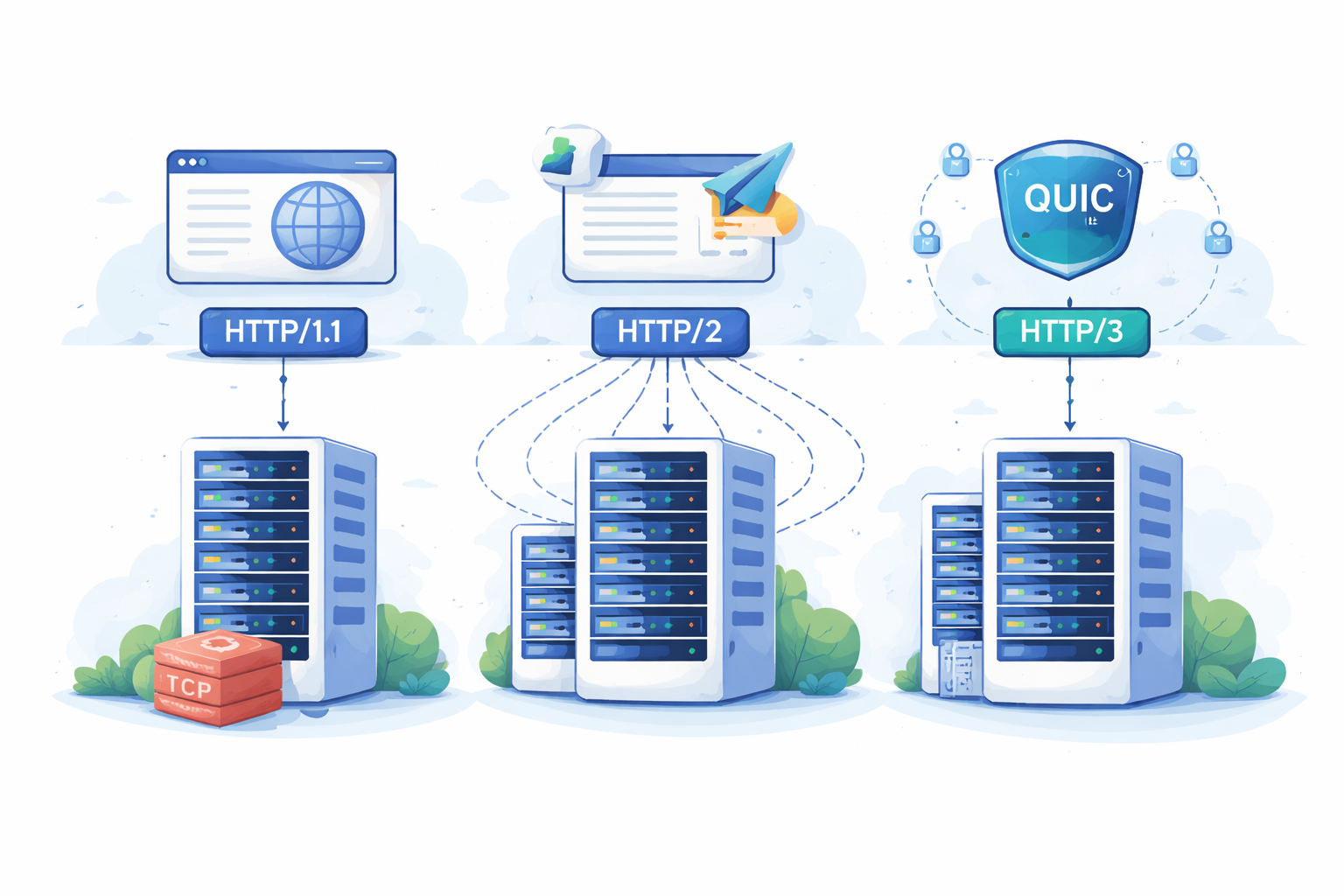
The Hypertext Transfer Protocol (HTTP) is the foundation of the web, enabling communication between clients—like browsers or apps—and servers. Over the years, HTTP has evolved from HTTP/1.1 to HTTP/2 and now HTTP/3, each iteration addressing the limitations of its predecessor while improving speed, reliability, and security. For developers and system architects, understanding these differences is essential for building modern, high-performance web applications.
Web traffic today is heavier than ever, with pages including dozens of assets, scripts, images, and APIs. Protocol efficiency directly affects page load times, server load, and overall user experience. Choosing the right HTTP version can mean the difference between a fast, responsive application and a sluggish one.
HTTP/1.1: The Classic Workhorse
HTTP/1.1, standardized in 1997, was a major improvement over HTTP/1.0. It introduced persistent connections, allowing multiple requests over a single TCP connection, which reduced the overhead of repeatedly opening and closing connections. It also offered optional pipelining, which allowed the client to send multiple requests without waiting for responses. These improvements made the web more efficient for its time.
However, HTTP/1.1 has significant limitations. Head-of-line blocking at the TCP level means that a slow request can delay all subsequent requests on the same connection. To work around this, browsers often open multiple simultaneous connections to the same server, which can increase memory and CPU usage on both client and server. This architecture struggles with modern web applications that load many small assets or perform multiple API calls simultaneously.
Despite these drawbacks, HTTP/1.1 is still widely used because of its simplicity, broad support, and compatibility with legacy systems.
Run Code from Your Browser - No Installation Required

HTTP/2: Speed, Multiplexing, and Compression
HTTP/2, finalized in 2015, was designed to address many of the inefficiencies in HTTP/1.1 while remaining backward compatible. Its most notable feature is multiplexing, which allows multiple requests and responses to be sent simultaneously over a single TCP connection without blocking each other. This eliminates the need for multiple parallel connections, reducing resource consumption on both client and server.
HTTP/2 also introduced header compression using HPACK. This reduces the amount of redundant metadata sent with every request, which is especially valuable when requests include large cookies or complex headers. Another innovation is server push, where the server can proactively send resources to the client before they are requested, further reducing latency in page loading.
While HTTP/2 solves many HTTP/1.1 problems, it still relies on TCP. This means head-of-line blocking at the transport layer persists: if a TCP packet is lost, all streams on that connection must wait for retransmission. Despite this, HTTP/2 provides significant performance improvements for most modern web applications.
HTTP/3: QUIC and the Future of HTTP
HTTP/3, finalized in 2020, represents a more radical departure. It uses QUIC, a transport protocol built on UDP instead of TCP. By doing this, HTTP/3 eliminates TCP-level head-of-line blocking entirely. QUIC integrates encryption (TLS 1.3) by default and allows faster connection establishment, even supporting 0-RTT connections, where repeat visits can start data transfer immediately without a full handshake.
These improvements make HTTP/3 particularly effective for high-latency or unreliable networks, such as mobile connections. HTTP/3 also handles multiple simultaneous requests more efficiently, reducing delays caused by packet loss or slow connections. While support for HTTP/3 is growing in modern browsers, server infrastructure and network devices must be configured properly to fully leverage QUIC.
The adoption of HTTP/3 will continue to accelerate as more applications prioritize speed, reliability, and improved mobile performance. Its design anticipates the needs of the modern web far beyond what HTTP/1.1 and HTTP/2 can achieve.
Comparing the Three Versions
Each HTTP version builds on the previous one while addressing key limitations. HTTP/1.1 is simple and reliable but struggles with multiple simultaneous requests and high-latency networks. HTTP/2 solves many of these issues with multiplexing and compression, offering faster load times for pages with many assets. HTTP/3 goes a step further by replacing TCP with QUIC, reducing latency and improving reliability on lossy networks.
Encryption is optional in HTTP/1.1, standard in HTTP/2, and mandatory in HTTP/3. Connection establishment becomes progressively faster from HTTP/1.1 to HTTP/3, and modern web applications benefit the most from HTTP/3’s ability to recover quickly from network interruptions.
Start Learning Coding today and boost your Career Potential
When to Use Each Version
HTTP/1.1 is appropriate for legacy applications or simple services where modern features are unnecessary. HTTP/2 is suitable for most contemporary websites, reducing latency, improving resource utilization, and enabling server push. HTTP/3 is ideal for mobile-first applications, global services, or systems that require low latency and resilience against unreliable network conditions. Planning for HTTP/3 now ensures your architecture is future-proof as adoption grows.
Conclusion
The evolution from HTTP/1.1 to HTTP/2 and HTTP/3 reflects the changing demands of the modern web. Each version improves speed, reduces latency, and enhances reliability in its own way. For developers and architects, understanding these differences is crucial to building efficient, scalable, and high-performance applications. Adopting the right HTTP version can dramatically improve user experience, reduce server load, and prepare systems for the web’s increasingly demanding traffic.
FAQ
Q: What is the main difference between HTTP/1.1, HTTP/2, and HTTP/3?
A: The main difference lies in how requests and connections are handled. HTTP/1.1 uses TCP with limited pipelining and suffers from head-of-line blocking. HTTP/2 introduces multiplexing and header compression but still relies on TCP. HTTP/3 replaces TCP with QUIC over UDP, eliminating transport-level blocking and enabling faster, more reliable connections.
Q: Should I upgrade my website to HTTP/3 immediately?
A: Upgrading to HTTP/3 is beneficial for improving speed, especially on mobile or unreliable networks. However, HTTP/2 already provides significant improvements over HTTP/1.1. You should ensure server support and client compatibility before fully switching, but starting adoption now future-proofs your application.
Q: Is HTTP/2 compatible with HTTP/1.1?
A: Yes. HTTP/2 was designed to be backward compatible. Servers and clients that support HTTP/2 can fall back to HTTP/1.1 if needed, allowing gradual adoption without breaking existing systems.
Q: How does server push in HTTP/2 work, and is it widely used?
A: Server push allows the server to proactively send resources before the client requests them, reducing page load times. While powerful, it’s complex to implement and not universally used, as improperly configured pushes can waste bandwidth.
Q: Does HTTP/3 require special network configuration?
A: HTTP/3 uses QUIC over UDP, which may require updates to firewalls, proxies, and load balancers that previously handled only TCP traffic. Most modern infrastructure supports QUIC, but checking compatibility is essential for a smooth rollout.
Q: How does encryption differ across HTTP versions?
A: Encryption is optional in HTTP/1.1, standard in HTTP/2, and mandatory in HTTP/3 (TLS 1.3). This ensures modern HTTP connections are secure by default, improving privacy and reducing the risk of interception.
Q: Can HTTP/3 improve performance on slow or lossy networks?
A: Yes. QUIC’s design allows faster recovery from packet loss, eliminates TCP-level head-of-line blocking, and reduces latency with 0-RTT connections, making HTTP/3 ideal for mobile or unreliable connections.
Q: Is it necessary to support all three versions simultaneously?
A: Supporting multiple versions ensures compatibility with all clients. HTTP/3 is supported by modern browsers, but some older clients still use HTTP/2 or HTTP/1.1. Graceful fallback ensures a reliable experience for all users.
Ця стаття була корисною?
Поділитися:
Ця стаття була корисною?
Поділитися:
Курси по темі
Всі курсиTop 25 C# Interview Questions and Answers
Master the Essentials and Ace Your C# Interview

by Ihor Gudzyk
C++ Developer
Nov, 2024・17 min read

Best Laptops for Coding in 2024
Top Picks and Key Features for the Best Coding Laptops

by Anastasiia Tsurkan
Backend Developer
Aug, 2024・12 min read

10 Developer Tasks You Can Already Delegate to AI
How AI quietly takes over repetitive dev work
by Eugene Obiedkov
Full Stack Developer
Feb, 2026・6 min read

Зміст
