Gerelateerde cursussen
Bekijk Alle CursussenIsolation Levels in Databases Explained
Understanding Transaction Isolation Levels and Concurrency Control in Modern Databases

by Eugene Obiedkov
Full Stack Developer
Feb, 2026・
10 min read


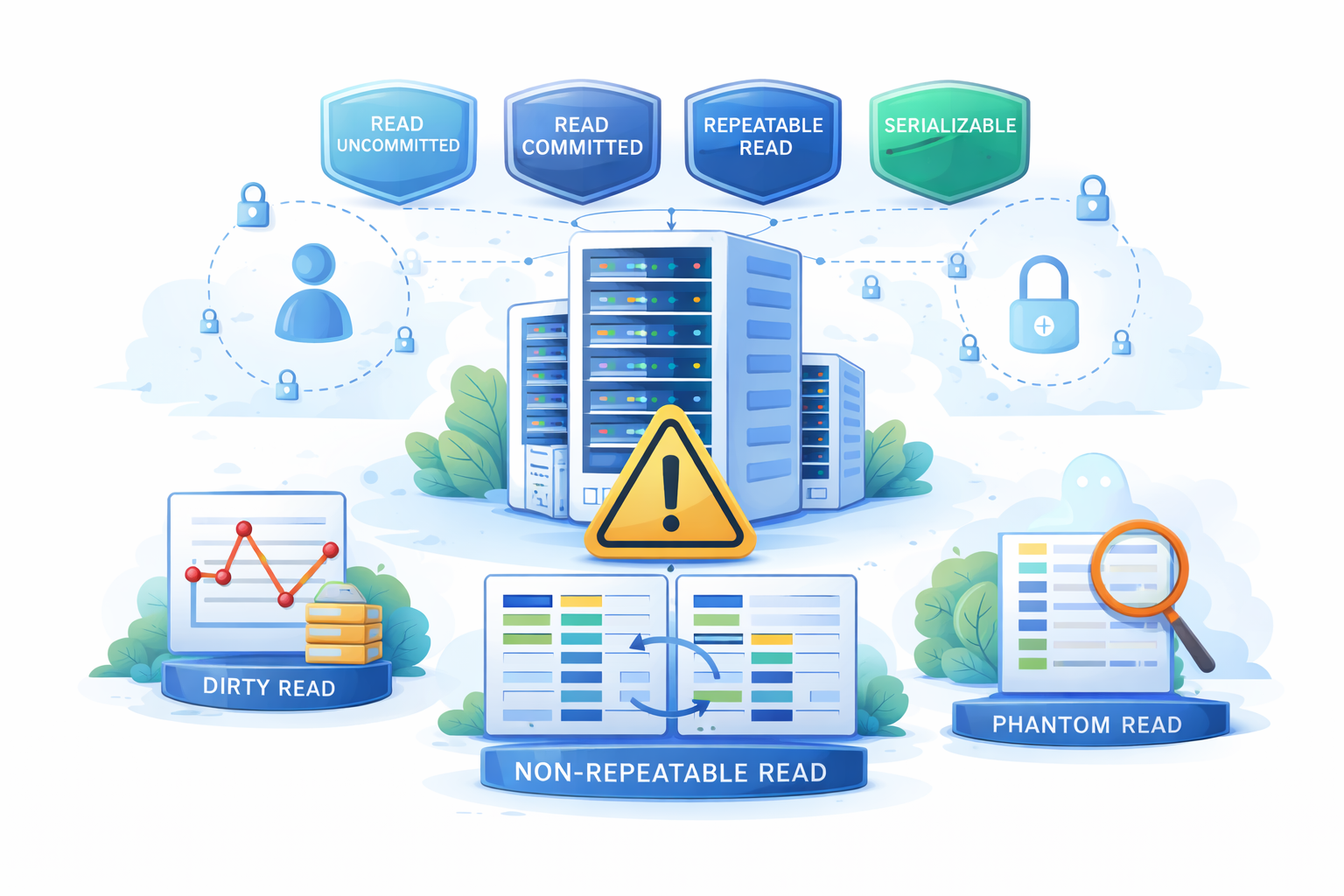
When multiple users interact with a database at the same time, maintaining data consistency becomes a serious challenge. Imagine thousands of transactions updating balances, placing orders, or modifying records simultaneously. Without proper isolation, data can easily become inconsistent, corrupted, or logically incorrect.
This is where transaction isolation levels come into play. Isolation defines how and when changes made by one transaction become visible to others. It directly affects system behavior, performance, and data correctness. Understanding isolation levels is essential for backend developers, database engineers, and system architects building scalable and reliable systems.
What Is Transaction Isolation?
A transaction is a sequence of operations executed as a single unit of work. In relational databases, transactions follow the ACID principles: Atomicity, Consistency, Isolation, and Durability.
Isolation determines how independent transactions are from each other while running concurrently. In real systems, full isolation can reduce performance, while low isolation can introduce logical errors. Therefore, databases provide different isolation levels that balance correctness and performance.
Before exploring each level, it’s important to understand the main concurrency problems they are designed to prevent.
Common Concurrency Problems
A Dirty Read happens when one transaction reads data that has been modified by another transaction but not yet committed. If the second transaction rolls back, the first transaction has read invalid data.
A Non-Repeatable Read occurs when a transaction reads the same row twice and gets different values because another transaction updated and committed changes in between.
A Phantom Read appears when a transaction queries a set of rows matching a condition, and another transaction inserts or deletes rows that match that condition before the first transaction finishes.
These anomalies define the differences between isolation levels.
Run Code from Your Browser - No Installation Required

Read Uncommitted
Read Uncommitted is the lowest isolation level. Transactions can see changes made by other transactions even if those changes are not committed yet.
For example, Transaction A updates a user’s balance from 100 to 50 but has not committed yet. Transaction B reads the balance and sees 50. If Transaction A rolls back, the balance returns to 100, but Transaction B already used incorrect data. This is a classic dirty read.
This level offers maximum performance because there are almost no locking restrictions, but it sacrifices data correctness. In practice, most modern databases do not truly allow dirty reads even if this level is selected.
Read Committed
Read Committed prevents dirty reads. A transaction can only see data that has been committed by other transactions.
For example, Transaction A updates a product price but does not commit. Transaction B attempts to read that product. Instead of seeing the uncommitted value, it waits or reads the last committed version.
However, non-repeatable reads can still happen. Suppose Transaction B reads a user’s balance as 100. Meanwhile, Transaction A updates it to 120 and commits. If Transaction B reads the balance again, it now sees 120. The same query produced different results within the same transaction.
Read Committed is the default isolation level in many databases, including PostgreSQL and Oracle. It provides a good balance between consistency and performance.
Repeatable Read
Repeatable Read ensures that if a transaction reads a row, it will always see the same version of that row for the duration of the transaction.
For example, Transaction A reads an order amount of 200. Transaction B updates that order to 250 and commits. If Transaction A reads the same order again, it still sees 200 until it completes. This eliminates non-repeatable reads.
However, phantom reads may still occur depending on the database implementation. For instance, Transaction A selects all orders where status equals “pending.” Transaction B inserts a new pending order and commits. If Transaction A runs the same query again, it might see the new row.
In MySQL’s InnoDB engine, Repeatable Read also prevents phantom reads using gap locking. In PostgreSQL, phantom prevention is handled differently using MVCC mechanisms.
Repeatable Read provides stronger consistency but may increase locking overhead and reduce concurrency.
Serializable
Serializable is the highest isolation level. It guarantees behavior equivalent to transactions running one after another sequentially, even if they actually execute concurrently.
For example, two users try to transfer money from the same account at the same time. Under lower isolation levels, both transactions might read the same balance and overspend the account. Under Serializable isolation, the database ensures that one transaction completes first, and the second one operates on updated data or fails and retries.
This level prevents dirty reads, non-repeatable reads, and phantom reads. However, it can significantly reduce throughput because it requires strict locking or advanced concurrency control mechanisms.
Serializable is often used in financial systems or critical business logic where absolute correctness is more important than performance.
Start Learning Coding today and boost your Career Potential
How Databases Implement Isolation
Modern databases often use locking mechanisms or MVCC (Multi-Version Concurrency Control).
Locking blocks other transactions from modifying or reading certain data. While simple conceptually, excessive locking can reduce performance.
MVCC works differently. Instead of blocking readers, it keeps multiple versions of rows. Each transaction sees a consistent snapshot of the database. PostgreSQL heavily relies on MVCC, while MySQL InnoDB combines MVCC with locking.
Understanding how your specific database implements isolation is crucial because behavior may slightly differ across systems.
Choosing the Right Isolation Level
There is no universally "best" isolation level. The right choice depends on your business requirements.
If performance is critical and occasional inconsistencies are acceptable, Read Committed is often sufficient. For reporting systems or workflows that require stable data during execution, Repeatable Read may be more appropriate. For financial operations, inventory management, or banking systems, Serializable ensures maximum safety.
In distributed or high-load systems, overly strict isolation can create bottlenecks. Therefore, architects often combine proper isolation with application-level safeguards, retries, and optimistic locking.
Conclusion
Isolation levels define how safely concurrent transactions interact in a database system. From Read Uncommitted to Serializable, each level represents a trade-off between performance and consistency.
Understanding dirty reads, non-repeatable reads, and phantom reads helps you design systems that behave predictably under load. Choosing the correct isolation level is not just a database configuration detail—it is a core architectural decision that directly impacts scalability, correctness, and user trust.
FAQ
Q: What are isolation levels in a database?
A: Isolation levels define how transactions interact with each other when running concurrently. They determine what kind of data one transaction can see while another transaction is modifying the same data.
Q: Why are isolation levels important?
A: Without proper isolation, concurrent transactions can cause inconsistent or incorrect data. Isolation levels help balance data consistency and system performance in multi-user environments.
Q: What is the difference between Read Committed and Repeatable Read?
A: Read Committed prevents dirty reads but allows non-repeatable reads. Repeatable Read ensures that rows read within a transaction remain consistent, preventing non-repeatable reads, though phantom reads may still occur depending on the database.
Q: What isolation level should I use by default?
A: In most applications, Read Committed provides a good balance between consistency and performance. However, for financial or critical business operations, stronger isolation such as Repeatable Read or Serializable may be necessary.
Q: Does Serializable guarantee perfect safety?
A: Serializable provides the highest level of consistency by making transactions behave as if they run sequentially. However, it can reduce performance and increase contention under high load.
Q: What is MVCC and how does it relate to isolation?
A: MVCC (Multi-Version Concurrency Control) allows databases to keep multiple versions of a row so that transactions can read consistent snapshots without blocking each other. It is commonly used to implement isolation efficiently.
Q: Can higher isolation levels hurt performance?
A: Yes. Higher isolation levels increase locking or version tracking, which can reduce concurrency and throughput. Choosing the right level depends on your system’s consistency requirements.
Q: Are isolation levels implemented the same way in all databases?
A: No. Different databases implement isolation using different internal mechanisms such as locking or MVCC. The behavior may vary slightly between systems like PostgreSQL, MySQL, or Oracle.
Was dit artikel nuttig?
Delen:
Was dit artikel nuttig?
Delen:
Gerelateerde cursussen
Bekijk Alle CursussenApache Iceberg and the Modern Data Lakehouse
How an open table format quietly became the foundation of modern analytics

by Daniil Lypenets
Full Stack Developer
May, 2026・15 min read

TOP 20 Excel Features You Did Not Know About and Probably Should
Unlock Hidden Excel Gems: Master These 20 Features to Boost Your Productivity and Save Time

by Anastasiia Tsurkan
Backend Developer
Dec, 2024・8 min read

Engineering Distributed Data Processing at Scale with MapReduce
Architectural Foundations Of Parallel Computation In Big Data
by Radomanova Sofia
Data Analyst
May, 2026・5 min read
Inhoud van dit artikel
