Corsi correlati
Guarda tutti i corsiPrincipiante
AI Automation Workflows with n8n
n8n is a flexible automation platform for connecting apps, transforming data, and building AI-powered workflows. You'll develop strong fundamentals through real, practical examples, covering triggers, JSON handling, data-flow theory, AI integration, webhooks, and complete automation builds. The focus is on understanding how information moves through a workflow and how to structure that information so nodes and APIs behave predictably. The result is the ability to design, debug, and ship reliable automations that work end to end.

Principiante
Workflow Automation with Make.com
Learn how to build powerful, real-world automation systems using Make.com and AI. Start with the fundamentals of scenario building and flow control, then master data handling, functions, APIs, and webhooks. Move into advanced workflows that combine RSS feeds, AI agents, and multimedia processing to create intelligent content pipelines. Finish by assembling a complete automation system, managing AI outputs, and exploring expansion ideas for scaling your workflows.

Principiante
AI-Powered Sales and Marketing with ChatGPT
Master the art of using ChatGPT to scale your marketing efforts without losing your brand's voice. In this hands-on course, you'll learn to build custom GPTs, create high-converting email campaigns, generate social media content, repurpose blog posts into video scripts and podcasts, and manage tone consistently across platforms. Explore tools like Canvas and Projects to organize workflows, collaborate effectively, and maintain context across campaigns. You'll also learn to avoid common pitfalls of over-automation and ensure your messaging remains human, relevant, and on-brand. Perfect for creators, marketers, and content teams ready to work smarter.

The Rise of Solo Founders With AI
How one person can now do the work of an entire startup team

by Ihor Gudzyk
C++ Developer
Feb, 2026・
9 min read


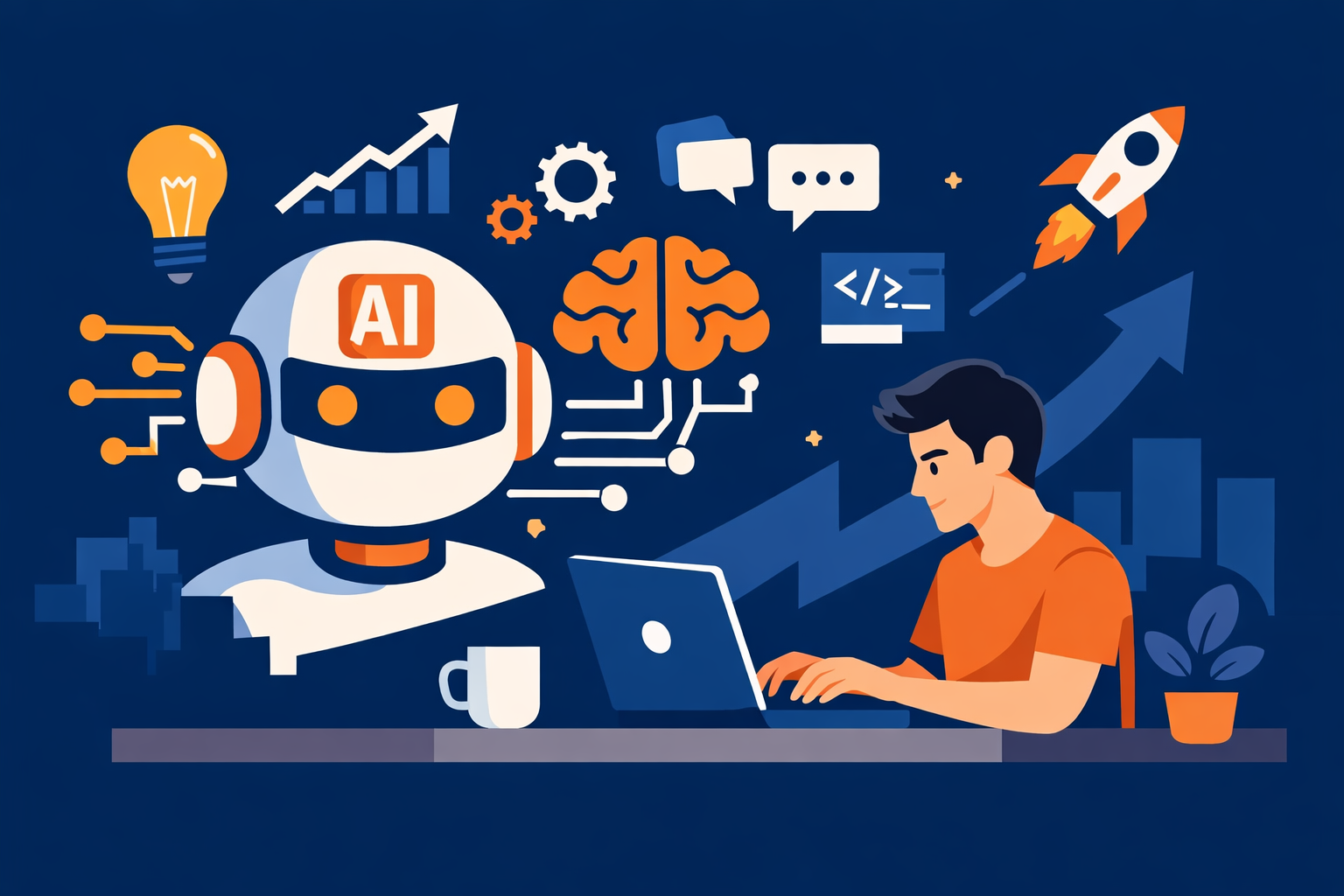
For a long time, building a startup meant building a team first. Development, design, marketing, and operations were separate roles, and even small products carried heavy coordination and hiring costs. That assumption no longer holds.
By 2026, AI collapses roles, not companies. The work still exists, but it no longer requires departments to execute it. One person, supported by AI systems, can now move from idea to launch without waiting on other people. The main constraint has shifted:
-
People → clarity;
-
Headcount → decision-making;
-
Execution → focus.
This changes what it means to be a founder:
-
AI removes repetitive and mechanical work;
-
Founders keep direction, taste, and judgment;
-
Speed comes from fewer handoffs, not more effort.
The Tech Stack of Solo Founders
What enables solo founders is not one breakthrough tool, but an AI-native stack. These systems are designed to work together, covering entire workflows instead of isolated tasks. At this point, speed matters less than sufficiency. The stack exists to remove dependency, not to optimize every step. Core layers of the stack:
| Stack layer | What it replaces | What it enables |
|---|---|---|
AI agents & MCP servers | Ops teams, manual automation | Long-running tasks, workflow triggers, data sync, real actions |
|
AI coding environments (Cursor, Lovable, Base44) | Full dev teams | Rapid prototyping, iteration, and deployment by one person |
Multimodal AI | Separate design, logic, and content steps | UI, logic, text, and assets from a single prompt |
No-code + AI hybrids | Backend and infrastructure teams | Databases, auth, payments, dashboards without custom backends |
Individually, these tools save time. Combined, they remove dependency. The stack doesn't make you faster, it makes you sufficient.
Run Code from Your Browser - No Installation Required
From team roles to AI roles
In traditional startups, progress depended on coordinating specialists. In AI-first solo startups, the structure changes. The work still exists, but it is reconfigured around systems, not people. The shift looks like this:
| Traditional role | AI-assisted equivalent | Founder’s responsibility |
|---|---|---|
Developer | AI coding agent | Review, architecture, correctness |
Designer | AI UI generation | Taste, usability judgment, consistency |
Marketer | AI content + analytics | Positioning, narrative, channel choice |
Operations | AI workflows + alerts | Oversight, exceptions, judgment |

The implication is clear. AI handles execution and scale, but humans decide direction. The founder is no longer doing every task manually, they are designing systems, reviewing outputs, and choosing what deserves attention.
What Solo Founders are Actually Building
Solo founders are not chasing unicorns or massive platforms. Most successful projects are small, focused, and designed to reach sustainability without large teams. The emphasis is on solving a specific problem for a clearly defined audience, not on scaling as fast as possible.
In practice, this shows up as micro-SaaS products, niche tools for specific professions, internal tools that later become sellable products, or content-driven businesses supported by AI backends. What makes these projects work is not their ambition, but their scope. They are small enough to control, ship, and maintain, yet valuable enough to generate real revenue.
Why Having Powerful Tools Is Not Enough
AI systems execute extremely well, but they do not choose direction. They can generate code, content, and workflows, yet they cannot decide what is worth building or when to stop.
As a result, the main failure mode for solo founders is no longer lack of technical skill. It is lack of focus. Poor prompts usually reflect poor thinking, and overbuilding is often a sign of unclear priorities. Vision, taste, and sequencing still matter more than raw output.
 Note
NoteStart Learning Coding today and boost your Career Potential
Risks And Limits Of AI-First Solo Startups
AI-first solo startups are powerful, but they come with real trade-offs. Automation can create a false sense of control, especially when systems grow faster than understanding. When too much logic is delegated too early, founders risk losing visibility into how their product actually works.
Common failure points show up repeatedly:
- Over-automation without deep understanding of the system;
- Vendor lock-in to AI platforms and proprietary workflows;
- Debugging difficulty when large parts of the system were not written by hand;
- Burnout, because even with AI, one person still carries all responsibility.
FAQs
Q: Can AI-first solo startups scale safely?
A: Yes, but only if the founder understands the systems they automate. Scaling without understanding increases fragility and makes failures harder to diagnose.
Q: Is vendor lock-in a serious risk for solo founders?
A: It can be. Relying heavily on a single AI platform or proprietary workflow can limit flexibility and increase costs over time, especially as pricing or policies change.
Q: Does using AI make debugging harder?
A: Often, yes. When large parts of the system are generated or abstracted away, tracing errors requires deeper inspection and stronger mental models from the founder.
Q: Can AI reduce burnout for solo founders?
A: AI reduces manual effort, but it does not reduce responsibility. Without clear boundaries and priorities, solo founders can still burn out by trying to automate everything.
Q: What is the biggest mistake AI-first solo founders make?
A: Over-automation before clarity. Automating a poorly understood or poorly designed system only amplifies its problems.
È utile questo articolo?
Condividi:
È utile questo articolo?
Condividi:
Corsi correlati
Guarda tutti i corsiPrincipiante
AI Automation Workflows with n8n
n8n is a flexible automation platform for connecting apps, transforming data, and building AI-powered workflows. You'll develop strong fundamentals through real, practical examples, covering triggers, JSON handling, data-flow theory, AI integration, webhooks, and complete automation builds. The focus is on understanding how information moves through a workflow and how to structure that information so nodes and APIs behave predictably. The result is the ability to design, debug, and ship reliable automations that work end to end.
Principiante
Workflow Automation with Make.com
Learn how to build powerful, real-world automation systems using Make.com and AI. Start with the fundamentals of scenario building and flow control, then master data handling, functions, APIs, and webhooks. Move into advanced workflows that combine RSS feeds, AI agents, and multimedia processing to create intelligent content pipelines. Finish by assembling a complete automation system, managing AI outputs, and exploring expansion ideas for scaling your workflows.
Principiante
AI-Powered Sales and Marketing with ChatGPT
Master the art of using ChatGPT to scale your marketing efforts without losing your brand's voice. In this hands-on course, you'll learn to build custom GPTs, create high-converting email campaigns, generate social media content, repurpose blog posts into video scripts and podcasts, and manage tone consistently across platforms. Explore tools like Canvas and Projects to organize workflows, collaborate effectively, and maintain context across campaigns. You'll also learn to avoid common pitfalls of over-automation and ensure your messaging remains human, relevant, and on-brand. Perfect for creators, marketers, and content teams ready to work smarter.
The SOLID Principles in Software Development
The SOLID Principles Overview

by Anastasiia Tsurkan
Backend Developer
Nov, 2023・8 min read
How the 1958 Perceptron Built ChatGPT
From Linear Classifiers to Large Language Models
by Radomanova Sofia
Data Analyst
May, 2026・6 min read
Top 25 C# Interview Questions and Answers
Master the Essentials and Ace Your C# Interview
by Ihor Gudzyk
C++ Developer
Nov, 2024・17 min read
Contenuto di questo articolo
