Corsi correlati
Guarda tutti i corsiWhat OpenClaw Is and Why Developers Are Paying Attention
How OpenClaw Connects Language Models with Real Tools and Automation Tasks

by Oleh Subotin
Full Stack Developer
Mar, 2026・
6 min read


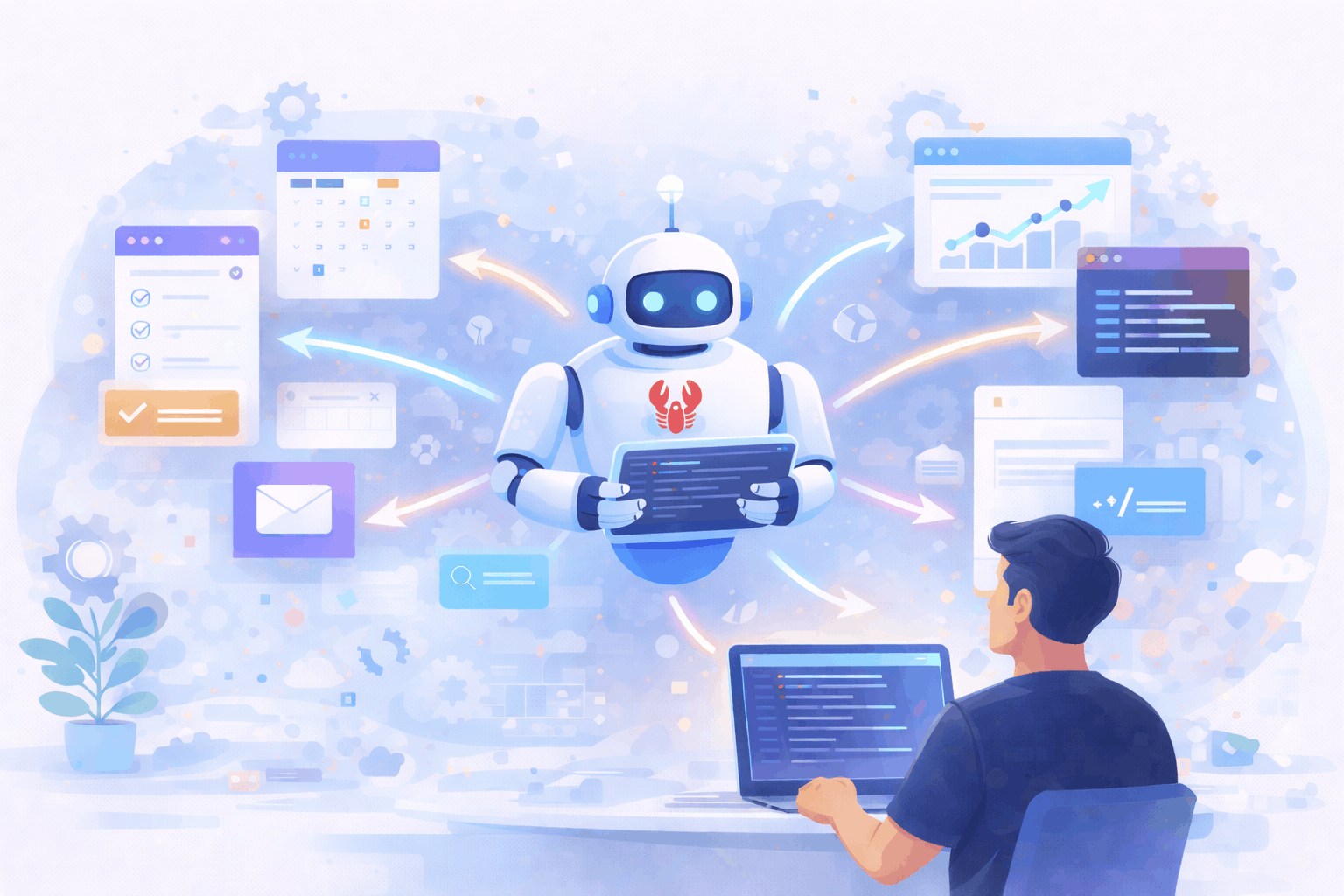
Over the past year, the conversation around AI tools has shifted from chat assistants to something more autonomous: AI agents. Instead of simply answering questions, these systems attempt to execute tasks, interact with tools, and operate across multiple services.
OpenClaw has recently attracted attention in this space. The project positions itself as a personal AI agent that can run locally and interact with a variety of services through messaging platforms and integrations.
For developers, the interest is less about the novelty of another AI tool and more about what OpenClaw represents: a practical attempt to turn language models into task-oriented software agents.
What OpenClaw Actually Is
At its core, OpenClaw is an AI agent framework designed to act as a personal assistant that runs on your own infrastructure.
Unlike traditional AI chatbots that operate only through a single interface, OpenClaw can interact through multiple communication channels. The system can connect to platforms such as messaging apps, collaboration tools, and developer services.
Instead of opening a dedicated application, users interact with the agent through the tools they already use.
This approach makes the assistant feel less like a standalone product and more like a layer that sits on top of existing workflows.
From Chatbots to Agents
Traditional AI assistants mainly respond to prompts. They generate explanations, write code snippets, or summarize information, but the interaction ends with the response.
Agent-based systems attempt to go further. Rather than simply answering questions, an agent may attempt to perform actions such as:
- Retrieving information from APIs;
- Interacting with files or databases;
- Executing scripts or automation tasks;
- Coordinating multiple tools in a workflow.
OpenClaw belongs to this category of systems. Its design focuses on connecting language models with practical operations rather than limiting the interaction to conversation.
Run Code from Your Browser - No Installation Required

Why Developers Are Interested
Part of the attention around OpenClaw comes from the broader trend of local and self-hosted AI tools.
Many modern AI products rely heavily on cloud services and closed platforms. OpenClaw takes a different approach by emphasizing control and extensibility. Developers can configure the system, connect it to their own tools, and extend its capabilities.
For developers, this opens several interesting possibilities. An AI agent can potentially:
- Automate repetitive development tasks;
- Coordinate multiple services or APIs;
- Monitor systems and retrieve logs;
- Assist with infrastructure management.
While these ideas are still evolving, they highlight a direction where AI tools act less like assistants and more like programmable collaborators.
The Challenge of Autonomous Tools
The idea of an agent capable of executing actions also introduces new challenges.
Granting an AI system access to files, services, or external tools requires careful permission management. Developers need to define clear boundaries for what an agent is allowed to do.
This is not a purely technical issue. It also raises broader questions about reliability and security. A system that can perform actions automatically must be monitored carefully to avoid unintended consequences.
For this reason, many teams treat agent frameworks like OpenClaw as experimental tools rather than fully autonomous systems.
What OpenClaw Signals About the Future
Even if OpenClaw itself evolves or is replaced by other tools, it represents a larger shift in how developers interact with software.
For years, programming interfaces were built around graphical dashboards, command-line tools, and APIs. AI agents introduce a different interface: conversation combined with automation. Instead of manually connecting tools together, developers may increasingly describe workflows and allow an agent to coordinate the steps.
This does not eliminate traditional development practices, but it introduces a new layer of interaction on top of existing systems.
Start Learning Coding today and boost your Career Potential
Conclusion
OpenClaw is part of a growing wave of AI agent frameworks that attempt to move beyond simple chat interfaces.
For developers, the project is interesting not only because of its features but because of the direction it suggests. AI tools are gradually evolving from assistants that generate text into systems that interact with real software environments.
Whether OpenClaw becomes a widely adopted platform or simply an early experiment, it highlights an important shift in the relationship between developers and automation.
FAQs
Q: What is OpenClaw?
A: OpenClaw is an AI agent framework designed to connect language models with real tools and services. Instead of only answering prompts, it can help automate tasks and interact with external systems.
Q: How is OpenClaw different from a typical AI chatbot?
A: Traditional AI chatbots mainly generate responses to prompts. OpenClaw focuses on executing actions, such as retrieving data, interacting with APIs, or coordinating workflows across tools.
Q: Why are developers interested in AI agent frameworks like OpenClaw?
A: Developers are exploring AI agents because they can potentially automate repetitive tasks, integrate with existing services, and act as assistants that help manage development workflows.
Q: Can OpenClaw run locally?
A: Many AI agent frameworks, including OpenClaw-style systems, aim to support local or self-hosted environments so developers can maintain control over data and integrations.
Q: Is OpenClaw meant to replace developers?
A: No. Tools like OpenClaw are designed to assist with automation and repetitive operations. Developers still define the architecture, security boundaries, and system behavior.
Q: What kinds of tasks could an AI agent like OpenClaw perform?
A: Depending on configuration, an AI agent might retrieve data from APIs, monitor logs, automate scripts, interact with project tools, or assist with infrastructure and development workflows.
È utile questo articolo?
Condividi:
È utile questo articolo?
Condividi:
Corsi correlati
Guarda tutti i corsiWhy Good Developers Spend More Time Reading Code Than Writing It
Understanding Why Code Comprehension Becomes the Most Valuable Engineering Skill
by Oleh Subotin
Full Stack Developer
Mar, 2026・5 min read

What Zod Solves in TypeScript Applications
Why Runtime Validation Became a Missing Piece in Many TypeScript Projects
by Oleh Subotin
Full Stack Developer
Mar, 2026・5 min read
Navigating the YouTube Influencer Maze in Your Tech Career
Staying Focused and Disciplined Amidst Overwhelming Advice
by Oleh Subotin
Full Stack Developer
Jul, 2024・5 min read

Contenuto di questo articolo
