Курси по темі
Всі курсиПросунутий
Neural Networks Compression Theory
A rigorous, mathematics-driven exploration of the theoretical foundations, methods, and limitations of neural network compression. This course focuses on intuition, formal reasoning, and the interplay between information theory and deep learning model design.

Просунутий
Quantization Theory for Neural Networks
A mathematically rigorous exploration of quantization for large neural networks, focusing on numerical representations, error propagation, and the theoretical limits of precision reduction. This course emphasizes the underlying numerical analysis, stability trade-offs, and information loss inherent in quantizing deep models.
Proving Bigger Isn't Always Better Using Small Language Models
How Compact Models Are Revolutionizing Privacy, Cost, and Edge Computing
by Arsenii Drobotenko
Data Scientist, Ml Engineer
Feb, 2026・
7 min read


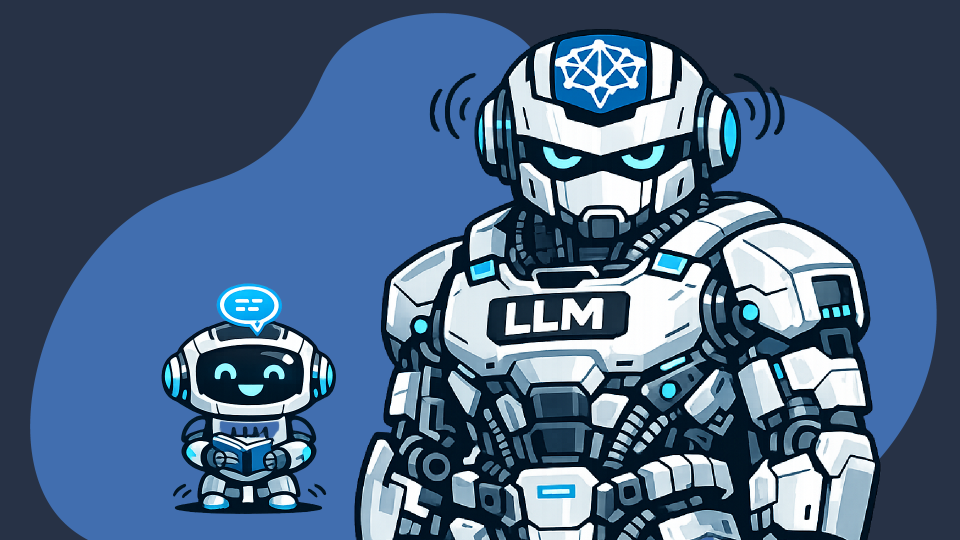
Imagine a startup building a simple customer support chatbot. To ensure the best quality, the developers connect it to the most powerful model available, like GPT-4. At first, it works perfectly. But as the user base grows, two problems emerge. First, the monthly API bill skyrockets to thousands of dollars. Second, enterprise clients refuse to sign up because they are terrified of sending their private data to a third-party cloud API.
This scenario highlights the "Cloud Shock" that many businesses face in 2026. They realize that using a massive, general-purpose brain for a narrow, specific task is inefficient. It is like using a Ferrari to deliver a pizza.
The solution lies in small language models (SLMs). These are compact, efficient AI models that provide high performance for specific tasks while running locally on your own hardware.
The Shift from Giant Brains to Specialized Tools
For years, the AI industry followed a simple rule: "Bigger is Better". Models grew from millions to billions, and then to trillions of parameters. While these giants are incredible at reasoning and creative writing, they are slow, expensive, and energy-hungry.
The trend has now shifted. Developers are discovering that a small model, trained on high-quality data, can outperform a large model trained on generic data.
Core Concepts Behind SLMs
To understand how a model can be "small" yet "smart", you need to know two key engineering techniques.
Knowledge Distillation
This is the process of teaching a small student model using a large teacher model. Instead of training the small model on raw, messy internet data, developers feed it the refined, high-quality outputs of a massive model (like GPT-4).
The small model does not need to learn how to reason from scratch. It simply mimics the reasoning patterns of the teacher. This allows a 7-billion parameter model to achieve results comparable to a 70-billion parameter model on specific benchmarks.
Quantization
Standard AI models process data using high-precision numbers (usually 16-bit or 32-bit floating point numbers). Quantization is the process of reducing this precision to lower formats, such as 4-bit integers.
Think of it like image compression. You can reduce a high-resolution PNG image to a JPEG. You lose a tiny amount of detail, but the file size drops by 90%. Quantization does the same for AI weights, allowing models that used to require massive server GPUs to run on a standard laptop or even a smartphone.
Comparison of LLMs vs SLMs
| Feature | Large Language Models (LLMs) | Small Language Models (SLMs) |
|---|---|---|
| Size (Parameters) | 100B+ (e.g., GPT-4, Claude Opus) | < 10B (e.g., Phi-3, Gemma, Llama 3 8B) |
| Hardware Required | Data Center GPUs (H100 clusters) | Consumer Laptop, Phone, Edge Device |
| Latency | High (Network calls + processing time) | Low (Instant local processing) |
| Cost | High (Per-token API fees) | Low (Electricity only) |
| Privacy | Data leaves your perimeter | Data stays on the device |
Practical Use Cases for SLMs
SLMs are not replacements for GPT-4 for everything. They excel in specific domains.
Edge AI and Offline Capabilities
If you are building an app for airline pilots or field researchers who often lose internet connection, you cannot rely on cloud APIs. SLMs allow you to embed intelligent features - like translation, summarization, or voice recognition - directly into the application. The AI lives on the device.
PII Masking and Data Privacy
Before sending sensitive customer data to a powerful cloud model, companies can use a local SLM to scrub Personal Identifiable Information (PII).
- Input: "My name is John Smith and my ID is 12345";
- Local SLM: replaces data with placeholders -> "My name is [NAME] and my ID is [ID]";
- Cloud LLM: analyzes the safe text.
Code Completion
Developers need instant feedback. Waiting 500ms for a cloud model to suggest a variable name breaks the flow. SLMs trained specifically on code can run inside the IDE, offering near-zero latency suggestions.
Trade-offs and Limitations
While SLMs are efficient, they are not magic. You must be aware of their limitations.
- Limited "world knowledge": a 7B model cannot memorize the entire internet. It might not know obscure historical facts or the capital of a small country;
- Reasoning depth: for complex, multi-step logic puzzles or advanced mathematical proofs, massive models still hold the advantage. SLMs are better at executing defined tasks than solving open-ended problems.
Ця стаття була корисною?
Поділитися:
Ця стаття була корисною?
Поділитися:
Курси по темі
Всі курсиПросунутий
Neural Networks Compression Theory
A rigorous, mathematics-driven exploration of the theoretical foundations, methods, and limitations of neural network compression. This course focuses on intuition, formal reasoning, and the interplay between information theory and deep learning model design.
Просунутий
Quantization Theory for Neural Networks
A mathematically rigorous exploration of quantization for large neural networks, focusing on numerical representations, error propagation, and the theoretical limits of precision reduction. This course emphasizes the underlying numerical analysis, stability trade-offs, and information loss inherent in quantizing deep models.
Automating AI Evaluation with LLM-as-a-Judge
Replacing Manual Review with Scalable AI Grading
by Arsenii Drobotenko
Data Scientist, Ml Engineer
Feb, 2026・5 min read
GraphRAG for Connecting the Dots Beyond Vector Search
Unlocking Complex Reasoning in AI with Knowledge Graphs
by Arsenii Drobotenko
Data Scientist, Ml Engineer
Feb, 2026・7 min read
RAG for Bridging the Gap Between AI and Your Data
How to Teach AI to Use Your Private Data Without Hallucinations
by Arsenii Drobotenko
Data Scientist, Ml Engineer
Feb, 2026・10 min read
Зміст
