Verwandte Kurse
Alle Kurse anzeigenFortgeschritten
Java OOP
Those who know OOP can program well. That's what many programmers say. Get ready for an important part of your Java learning journey, mastering which will greatly boost your programming skills in general. You will learn how to effectively use the Java development environment, the principles of Object-Oriented Programming (OOP), and best practices in OOP. You will learn to make your code flexible and deepen your knowledge of previously covered topics. Let's get started!

Anfänger
Java Basics
Learn the fundamentals of Java and its key features in this course. By the end, you'll be able to solve simple algorithmic tasks and gain a clear understanding of how basic console Java applications operate.
Mittelstufe
Java Classes and Core Mechanics
You will learn about best practices in coding, how to create your own methods and classes, and how to work with them and configure their interaction. You will also understand how Java works at the computer level and how code compilation generally works.
Records in Java
A quick guide to Java Records and how they simplify immutable data classes

by Eugene Obiedkov
Full Stack Developer
Mar, 2026・
6 min read


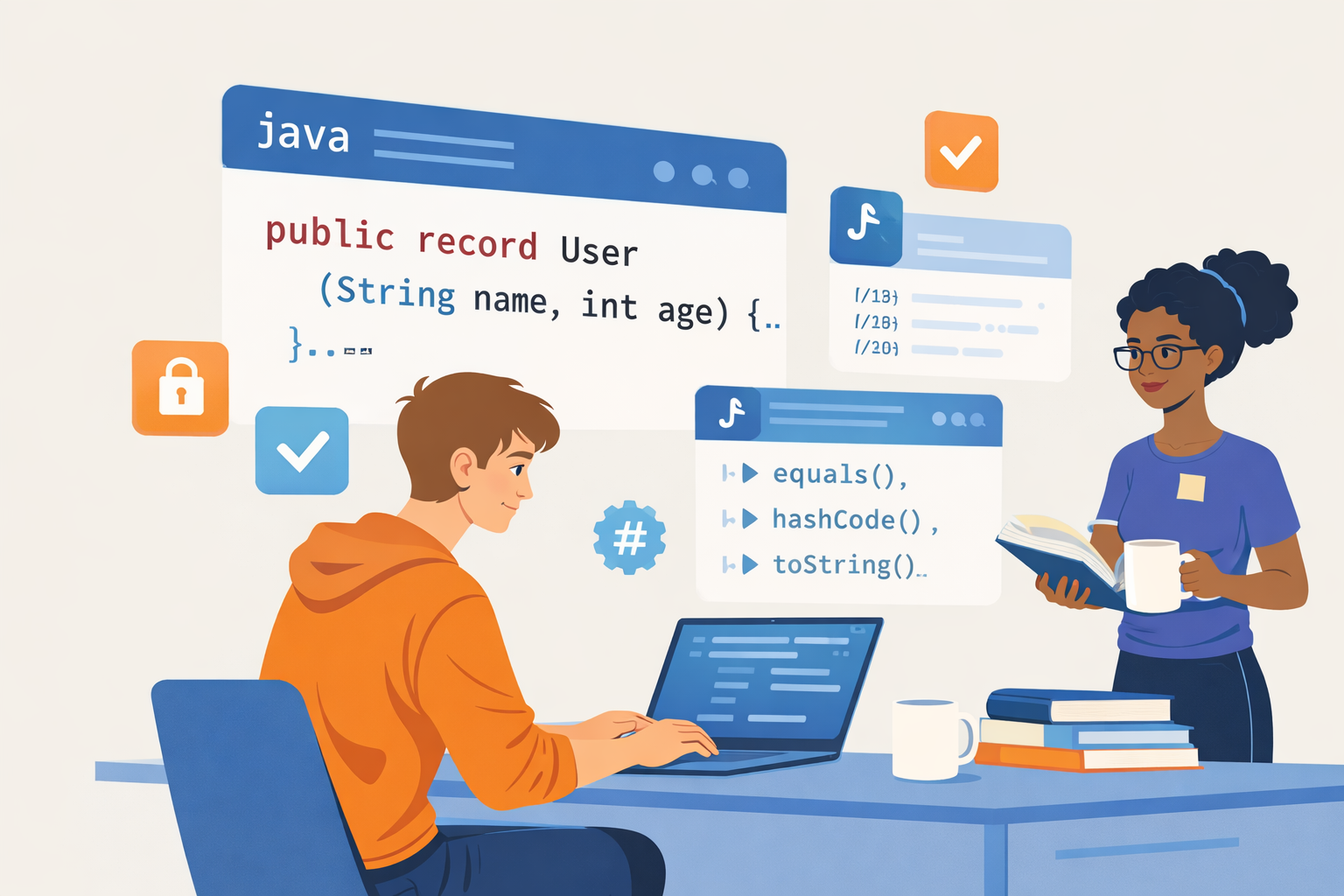
Java has always been known for its stability, readability, and strong object-oriented principles. However, one common criticism developers have had over the years is the amount of boilerplate code required for simple data-holding classes. Creating a class that only stores data often means writing constructors, getters, equals(), hashCode(), and toString() methods manually.
To address this issue, Java introduced Records, a feature designed to simplify the creation of immutable data classes. Records reduce boilerplate while keeping code clean, expressive, and easy to maintain.
The Problem with Traditional Java Classes
Before records existed, developers commonly created classes whose only purpose was to store data. These classes are often called POJOs (Plain Old Java Objects) or data carrier classes.
A simple example might look like this:
public class User {

    private final String name;
    private final int age;

    public User(String name, int age) {
        this.name = name;
        this.age = age;
    }

    public String getName() {
        return name;
    }

    public int getAge() {
        return age;
    }

    @Override
    public boolean equals(Object o) { ... }

    @Override
    public int hashCode() { ... }

    @Override
    public String toString() { ... }
}
Even for a very simple class, developers must write a large amount of repetitive code. While IDEs can generate these methods automatically, the resulting code is still verbose and harder to read.
This is exactly the type of problem records were designed to solve.
What Are Java Records?
A record is a special type of class that is designed specifically for holding data. Instead of writing all the boilerplate code manually, developers can declare the structure of the data, and Java automatically generates the necessary methods.
Here is the same example implemented as a record:
public record User(String name, int age) {}
With just one line of code, Java automatically generates:
- private final fields;
- a constructor;
- getter methods;
equals();hashCode();toString().
The generated methods follow consistent conventions and make the class immutable by default.
Run Code from Your Browser - No Installation Required

Immutability by Design
One of the most important characteristics of records is immutability.
Fields inside a record are implicitly final, which means their values cannot be changed after the object is created.
Example:
User user = new User("Alice", 25);
Once the object is created, the name and age values cannot be modified.
Immutability is beneficial because it:
- improves thread safety;
- simplifies reasoning about code;
- prevents accidental state changes;
- makes objects more predictable.
These properties make records especially useful for DTOs (Data Transfer Objects), configuration objects, and API responses.
Automatically Generated Methods
When a record is declared, Java automatically generates several methods.
For example:
public record User(String name, int age) {}
The following methods are created automatically:
Getter-like accessors:
user.name()
user.age()
A constructor:
new User("Alice", 25);
Standard utility methods:
equals();hashCode();toString().
The generated toString() method produces readable output:
User[name=Alice, age=25]
This behavior helps reduce repetitive coding patterns and ensures consistency across projects.
Adding Custom Logic to Records
Even though records are concise, they are still classes. Developers can add methods and validation logic when necessary.
For example:
public record User(String name, int age) {

    public User {
        if (age < 0) {
            throw new IllegalArgumentException("Age cannot be negative");
        }
    }
}
This is called a compact constructor, and it allows developers to validate parameters when an object is created.
Records can also include additional methods:
public record User(String name, int age) {

    public boolean isAdult() {
        return age >= 18;
    }
}
This flexibility allows records to remain simple while still supporting business logic when needed.
Start Learning Coding today and boost your Career Potential
Records in Modern Java Development
Records have become an important feature in modern Java development because they align with current architectural trends:
-
immutable data structures;
-
functional programming concepts;
-
cleaner and more expressive code.
Many modern frameworks and libraries support records, including serialization frameworks, REST APIs, and configuration systems.
By reducing boilerplate and enforcing immutability, records help developers focus on the structure of data rather than repetitive code.
FAQ
Q: What are Java Records?
A: Java Records are a special type of class designed for storing immutable data. They automatically generate common methods such as constructors, accessors, equals(), hashCode(), and toString(), significantly reducing boilerplate code.
Q: Why were records introduced in Java?
A: Records were introduced to simplify the creation of data-holding classes. Traditional Java classes often required large amounts of repetitive code, while records allow developers to define the structure of the data in a concise and readable way.
Q: Are Java Records immutable?
A: Yes. Fields inside a record are implicitly final, which means their values cannot be changed after the object is created. This makes records inherently immutable and safer to use in concurrent applications.
Q: When should developers use Java Records?
A: Records are best used for data carrier objects such as DTOs, API response models, configuration objects, and other structures where the primary purpose of the class is to hold data rather than complex behavior.
War dieser Artikel hilfreich?
Teilen:
War dieser Artikel hilfreich?
Teilen:
Verwandte Kurse
Alle Kurse anzeigenFortgeschritten
Java OOP
Those who know OOP can program well. That's what many programmers say. Get ready for an important part of your Java learning journey, mastering which will greatly boost your programming skills in general. You will learn how to effectively use the Java development environment, the principles of Object-Oriented Programming (OOP), and best practices in OOP. You will learn to make your code flexible and deepen your knowledge of previously covered topics. Let's get started!
Anfänger
Java Basics
Learn the fundamentals of Java and its key features in this course. By the end, you'll be able to solve simple algorithmic tasks and gain a clear understanding of how basic console Java applications operate.
Mittelstufe
Java Classes and Core Mechanics
You will learn about best practices in coding, how to create your own methods and classes, and how to work with them and configure their interaction. You will also understand how Java works at the computer level and how code compilation generally works.
Top 25 C# Interview Questions and Answers
Master the Essentials and Ace Your C# Interview

by Ihor Gudzyk
C++ Developer
Nov, 2024・17 min read
Rust for Web Backend Development: Axum, Actix, and the Memory-Safe Future
Why Rust is no longer just a systems language

by Daniil Lypenets
Full Stack Developer
May, 2026・16 min read

Best Laptops for Coding in 2024
Top Picks and Key Features for the Best Coding Laptops

by Anastasiia Tsurkan
Backend Developer
Aug, 2024・12 min read
Inhalt dieses Artikels
