Cours connexes
Voir tous les coursDébutant
AI Automation Workflows with n8n
n8n is a flexible automation platform for connecting apps, transforming data, and building AI-powered workflows. You'll develop strong fundamentals through real, practical examples, covering triggers, JSON handling, data-flow theory, AI integration, webhooks, and complete automation builds. The focus is on understanding how information moves through a workflow and how to structure that information so nodes and APIs behave predictably. The result is the ability to design, debug, and ship reliable automations that work end to end.

Débutant
AI Tools for Task Automation
Explore how modern AI tools can transform the way you work and create. Learn to streamline daily tasks, generate high quality content, and speed up production using intuitive platforms built for productivity, design, audio, and video. Write faster, automate repetitive work, design stunning visuals, clean up recordings, and turn ideas into engaging videos with the help of AI. No technical background is required. Perfect for creators, marketers, educators, freelancers, and busy professionals who want to work smarter and get more done with less effort. Gain practical experience with tools that simplify complex tasks and unlock new creative potential.

AI as a Colleague
How Collaborative Systems Are Reshaping Work Teams in 2026

by Daniil Lypenets
Full Stack Developer
Feb, 2026・
7 min read


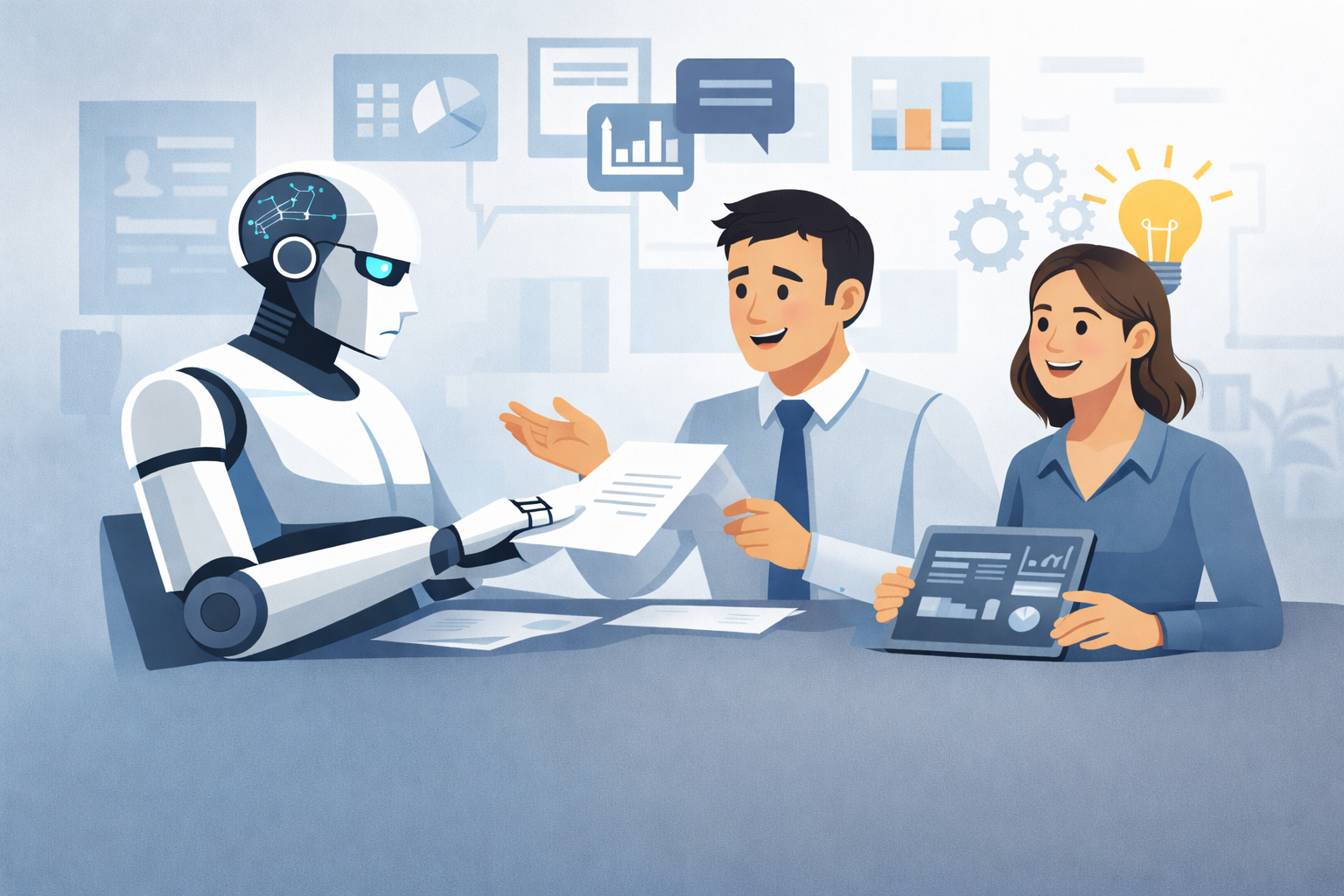
Artificial intelligence is no longer just a tool. In 2026, it increasingly functions as a colleague.
Not in a symbolic sense, but operationally. AI systems now participate in meetings, generate reports, draft strategies, analyze datasets, write code, summarize legal documents, monitor performance metrics, and even propose product decisions.
The shift is subtle but profound.
We are moving from using software to delegating cognitive tasks to autonomous or semi autonomous AI collaborators.
This transformation brings measurable productivity gains. It also introduces structural risks that organizations are only beginning to understand.
From Automation to Collaboration
Early AI adoption focused on automation. Replace repetitive tasks. Reduce manual effort. Increase throughput.
The 2026 wave is different. It centers on collaboration.
Modern AI systems:
-
Participate in Slack and Teams channels;
-
Draft and refine strategic documents;
-
Suggest improvements in real time;
-
Analyze internal data continuously;
-
Assist in product design and engineering workflows.
These systems are not simply executing scripts. They interpret context, summarize discussions, and propose next actions.
In many teams, AI now acts as:
-
A research assistant;
-
A junior analyst;
-
A documentation writer;
-
A brainstorming partner;
-
A code reviewer.
This integration changes team dynamics.
Productivity Gains and Cognitive Offloading
The primary benefit of AI as a colleague is cognitive offloading.
Teams no longer need to manually:
-
Compile weekly performance summaries;
-
Draft first versions of proposals;
-
Search through internal documentation;
-
Structure presentation outlines;
-
Translate technical findings into business language.
AI systems generate drafts instantly.
This reduces time spent on repetitive cognitive work and allows human team members to focus on higher level reasoning, negotiation, and decision making.
For distributed and remote teams, AI collaborators also reduce coordination friction. They summarize meetings, extract action items, and maintain shared context across time zones.
However, efficiency does not automatically equal improvement.
The Risk of Over Delegation
As AI becomes more embedded in daily workflows, a new problem emerges: skill erosion.
When AI consistently drafts reports, structures arguments, and writes code, humans begin to disengage from the underlying reasoning process.
Over time, teams may:
-
Lose deep familiarity with internal systems;
-
Accept AI outputs without critical review;
-
Struggle to debug errors independently;
-
Forget how to perform tasks manually.
Collaboration can silently shift into dependency.
The more fluent the AI appears, the easier it becomes to assume correctness.
That assumption is dangerous.
Run Code from Your Browser - No Installation Required
AI in Meetings and Decision Making
AI meeting assistants are now capable of:
-
Transcribing conversations;
-
Generating summaries;
-
Proposing decisions;
-
Highlighting risks;
-
Predicting likely outcomes.
In some organizations, AI generated recommendations influence strategic decisions.
The benefit is speed. The risk is bias amplification.
AI models are trained on historical data and probabilistic patterns. If the historical data reflects flawed assumptions, outdated strategies, or systemic bias, the AI will reinforce them.
Teams may gradually defer to AI recommendations, especially when outputs are presented confidently and supported by synthetic reasoning.
A colleague that never hesitates can reshape group psychology.
Trust, Authority, and Psychological Dynamics
One of the least discussed aspects of AI collaboration is authority perception.
When an AI system:
-
Produces polished analysis;
-
References multiple data sources;
-
Delivers immediate responses;
-
Appears objective.
team members may unconsciously attribute authority to it.
This changes discussion dynamics.
Junior employees may hesitate to challenge AI generated insights. Managers may rely on AI summaries instead of engaging deeply with primary materials.
The result can be reduced debate quality.
Human disagreement is often productive. It exposes blind spots and surfaces alternative interpretations.
AI systems optimize for coherence, not constructive tension.
The Accountability Question
When AI participates in team workflows, responsibility becomes blurred.
If a report drafted by AI contains a critical misinterpretation, who is accountable?
-
The employee who approved it;
-
The manager who relied on it;
-
The team that integrated it;
-
The vendor that built the model.
AI does not assume responsibility.
In collaborative environments, the illusion of shared authorship can dilute ownership. Teams must clearly define review processes and decision authority.
Otherwise, mistakes propagate without clear accountability structures.
The Augmented Team Model
The most resilient organizations in 2026 do not treat AI as a replacement for thinking. They treat it as a force multiplier.
In high performing teams:
-
AI generates first drafts;
-
Humans critique and refine;
-
AI accelerates data processing;
-
Humans validate strategic implications;
-
AI monitors patterns;
-
Humans make final decisions.
This division preserves cognitive engagement while leveraging speed.
AI becomes a junior colleague that requires supervision rather than an autonomous authority.
Start Learning Coding today and boost your Career Potential
Designing Healthy Human AI Collaboration
Successful collaboration requires intentional design.
Teams must:
-
Define which tasks AI can fully automate;
-
Identify tasks requiring mandatory human review;
-
Train employees to critique AI outputs;
-
Maintain manual competence for critical workflows;
-
Measure quality impact, not just speed.
AI can elevate team performance.
But only when humans remain intellectually active participants rather than passive recipients of generated content.
The future of work is not human versus AI.
It is human with AI, under clear governance and disciplined review.
FAQ
Q: Is AI as a colleague just a productivity trend?
A: No. AI collaboration is becoming structurally embedded in workflows across engineering, marketing, research, and operations. It is not simply automation, but participation in cognitive processes.
Q: Does AI collaboration reduce the need for skilled employees?
A: No. It changes skill requirements. Teams still need strong critical thinking, domain expertise, and review capability. Without those skills, AI output cannot be evaluated safely.
Q: Can AI participate in strategic decision making?
A: AI can provide analysis and scenario modeling, but it should not have decision authority. Final strategic responsibility must remain with human leadership.
Q: Does working with AI improve creativity?
A: It can. AI can generate variations, suggest alternative approaches, and accelerate brainstorming. However, originality and contextual judgment still depend on human insight.
Q: Is there a risk that teams become dependent on AI?
A: Yes. Over reliance can lead to skill erosion and reduced critical engagement. Organizations must maintain review culture and ensure employees understand the work beneath AI outputs.
Q: How should companies introduce AI into team workflows?
A: Gradually and transparently. Start with augmentation rather than replacement, define clear review checkpoints, and train employees to treat AI output as drafts, not final authority.
Q: Will AI eventually function as a fully autonomous team member?
A: In tightly constrained environments, limited autonomy is possible. In complex, ambiguous domains, human oversight will remain essential for the foreseeable future.
Cet article a-t-il été utile ?
Partager:
Cet article a-t-il été utile ?
Partager:
Cours connexes
Voir tous les coursDébutant
AI Automation Workflows with n8n
n8n is a flexible automation platform for connecting apps, transforming data, and building AI-powered workflows. You'll develop strong fundamentals through real, practical examples, covering triggers, JSON handling, data-flow theory, AI integration, webhooks, and complete automation builds. The focus is on understanding how information moves through a workflow and how to structure that information so nodes and APIs behave predictably. The result is the ability to design, debug, and ship reliable automations that work end to end.
Débutant
AI Tools for Task Automation
Explore how modern AI tools can transform the way you work and create. Learn to streamline daily tasks, generate high quality content, and speed up production using intuitive platforms built for productivity, design, audio, and video. Write faster, automate repetitive work, design stunning visuals, clean up recordings, and turn ideas into engaging videos with the help of AI. No technical background is required. Perfect for creators, marketers, educators, freelancers, and busy professionals who want to work smarter and get more done with less effort. Gain practical experience with tools that simplify complex tasks and unlock new creative potential.
Contenu de cet article
