Relaterte kurs
Se alle kurs
System Design
Designing Scalable, Reliable, and High-Performance Software Architectures

by Eugene Obiedkov
Full Stack Developer
Mar, 2026・
8 min read


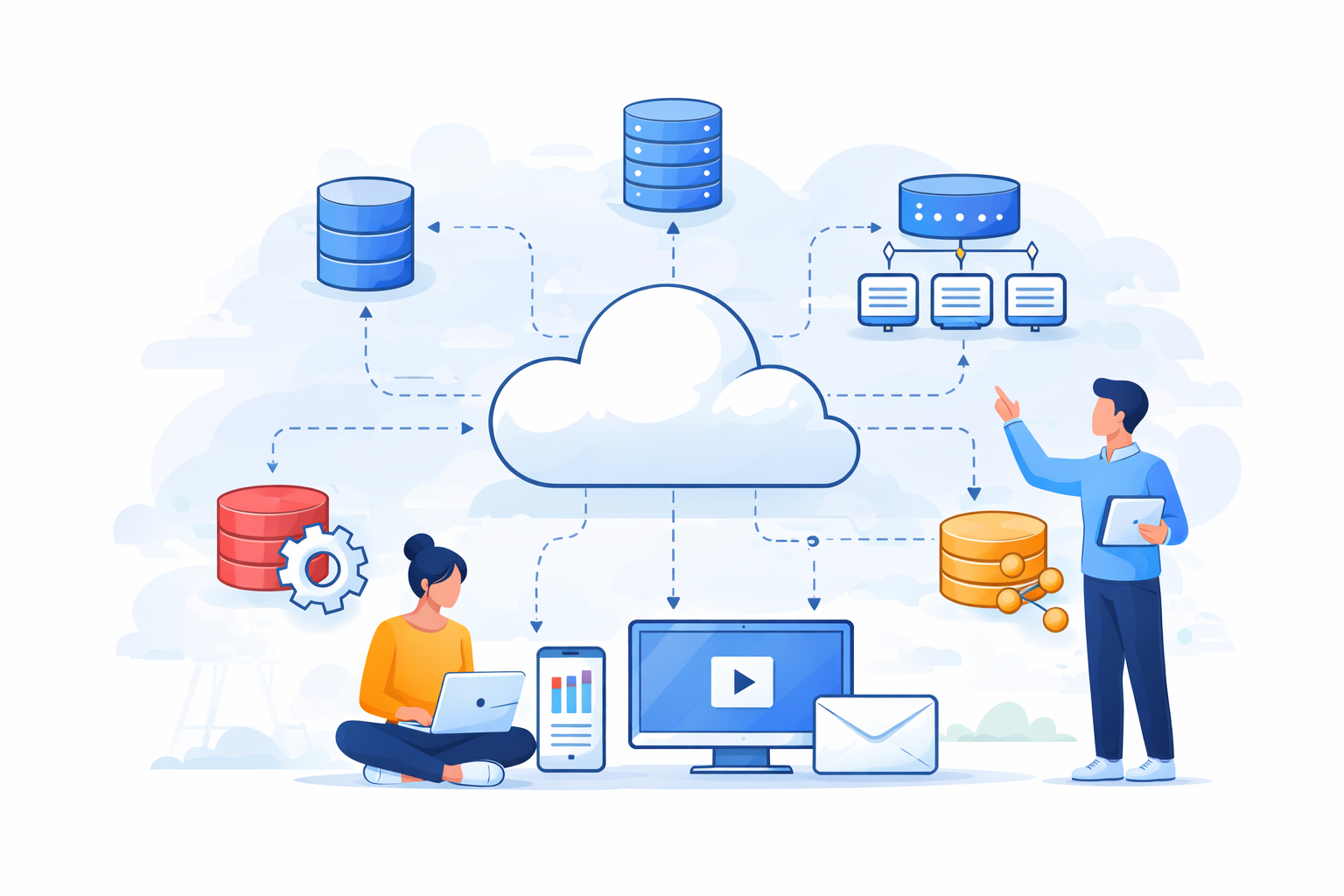
System design is the process of defining the architecture of a software system so that it effectively solves business problems, handles load, scales properly, and remains maintainable over time.
If algorithms answer the question "How do we solve a specific problem?", system design answers "How do we build the entire system?".
For a mid-level or senior developer, understanding system design is essential. This is where you move from simply writing code to designing architecture.
What System Design Means in Practice
In software engineering, system design is about modeling the structure of an application: defining its components, how they communicate, how data is stored, how scaling works, and how failures are handled.
At this level, you’re not thinking about classes and methods. You’re thinking about services, APIs, databases, message queues, load balancers, and infrastructure.
For example, when building a REST API or a mobile app with a backend, system design determines:
- whether the architecture is monolithic or microservices-based;
- how traffic is distributed;
- how data consistency is maintained;
- what happens if a component fails.
This is a higher level of abstraction than code.
Core Principles of System Design
Every system is designed around non-functional requirements. Functional requirements define what the system does. Non-functional requirements define how well it does it.
Scalability
The system must handle growth in users and traffic. Scaling can be vertical (adding more resources to a single server) or horizontal (adding more servers).
Reliability
The system should continue operating even when failures occur. Techniques like replication, clustering, and backups improve reliability.
Availability
Downtime should be minimized. High availability is achieved through redundancy and load balancing.
Performance
Design decisions affect latency and throughput. This includes efficient data modeling, indexing, caching strategies, and minimizing network overhead.
Monolith vs Microservices
A monolithic architecture deploys the entire application as a single unit. It is simpler to build and test early on. However, as the system grows, scaling individual components becomes difficult.
A microservices architecture splits the system into independent services. Each service owns a specific business domain and can scale independently. This increases flexibility but also adds infrastructure complexity and network communication overhead.
The right choice depends on team size, expected traffic, and long-term product strategy.
Run Code from Your Browser - No Installation Required

Data Management
One of the central concerns in system design is choosing the right data storage model.
Relational databases are well suited for systems requiring strong consistency and transactional guarantees. NoSQL solutions are often used when flexible schemas and high scalability are needed.
In distributed systems, the CAP theorem states that you cannot simultaneously guarantee consistency, availability, and partition tolerance. Architects must decide which trade-offs are acceptable.
Caching is another critical consideration. Storing frequently accessed data in memory reduces load on the primary database and significantly improves response times.
Asynchronous Processing and Message Queues
As traffic increases, purely synchronous communication can become a bottleneck. Introducing message brokers allows systems to decouple request handling from processing.
This approach is especially useful for background tasks such as sending emails, processing payments, or handling analytics events.
Asynchronous architecture improves both scalability and fault tolerance.
Load Balancing
A load balancer distributes incoming traffic across multiple servers. This prevents any single node from becoming overloaded and enables horizontal scaling.
NGINX is commonly used as a reverse proxy and load balancer. It can distribute traffic using strategies like round-robin, IP hash, or load-based routing.
Without load balancing, real-world scalability is nearly impossible.
Caching
Caching stores frequently accessed data in fast storage to reduce repeated database queries.
Redis is an in-memory data store that provides extremely low-latency access. In high-traffic systems, caching can reduce database load dramatically.
Designing proper cache invalidation strategies is one of the hardest problems in system design.
Start Learning Coding today and boost your Career Potential
Horizontal Scaling
Horizontal scaling means adding more servers to handle increased demand. For this to work, applications should ideally be stateless, meaning they do not store user session data in local memory.
State is externalized into databases, distributed caches, or shared storage systems.
This principle forms the foundation of modern cloud-native architectures.
Fault Tolerance
In real-world environments, servers crash, networks fail, and databases become temporarily unavailable. System design assumes that failures will happen.
Mechanisms such as retries, circuit breakers, replication, monitoring, and graceful degradation are essential.
A well-designed system doesn’t just work under ideal conditions — it behaves predictably under failure.
Conclusion
System design represents the shift from writing isolated pieces of code to building entire systems.
It is about architecture, scalability, reliability, and long-term maintainability.
For experienced developers, mastering system design opens the path to senior engineering and architectural roles.
If algorithms are the bricks, system design is the blueprint of the entire building.
FAQ
Q: What is System Design?
A: System Design is the process of defining the high-level architecture of a software system, including its components, interactions, data flow, scalability strategy, and fault tolerance mechanisms.
Q: Why is System Design important for experienced developers?
A: System Design enables developers to think beyond individual features and focus on building scalable, reliable, and maintainable systems that can support real-world traffic and business growth.
Q: What is the difference between functional and non-functional requirements?
A: Functional requirements describe what a system does, while non-functional requirements define how well it performs in terms of scalability, reliability, availability, and performance.
Q: What is scalability in System Design?
A: Scalability is the system’s ability to handle increasing traffic or data volume by either upgrading server resources (vertical scaling) or adding more servers (horizontal scaling).
Q: What is the difference between a monolith and microservices?
A: A monolithic architecture deploys the entire application as a single unit, while a microservices architecture splits the system into independent services that can be developed, deployed, and scaled separately.
Q: Why is caching important in distributed systems?
A: Caching reduces load on primary databases and decreases response times by storing frequently accessed data in fast storage, typically in memory.
Q: What is fault tolerance?
A: Fault tolerance is the system’s ability to continue functioning properly even when some of its components fail, using strategies such as retries, replication, and circuit breakers.
Q: What is horizontal scaling?
A: Horizontal scaling involves adding more servers to distribute traffic and increase system capacity, typically requiring stateless application design.
Q: What is the purpose of a load balancer?
A: A load balancer distributes incoming traffic across multiple servers to prevent overload, improve availability, and enable horizontal scaling.
Q: What do System Design interviews evaluate?
A: They assess a candidate’s ability to clarify requirements, estimate scale, design architecture, reason about trade-offs, and justify technical decisions.
Var denne artikkelen nyttig?
Del:
Var denne artikkelen nyttig?
Del:
Relaterte kurs
Se alle kursTop 25 C# Interview Questions and Answers
Master the Essentials and Ace Your C# Interview

by Ihor Gudzyk
C++ Developer
Nov, 2024・17 min read
8 In-Demand Skills to Earn Big in 2025
Skills to stay ahead

by Anastasiia Tsurkan
Backend Developer
Dec, 2024・23 min read

AI as a Colleague
How Collaborative Systems Are Reshaping Work Teams in 2026

by Daniil Lypenets
Full Stack Developer
Feb, 2026・7 min read

Innholdet i denne artikkelen
