Relaterte kurs
Se alle kurs
Top 25 Questions and Answers for Computer Vision Engineer Interview
Prepare for your Computer Vision Engineer interview covering CNNs, transformers, object detection pipelines, model optimization, 3D vision, and MLOps best practices.

by Kseniia Smolnikova
ML Engineer
May, 2026・
45 min read


Introduction
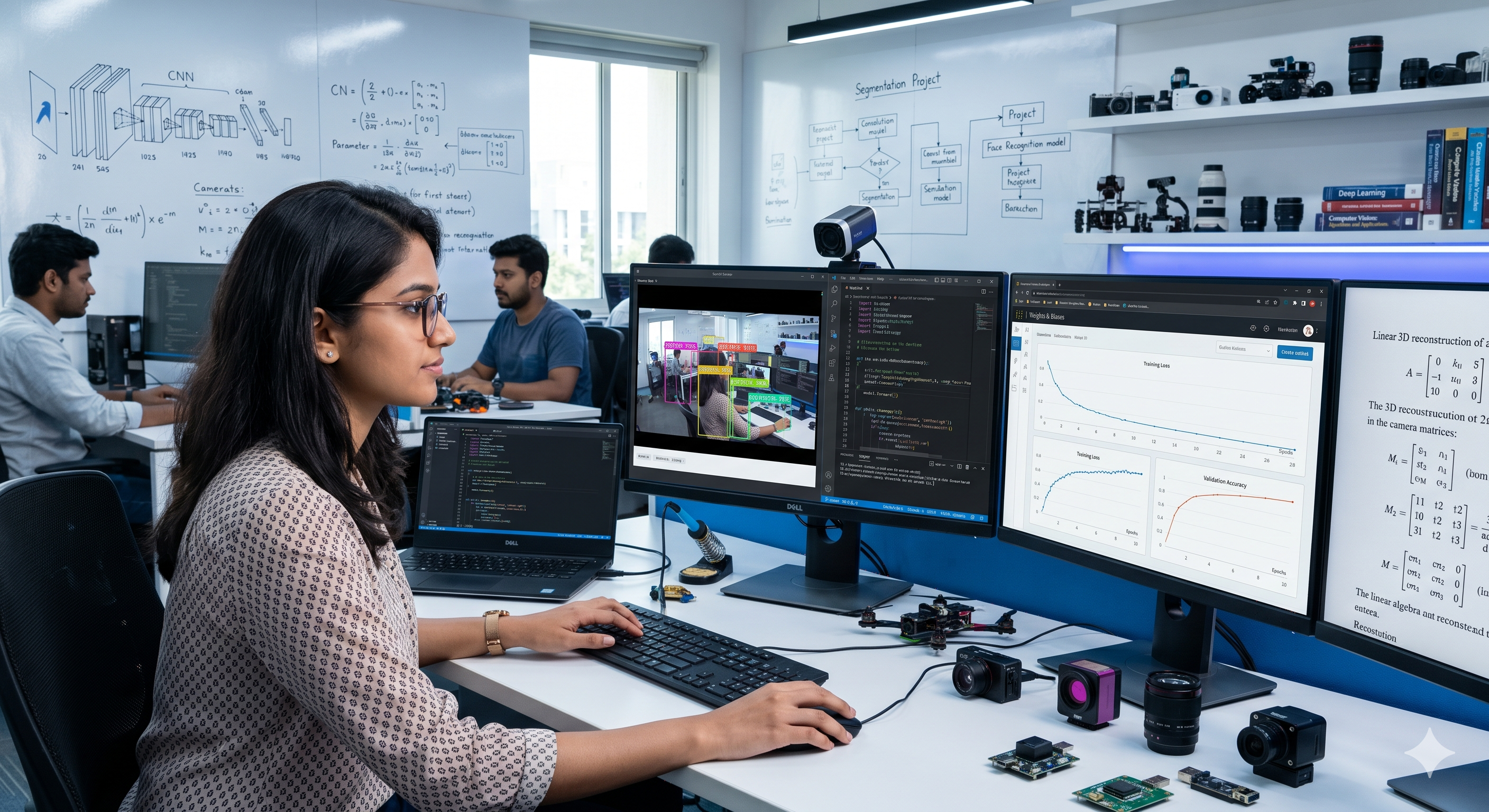
Computer Vision engineering sits at the intersection of deep learning research, systems programming, and production ML infrastructure. Interviewers at companies building self-driving vehicles, medical imaging platforms, AR/VR systems, and large-scale video analytics pipelines are not looking for candidates who can recite definitions. They are looking for engineers who understand why architectural decisions are made, how numerical instabilities emerge in training, and when a simpler baseline beats a complex model.
This guide presents 25 interview questions organized by domain depth — from core CNN mechanics and classical feature engineering, through modern transformer-based architectures, all the way to deployment, optimization, and edge inference. Each answer is written to reflect the reasoning process of a senior engineer, not just the correct term.
Foundations of Computer Vision and CNNs
Q1: Explain the Inductive Biases Built Into a CNN and Why They Matter
A: Convolutional Neural Networks encode two fundamental inductive biases: translation equivariance (a feature detector responds the same way regardless of where in the image the pattern appears) and locality (pixels close together are more semantically related than distant ones). These biases are baked in via the weight-sharing mechanism — the same kernel slides across the entire spatial domain.
This matters architecturally because it dramatically reduces the parameter count compared to a fully connected network, provides built-in data augmentation resistance, and makes gradient flow more stable early in training. However, these same biases are also CNNs' Achilles' heel: they struggle to capture long-range dependencies (e.g., relating the left eye to the right eye of a face) without stacking many layers or using dilated convolutions. This is precisely the design gap that Vision Transformers (ViTs) were introduced to address.
Q2: What Is the Difference Between Valid Padding and Same Padding and When Does It Matter
A: With valid padding, no zero-padding is added. The output spatial dimension is:
With same padding, zeros are added so the output has the same spatial size as the input (when stride = 1). It matters in several real scenarios:
- Skip connections (ResNet-style): when adding feature maps from two branches, their spatial dimensions must match. Same padding in residual blocks ensures this alignment without explicit dimension tracking;
- Fully Convolutional Networks (FCN): in segmentation models, you need to propagate spatial resolution faithfully — valid padding causes progressive shrinkage that misaligns with upsampling paths;
- Edge artifact sensitivity: same padding introduces artificial zeros at borders, which can confuse models trained on natural textures near image boundaries. For satellite or medical images where edges carry real signal, valid padding is safer.
Q3: Describe the Role of Batch Normalization in Deep CNNs Including Its Failure Modes
A: Batch Normalization (BN) normalizes activations within a mini-batch to zero mean and unit variance, then applies learned affine parameters $\gamma$ and $\beta$. Its primary effect is to reduce internal covariate shift — the phenomenon where the distribution of each layer's inputs shifts as upstream weights update during training. This allows higher learning rates and makes the network less sensitive to weight initialization.
Failure modes that interviewers look for:
| Scenario | Why BN Fails |
|---|---|
| Small batch sizes (< 8) | Batch statistics become noisy, normalization destabilizes rather than stabilizes |
| Recurrent / sequential data | Statistics computed across time steps don't correspond to a clean distribution |
| Test-time distribution shift | Running mean/variance computed during training may not represent the test distribution |
| Multi-GPU training with small per-GPU batch | Each GPU normalizes its own shard — statistics diverge across devices |
Alternatives: Layer Normalization (normalizes across features, not batch — preferred for transformers), Group Normalization (normalizes within channel groups — robust to small batches), Instance Normalization (one sample at a time — used in style transfer).
Q4: How Does Dilated (Atrous) Convolution Expand the Receptive Field Without Losing Resolution
A: A standard 3×3 convolution with dilation rate samples a 3×3 region. With , the same 3×3 kernel samples a 5×5 region by inserting gaps (zeros) between kernel elements. With , it covers a 9×9 region. The effective receptive field per axis grows as:
The critical insight is that no downsampling occurs — spatial resolution is preserved. This is foundational to architectures like DeepLab for semantic segmentation and WaveNet for sequence modeling. However, dilated convolutions create a gridding artifact: if you stack multiple layers with the same dilation rate, the sampled points follow a regular sparse grid, potentially ignoring intermediate spatial information. The fix is to use hybrid dilation rates (e.g., 1, 2, 5, 1, 2, 5) across consecutive layers to ensure full coverage — a technique popularized by the HDC (Hybrid Dilated Convolution) paper.
Q5: What Are Depthwise Separable Convolutions and How Do They Reduce Computation
A: A standard convolution applies filters of size , producing a cost of:
A depthwise separable convolution splits this into two stages:
- Depthwise convolution: apply one filter per input channel — cost: ;
- Pointwise convolution: apply convolutions to combine channels — cost: .
The total cost ratio versus a standard convolution is:
For , , this is roughly 8–9× cheaper. This is the core building block of MobileNet (v1/v2/v3) and Xception, enabling real-time inference on mobile and embedded hardware. The trade-off is mild accuracy degradation since the factorized operation has less representational capacity per layer — compensated by adding more layers within the same FLOPs budget.
Object Detection and Segmentation Architectures
Q6: Compare the Architectural Philosophy of YOLO Versus Two-Stage Detectors Like Faster RCNN
A: Two-stage detectors (Faster R-CNN, Cascade R-CNN) operate with a principled separation of concerns: Stage 1 (RPN) generates class-agnostic region proposals via a Region Proposal Network, and Stage 2 (RoI Head) classifies and refines bounding boxes within each proposed region using RoI Pooling or RoI Align. This separation allows the model to focus computational budget on promising regions, yielding high accuracy especially for small objects.
YOLO reframes detection as a single regression problem: the image is divided into an grid; each cell directly predicts bounding box coordinates, confidence scores, and class probabilities in a single forward pass. This eliminates the proposal stage entirely.
| Dimension | Faster R-CNN (Two-Stage) | YOLOv8 (One-Stage) |
|---|---|---|
| Latency | ~100–200ms (GPU) | ~5–15ms (GPU) |
| Small Object Accuracy | High (dedicated RoI stage) | Moderate (grid resolution limits) |
| Anchor-Free Variant | Sparse R-CNN, DINO | YOLOv8, YOLO-NAS |
| Deployment Complexity | High (NMS + RPN + RoI head) | Low (single backbone + head) |
| Best Use Case | High-accuracy offline pipelines | Real-time edge/mobile inference |
Q7: What Is RoI Align and Why Was It Introduced to Replace RoI Pooling
A: RoI Pooling divides a proposed region into a fixed grid and applies max pooling per cell. The issue is quantization error — the RoI boundaries are snapped to the nearest integer pixel coordinate twice (once to map to the feature map, once to divide into grid cells). This misalignment is tolerable for classification but catastrophic for precise localization tasks like instance segmentation (Mask R-CNN).
RoI Align eliminates quantization by computing feature values at continuous sub-pixel grid points using bilinear interpolation. The region boundaries and sampling points remain in floating-point coordinates throughout. In practice, this yields a 10–50% improvement in mask AP at higher IoU thresholds because the extracted features genuinely correspond to the pixel-accurate region of interest.
Q8: Explain the Feature Pyramid Network Architecture and Its Role in Multi-Scale Detection
A: Feature Pyramid Networks (FPN) address the fundamental multi-scale challenge: deep CNN layers have rich semantic content but coarse spatial resolution, while shallow layers have fine spatial resolution but weak semantics. A naïve approach — detecting at multiple scales independently is expensive and doesn't share representations.
FPN builds a top-down pathway with lateral connections: the backbone produces feature maps at multiple strides ( through ). A top-down path upsamples from the deepest layer and fuses with shallower layers via lateral convolutions that project backbone channels to a uniform dimension (typically 256). The result is a set of feature maps ( through ) at multiple scales that all carry strong semantic signal — enabling the detection head to confidently classify objects regardless of their size.
Q9: What Is the Difference Between Semantic Segmentation Instance Segmentation and Panoptic Segmentation
A:
- Semantic Segmentation: assigns a class label to every pixel. No distinction between individual instances. All pixels belonging to "car" are labeled identically. (e.g., FCN, DeepLabv3+);
- Instance Segmentation: detects and delineates individual object instances with pixel-precise masks. Two cars receive separate masks. Does not label background/stuff classes. (e.g., Mask R-CNN, SOLOv2);
- Panoptic Segmentation: unifies both. Every pixel is assigned a class and an instance ID. "Things" (countable objects) get instance IDs; "stuff" (sky, road) gets only class labels. (e.g., Panoptic FPN, Mask2Former).
The architectural evolution reflects a push toward a single unified model that can handle the full perceptual scene understanding task — relevant for autonomous driving systems where road surface, lane markings, and individual vehicles must all be understood simultaneously.
Transformers and Attention in Vision
Q10: How Does the Vision Transformer Differ Architecturally From a CNN and What Are Its Trade-offs
A: ViT (Dosovitskiy et al., 2020) treats an image as a sequence of fixed-size non-overlapping patches (typically ). Each patch is linearly projected into an embedding, a learnable token is prepended, positional embeddings are added, and the sequence is processed by standard Transformer encoder blocks with multi-head self-attention (MHSA).
Key architectural differences from CNN:
- No inductive bias: ViT has no built-in translation equivariance or locality. It must learn these from data — requiring large-scale pretraining (JFT-300M, ImageNet-21k) to match CNN performance;
- Global attention from layer 1: every patch can attend to every other patch immediately. CNNs build global receptive fields progressively through depth;
- Quadratic attention cost: standard MHSA scales as in sequence length. For a image with patches, — manageable. But for high-resolution inputs (e.g., for medical imaging), , making naive ViT prohibitively expensive.
This motivated Swin Transformer, which introduces windowed attention (local attention within non-overlapping windows) and shifted window patterns across layers to capture cross-window interactions efficiently, recovering the locality property while retaining transformer representational power.
Q11: Explain DETR and How It Eliminates Non-Maximum Suppression From the Detection Pipeline
A: DETR (Detection Transformer, Carion et al. 2020) reformulates object detection as a set prediction problem. The model produces exactly predictions ( by default) in parallel, and a bipartite matching loss (Hungarian algorithm) assigns ground truth objects to predictions during training. There is no anchor generation, no region proposal network, and crucially — no NMS post-processing.
The mechanism: a CNN backbone extracts feature maps; a Transformer encoder processes the flattened feature map with self-attention; learned object queries attend to encoder output via cross-attention in the decoder; each query predicts one pair; Hungarian matching finds the optimal one-to-one assignment between predictions and ground truth — unmatched predictions are assigned the "no object" class.
The elimination of NMS is significant for deployment: NMS has non-differentiable, hand-tuned IoU thresholds, and its performance degrades for densely packed objects. DETR's set prediction is end-to-end differentiable. The main limitation is slow convergence (~500 epochs vs ~12 for Faster R-CNN) — addressed by Deformable DETR and DN-DETR through improved query initialization and denoising training.
Run Code from Your Browser - No Installation Required

Training Dynamics and Loss Functions
Q12: When Would You Use Focal Loss Instead of Standard Cross-Entropy for Detection
A: Standard cross-entropy treats all samples equally. In one-stage detectors, the ratio of background anchors to foreground anchors can be 1000:1 or higher. The model quickly learns to predict "background" for everything — the loss is dominated by easy negatives, and gradients from the rare hard positives are overwhelmed.
Focal Loss (Lin et al., RetinaNet, 2017) modulates the per-sample loss by a focusing factor:
When , this reduces to standard cross-entropy. With (the typical default), well-classified easy negatives (high ) have their loss contribution reduced by up to , while hard misclassified examples retain near-full gradient signal.
Use focal loss when: class imbalance is severe (detection, medical anomaly detection), you are using a one-stage architecture without explicit hard negative mining (OHEM), or your precision-recall curve shows high recall but poor precision at low thresholds.
Q13: How Do You Diagnose and Address Training Instability in Large Vision Models
A: Training instability manifests as loss spikes, NaN gradients, or sudden accuracy collapse. Root causes and remedies:
- Gradient explosion: monitor gradient norms per layer. Apply gradient clipping ( is standard). Use weight initialization schemes (Kaiming He for ReLU, Xavier for sigmoid/tanh) and ensure normalization layers are correctly placed;
- Loss scale mismatch: if combining detection loss + segmentation loss + auxiliary losses, their magnitudes may differ by orders of magnitude. Normalize each component or use learned loss weighting (homoscedastic uncertainty weighting);
- Batch statistics corruption (BN): if using multi-GPU with BN, use Synchronized BN or switch to Layer Norm / Group Norm;
- Learning rate too aggressive: use warmup schedules (linear warmup for the first 1000–5000 steps) combined with cosine decay. The warmup period stabilizes early training when batch statistics are unreliable;
- Mixed precision underflow: with FP16 training, small gradients underflow to zero. Use dynamic loss scaling (PyTorch's
GradScaler) or BF16 (no underflow risk but reduced precision).
Q14: What Is the Role of Data Augmentation in Computer Vision and What Are the Risks of Over-Augmentation
A: Data augmentation is a form of regularization that expands the effective training distribution without collecting new labeled data. Standard augmentations (random crop, horizontal flip, color jitter) address geometric and photometric variance in the data-generating process.
Advanced policies like RandAugment, AutoAugment, and CutMix / MixUp have been shown to improve ImageNet top-1 accuracy by 1–3% at equivalent model size. CutMix in particular improves localization by forcing the model to attend to all image regions rather than discriminative shortcuts.
Risks of over-augmentation:
- Augmentation that creates out-of-distribution examples (e.g., rotating satellite images 90° is valid; rotating faces 180° is not) introduces noise that contradicts real data statistics;
- Geometric augmentations that affect label validity in detection/segmentation tasks require synchronized label transforms — easy to get wrong, especially with RoI-based operations;
- Aggressive color/contrast augmentation on medical images can destroy diagnostically relevant features (e.g., Hounsfield unit ranges in CT scans are semantically meaningful and must not be normalized away).
3D Vision Optical Flow and Video Understanding
Q15: Explain the Difference Between Monocular Depth Estimation and Stereo Depth Estimation
A: Stereo depth estimation uses two calibrated cameras with a known baseline. Depth is recovered geometrically via epipolar constraints and disparity:
where is focal length, is the stereo baseline, and is the horizontal disparity between corresponding points. This is geometrically grounded and scale-accurate. Challenges: requires a calibrated camera pair, fails for texture-less surfaces (ambiguous correspondences), and is computationally expensive for dense stereo matching.
Monocular depth estimation infers depth from a single image using learned priors about perspective, object size, occlusion, and texture gradients. Modern methods (MiDaS, Depth Anything, ZoeDepth) use ViT backbones pretrained on diverse data mixtures. Key limitation: scale ambiguity — the model cannot determine absolute metric depth without additional information (known object size, sparse GPS, or fusion with IMU). Outputs are typically relative depth and require scale normalization at inference time.
In production autonomous driving systems, both are combined with LiDAR point clouds and radar for redundancy and absolute scale grounding.
Q16: How Does Optical Flow Estimation Work and What Are Its Limitations in Practice
A: Optical flow estimates the per-pixel 2D motion field between consecutive video frames — for each pixel at time , find its displacement at time . Classical methods (Lucas-Kanade, Horn-Schunck) minimize photometric consistency under brightness constancy and smoothness assumptions.
Modern deep approaches (FlowNet, PWC-Net, RAFT) frame this as a feature correlation problem: extract feature pyramids from both frames, compute a correlation volume (dot product between all pairs of feature vectors within a search radius), then iteratively refine the flow field using the correlation volume as input.
Production limitations:
- Motion blur: fast-moving objects violate brightness constancy — the fundamental assumption of all optical flow methods;
- Occlusion: pixels visible at may be occluded at . Forward-backward consistency checks can detect but not recover these regions;
- Large displacements: coarse-to-fine pyramid approaches can miss objects whose motion exceeds the coarsest pyramid level's search range;
- Computational cost: high-quality flow (RAFT at full resolution) is 10–50ms per frame pair on GPU — acceptable for offline analytics but problematic for real-time systems.
Model Optimization and Deployment
Q17: Compare Quantization Pruning and Knowledge Distillation as Model Compression Strategies
| Strategy | Mechanism | Compression Ratio | Accuracy Impact | Hardware Dependency |
|---|---|---|---|---|
| Post-Training Quantization (PTQ) | Map FP32 weights/activations to INT8/INT4 | 4× (INT8), 8× (INT4) | Low (< 1% for INT8) | Requires INT8 kernels (TensorRT, ONNX RT) |
| Quantization-Aware Training (QAT) | Simulate quantization during backprop via fake-quant nodes | 4–8× | Minimal (recovers PTQ degradation) | Same as PTQ |
| Unstructured Pruning | Zero out individual weights below magnitude threshold | 2–10× | Moderate; requires fine-tuning | Limited speedup without sparse hardware (e.g., A100 sparsity) |
| Structured Pruning | Remove entire filters/channels/layers | 2–5× | Moderate; requires retraining | Hardware-agnostic speedup |
| Knowledge Distillation | Train small student on soft targets from large teacher | 10–100× (architecture change) | Low–moderate; soft targets preserve inter-class relations | None; architecture is redesigned |
In practice, these are composed: distill to a smaller architecture → apply structured pruning → apply QAT. This stacking is the production approach in mobile/edge CV systems.
Q18: What Is TensorRT and What Optimizations Does It Apply During Engine Building
A: TensorRT is NVIDIA's inference optimization SDK. When you feed it a trained model (via ONNX), it builds an optimized engine — a serialized, hardware-specific execution plan. Key optimizations:
- Layer fusion: merges Conv + BN + ReLU into a single kernel call, eliminating intermediate memory read/writes. This is the single largest latency win;
- Kernel auto-tuning: benchmarks multiple CUDA kernels for each operation (e.g., different GeMM implementations) and selects the fastest for the target GPU;
- Precision calibration: with INT8 mode, TensorRT runs a calibration dataset to determine per-tensor quantization ranges, minimizing accuracy degradation;
- Tensor memory planning: optimizes memory layout across the compute graph to minimize fragmentation and enable in-place operations where safe;
- Dynamic shape support: with explicit batch mode, handles variable-length inputs without rebuilding the engine.
A well-built TensorRT FP16 engine typically yields 2–5× lower latency than a native PyTorch FP32 model on the same GPU, without any accuracy change.
Q19: How Do You Deploy a Computer Vision Model on an Edge Device With Tight Memory Constraints
A: Edge deployment (NVIDIA Jetson, Coral TPU, Raspberry Pi, mobile SoCs) requires treating every byte and FLOP as a scarce resource. The process:
- Baseline profiling: measure FLOPs, parameter count, and memory footprint using tools like
torch.profiler,fvcore, ortflite_benchmark_tool; - Architecture selection: start with a hardware-appropriate backbone — MobileNetV3, EfficientNet-Lite, or NanoDet for detection. Avoid ViT unless using a compressed variant like MobileViT;
- Quantization: apply INT8 PTQ using representative calibration data. On Coral TPU, full INT8 is required for acceleration — FP32 ops fall back to CPU;
- Operator compatibility audit: export to TFLite or ONNX and check for unsupported ops. Custom ops incur serialization overhead;
- Memory-mapped weight loading: for extremely constrained devices, use mmap-based weight loading to avoid peak memory spikes during model loading;
- Pipeline batching: if latency SLA allows, batch multiple frames together to maximize throughput and amortize kernel launch overhead.
Self-Supervised and Generative Vision
Q20: Explain the Contrastive Learning Framework Used in CLIP and SimCLR
A: Contrastive learning trains a model such that representations of semantically similar samples are pulled together in embedding space, while dissimilar samples are pushed apart — without explicit labels.
SimCLR (Chen et al., 2020): for each image in a batch, generate two augmented views. The NT-Xent loss maximizes agreement between the two views of the same image (positive pair) while minimizing agreement with all other images in the batch (negative pairs):
where is a temperature parameter. Critical insight: larger batch sizes expose more negatives, dramatically improving representation quality.
CLIP (Radford et al., OpenAI 2021): extends contrastive learning to cross-modal pairs. Given a batch of (image, text) pairs, CLIP trains an image encoder and a text encoder so that the matrix of cosine similarities has maximal values along the diagonal (matched pairs) and minimal values off-diagonal (mismatched pairs). The resulting representations support zero-shot classification by computing similarity between an image embedding and text embeddings for each class description.
Q21: What Are Diffusion Models and How Are They Applied in Computer Vision Beyond Image Generation
A: Diffusion models learn to reverse a gradual Gaussian noise-adding process. During training, noise is added to a clean image over timesteps (forward process). The model (typically a U-Net with attention) is trained to predict the noise at each step given the noisy image and timestep embedding . The simplified training objective is:
Inference runs the reverse process: start from pure noise, iteratively denoise over $T$ steps.
Beyond image generation (Stable Diffusion, DALL-E 3), applications in CV engineering include:
- Image inpainting: condition the denoising on a masked region — reconstruct missing content with scene-consistent texture;
- Super-resolution: diffusion-based SR (SR3, SRDiff) produces perceptually sharper results than GAN-based methods by modeling the full distribution of plausible high-res images rather than collapsing to the mean;
- 3D point cloud completion and generation: score-based diffusion on point cloud representations (DiffusionSDF, Point-E);
- Data augmentation for rare classes: generate synthetic labeled training data for long-tail categories (e.g., rare vehicle types in autonomous driving datasets).
Start Learning Coding today and boost your Career Potential
Evaluation Metrics and Production MLOps
Q22: Explain Mean Average Precision and What Its Limitations Are as an Evaluation Metric
A: Mean Average Precision (mAP) computes the area under the Precision-Recall curve (AP) for each class, then averages across all classes. COCO-style mAP averages AP over IoU thresholds from 0.5 to 0.95 in steps of 0.05:
Limitations:
- Aggregate masking: a model that excels on frequent classes and fails on rare ones can achieve high mAP while being useless for the rare-class use case. Always report per-class AP alongside mAP;
- IoU threshold sensitivity: AP@0.5 rewards rough localization; AP@0.75 rewards precise localization. A model optimized for one may rank differently under the other;
- Ignores inference latency: two models with identical mAP at very different latency are not equivalent for production. Always report latency-accuracy trade-off curves;
- Label quality sensitivity: mAP is computed against human annotations. Annotation inconsistencies (ambiguous boundaries, missed instances) create a noisy ceiling that may never be reached even by a perfect model;
- No distribution shift robustness signal: a model with high mAP on the test set can fail catastrophically under deployment domain shift (different camera, lighting, weather).
Q23: How Would You Design a Monitoring System for a Computer Vision Model in Production
A: Production CV monitoring must track signals at three levels:
Data drift monitoring: track input image statistics (mean brightness, contrast, blur score via Laplacian variance ). Significant drift often precedes model performance degradation and can be detected without labels;
Prediction drift: track output class distribution and confidence histogram over time. A sudden shift in the fraction of high-confidence predictions or the dominant predicted class signals a model or data pipeline issue;
Ground truth labeling pipeline: for continuous monitoring, instrument a sampling strategy to route a subset of inference results to human labelers. Use active learning to prioritize low-confidence or boundary cases for labeling — maximizing monitoring signal per labeling cost.
The system should form a closed loop: drift alerts trigger a retraining pipeline, the new candidate model is validated in shadow mode (run in parallel, predictions logged but not served), then promoted via canary rollout to a small traffic slice before full deployment.
Q24: What Is the Difference Between Online and Offline Evaluation for Computer Vision Systems
A: Offline evaluation runs the model against a fixed held-out test set and reports metrics (mAP, IoU, F1). It is fast, reproducible, and necessary — but insufficient on its own. The test set may not represent the production distribution, and static benchmarks cannot capture temporal drift.
Online evaluation measures model behavior on live production traffic using business KPIs and A/B experiments. Examples: defect catch rate on a production line, pedestrian detection recall in a deployed ADAS system, or engagement rate on a video understanding recommendation system. Online evaluation is the ground truth of whether your model creates business value.
The gap between offline and online performance is known as train-serve skew — caused by differences in data preprocessing, feature computation, image resolution or compression, or temporal drift. Closing this gap requires consistent preprocessing pipelines between training and serving via shared code modules rather than reimplementations, plus shadow mode deployment and canary releases.
Q25: How Would You Approach Debugging a Model That Has High Validation Accuracy but Poor Production Performance
A: This is one of the most common and consequential failure modes in production CV systems. A systematic debugging process:
- Check preprocessing parity: compare the exact image pipeline (resize strategy, normalization constants, color channel order) between training code and serving code. A BGR/RGB swap alone can drop accuracy by 20–40%;
- Characterize the distribution shift: collect a sample of production failures. Do they share common attributes — specific lighting conditions, camera angles, object occlusion levels? Quantify the shift using embedding-space distance (e.g., FID between training distribution and production samples);
- Stratified error analysis: break failures down by image quality (blur, exposure), object size (small/medium/large), class frequency, and scene type. This converts "model is bad" into "model fails on small occluded objects in low-light" — an actionable finding;
- Feature activation analysis: use GradCAM or SHAP to visualize which image regions the model attends to for failure cases. Are they semantically correct? Models trained on biased datasets often attend to contextual cues rather than the object itself;
- Targeted data collection: once the failure mode is characterized, collect or synthesize labeled data specifically for that distribution slice. Even 500 hard examples added to training can close a significant performance gap;
- Continuous evaluation loop: instrument the system to route high-uncertainty predictions to human review, building a growing labeled set that reflects the real production distribution.
Conclusion
Preparing for a Computer Vision engineering interview at a senior level requires more than memorizing architectures — it demands the ability to reason about trade-offs, diagnose failure modes, and connect model design decisions to real-world deployment constraints. The 25 questions in this guide span the full stack: from the mathematical mechanics of convolution and attention, through detection and segmentation pipelines, to production monitoring and debugging strategies.
The engineers who stand out in these interviews are those who speak fluently about why a design decision was made, not just what it is. Why does RoI Align outperform RoI Pooling in segmentation specifically? Why does focal loss solve what cross-entropy cannot? Why does BN fail at small batch sizes in a mathematically precise sense? Practice articulating these causal chains clearly and concisely, and you will distinguish yourself in any technical screen.
FAQs
Q: What programming languages and frameworks should I be proficient in for a Computer Vision Engineer role?
A: Python is non-negotiable. Deep proficiency in PyTorch is expected at most research-leaning and product teams; TensorFlow/Keras knowledge is a plus for teams with legacy infrastructure. Beyond frameworks, proficiency in OpenCV for classical image processing, ONNX for model export, and at least one inference runtime (TensorRT, OpenVINO, TFLite) significantly strengthens your profile. C++ is highly valued for roles involving embedded systems, real-time robotics, or latency-critical inference pipelines.
Q: How important is mathematics for a Computer Vision Engineer interview?
A: Extremely important at mid/senior level. You should be comfortable with linear algebra (matrix operations, SVD, homogeneous coordinates for 3D vision), probability and statistics (Bayesian reasoning, distribution shift), calculus (backpropagation derivations, gradient flow analysis), and basic optimization theory (SGD, Adam, learning rate schedules). Interviewers will test whether you can derive the gradient of a loss function, explain why a specific optimizer converges for a given problem, or reason about the geometry of embedding spaces.
Q: Are system design questions common in Computer Vision Engineer interviews?
A: Yes, particularly at FAANG-tier and autonomous systems companies. You may be asked to design a real-time pedestrian detection system for a traffic camera network, a defect detection pipeline for a semiconductor fab, or a large-scale video content moderation system. These questions test your ability to make end-to-end architectural decisions: model selection, preprocessing pipeline design, inference infrastructure, monitoring, and retraining strategy. Practice walking through the full system lifecycle, not just the model training component.
Q: How should I prepare for take-home coding assignments in CV interviews?
A: Structure your submission as production code, not a notebook. Use clean modular architecture (dataset class, model class, training loop, evaluation script), add docstrings and type hints, include a reproducibility section (seed fixing, environment spec), and — critically — perform error analysis beyond reporting a single accuracy number. Show that you understand the failure modes of your model. This signals engineering maturity that separates candidates who have shipped production systems from those who have only run experiments.
Q: What is the most overlooked topic in Computer Vision interview preparation?
A: Model monitoring and production MLOps. Most candidates can discuss architectures fluently but struggle when asked how they would detect that a deployed model is degrading due to camera sensor drift, seasonal lighting changes, or a new product variant entering the assembly line. Companies building CV systems have learned through painful experience that model deployment is the beginning of the engineering challenge, not the end. Demonstrating that you think about data drift, retraining triggers, and online evaluation distinguishes you as an engineer who can own a system end-to-end.
Var denne artikkelen nyttig?
Del:
Var denne artikkelen nyttig?
Del:
Relaterte kurs
Se alle kursRegression as the Foundation of Predictive Modeling
Mapping Relationships Through Mathematical Estimation
by Radomanova Sofia
Data Analyst
May, 2026・6 min read
Synthetic Data and the Future of AI Training
How to Train Models When Real Data Is Scarce or Sensitive
by Arsenii Drobotenko
Data Scientist, Ml Engineer
Feb, 2026・5 min read

Navigating Imbalanced Datasets In Classification Models
Strategies For Handling Rare Events In Machine Learning
by Arsenii Drobotenko
Data Scientist, Ml Engineer
Mar, 2026・8 min read

Innholdet i denne artikkelen
