Verwandte Kurse
Alle Kurse anzeigenAnfänger
Introduction to JavaScript
Dive into the world of the most popular language for front-end development – JavaScript. JavaScript is a language built into almost every browser and can be used for a wide variety of tasks. Learn the basic functionality and prepare yourself for the challenges and more advanced programming techniques.

Anfänger
CSS Fundamentals
Master the essentials of CSS, the styling language that transforms the look and feel of web pages. Explore core concepts such as text styles, colors, spacing, the box model, Flexbox, and decorative effects. Build the skills to create visually engaging and well-structured web pages.

Anfänger
HTML Essentials
Master the skills needed to build well-structured and accessible HTML web content. Structure documents with tags, elements, and attributes, format text and lists, and embed images, audio, and video. Create tables for organized data and forms for user input, then apply semantic HTML to build a complete, accessible website from the ground up.
Why Frontend Developers Are Becoming Product Engineers
How Proximity to Users Is Reshaping the Frontend Role

by Oleh Subotin
Full Stack Developer
Feb, 2026・
4 min read


Frontend Sits Closest to User Behavior
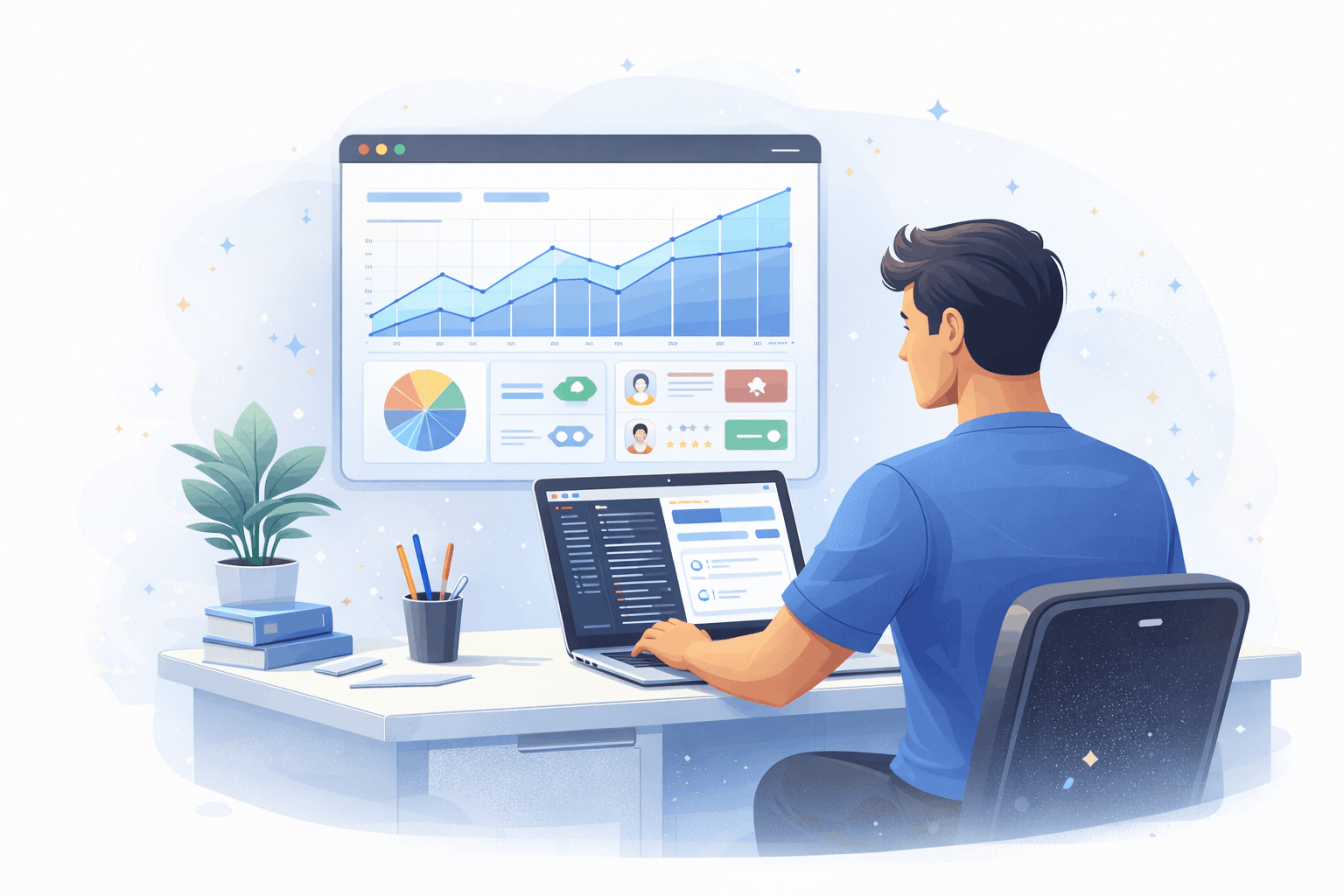
Frontend has always been the layer users interact with, but today its influence extends far beyond rendering interfaces.
Every delay, transition, layout decision, and interaction pattern shapes how users perceive a product. That proximity to behavior gives frontend developers visibility into something deeper than implementation. It gives them visibility into adoption.
When users hesitate, abandon flows, or fail to complete actions, the signals often surface first in the frontend layer. That exposure naturally pulls frontend work closer to product thinking.
Developers aren't just building screens. They're shaping outcomes.
Implementation Decisions Affect Product Metrics
Many product metrics once considered "business concerns" now sit directly within frontend influence. Performance affects retention. Interaction clarity affects conversion. Navigation structure affects feature discovery. Even subtle UI timing decisions influence whether users complete critical flows. Common product-impact areas influenced by frontend include:
- Onboarding completion;
- Checkout or subscription conversion;
- Feature adoption;
- Session duration;
- Perceived product reliability.
As these connections become clearer, frontend decisions increasingly carry product weight, not just technical weight.
Experimentation Lives in the Frontend Layer
Modern product development relies heavily on experimentation. A/B tests, feature flags, rollout gating, and UI variants are typically implemented in the frontend. This places frontend developers at the operational center of product iteration.
Experimentation introduces responsibilities like:
- Implementing variant experiences safely;
- Ensuring performance consistency across tests;
- Avoiding measurement bias through UI lag;
- Coordinating feature exposure logic.
Run Code from Your Browser - No Installation Required

Data Visibility Changes Decision-Making
As frontend integrates more analytics and behavioral instrumentation, developers gain visibility into how real users interact with the product. Heatmaps, drop-off analytics, click tracking, and session flows expose friction points that code reviews alone cannot reveal. This changes engineering judgment. Decisions start factoring in:
- Where users struggle;
- Where they hesitate;
- What flows fail silently;
- What UI elements go unnoticed.
The Skill Shift Toward Product Thinking
This evolution doesn't require frontend developers to become product managers. It requires them to develop product awareness. That awareness includes understanding user journeys, recognizing friction signals, anticipating behavioral impact, aligning implementation with outcomes.
The strongest frontend engineers today don't just ask "How do we build this?" They ask, "How will this be experienced?"
Conclusion
The modern frontend developer sits between engineering execution and product experience.
They translate system capabilities into user journeys. They expose friction before analytics reports do. They influence adoption through implementation quality.
In that sense, frontend is no longer just a delivery function. It's becoming a product function.
And the developers who recognize that shift early position themselves not just as feature builders, but as shapers of product success.
Start Learning Coding today and boost your Career Potential
FAQs
Q: What does it mean for a frontend developer to become a product engineer?
A: It means frontend work increasingly influences product outcomes. Decisions around performance, interaction design, and experimentation directly affect adoption, conversion, and user behavior.
Q: Do frontend developers need to become product managers?
A: No. The shift isn't about owning roadmaps. It's about understanding how technical decisions shape user experience and business metrics.
Q: Why is frontend so close to product impact?
A: Because it sits at the interaction layer. Users experience performance, navigation, and usability through the frontend first, making it the surface where product value is perceived.
Q: How does experimentation involve frontend engineers?
A: A/B tests, feature flags, and rollout logic are typically implemented in the frontend. Developers ensure variants load correctly, perform consistently, and don't bias measurement.
Q: What skills help frontend developers grow into product-minded roles?
A: Awareness of user journeys, analytics interpretation, performance trade-offs, and usability patterns all strengthen product alignment.
War dieser Artikel hilfreich?
Teilen:
War dieser Artikel hilfreich?
Teilen:
Verwandte Kurse
Alle Kurse anzeigenAnfänger
Introduction to JavaScript
Dive into the world of the most popular language for front-end development – JavaScript. JavaScript is a language built into almost every browser and can be used for a wide variety of tasks. Learn the basic functionality and prepare yourself for the challenges and more advanced programming techniques.
Anfänger
CSS Fundamentals
Master the essentials of CSS, the styling language that transforms the look and feel of web pages. Explore core concepts such as text styles, colors, spacing, the box model, Flexbox, and decorative effects. Build the skills to create visually engaging and well-structured web pages.
Anfänger
HTML Essentials
Master the skills needed to build well-structured and accessible HTML web content. Structure documents with tags, elements, and attributes, format text and lists, and embed images, audio, and video. Create tables for organized data and forms for user input, then apply semantic HTML to build a complete, accessible website from the ground up.
useState Hook in React with TypeScript
Guide to Using useState in React with TypeScript
by Oleh Subotin
Full Stack Developer
May, 2024・9 min read

Users Don't See Features — They See Friction
Why Product Quality Starts before Features Load
by Oleh Subotin
Full Stack Developer
Feb, 2026・5 min read
Frontend Architecture Matters More Than Framework Choice
Why Structural Decisions Outlive Technology Stacks
by Oleh Subotin
Full Stack Developer
Feb, 2026・4 min read
Inhalt dieses Artikels
